The television landscape of the mid-20th century was defined by a handful of procedural dramas that transitioned from the era of radio and pulp fiction into the living rooms of millions, but few achieved the enduring influence of Perry Mason. Premiering on CBS on September 21, 1957, the series introduced audiences to a formidable Los Angeles defense attorney whose sharp intellect and unwavering dedication to justice transformed the courtroom drama into a staple of American entertainment. Based on the characters created by author Erle Stanley Gardner, the original series ran for nine seasons, producing 271 episodes and establishing a formula for legal storytelling that persists in modern television. While the series has seen various iterations, including a successful run of television movies and a recent prestige cable reboot, the 1957–1966 cast remains the definitive ensemble that cemented the franchise’s place in history.
The Architect of the Courtroom: Raymond Burr as Perry Mason
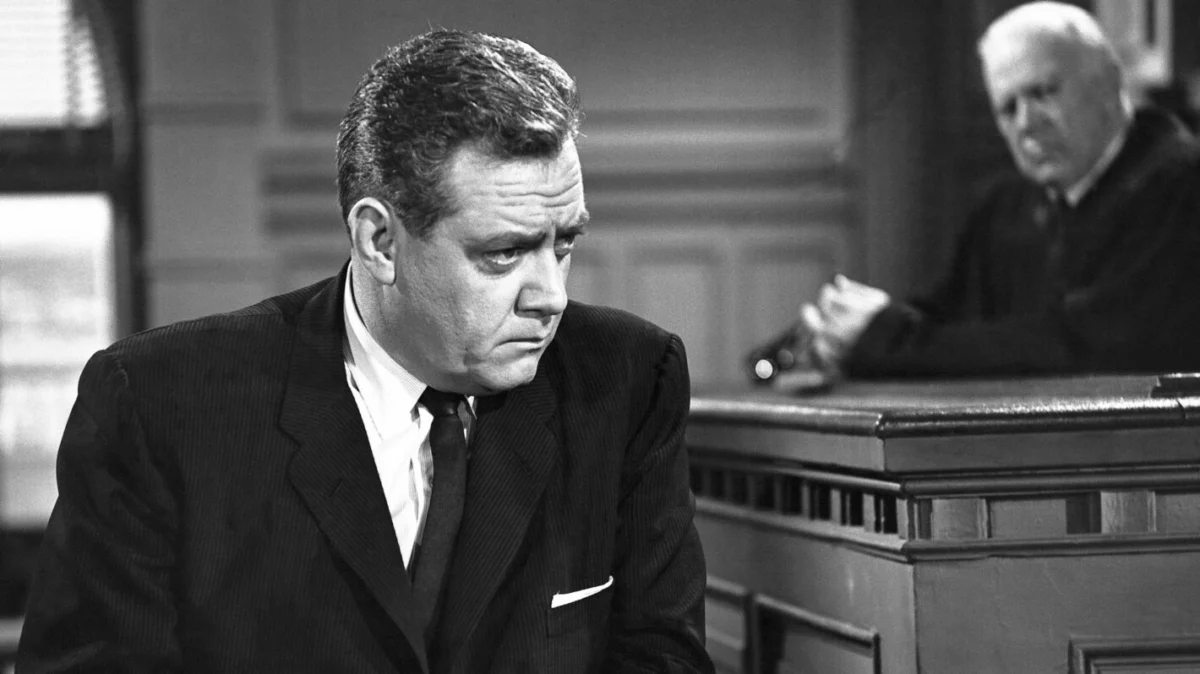
Raymond Burr’s portrayal of Perry Mason is widely considered one of the most iconic performances in television history. Before taking the role that would define his career, Burr was a seasoned character actor often cast as a villain or a heavy in film noir, most notably as the murderous Lars Thorwald in Alfred Hitchcock’s Rear Window (1954). When he auditioned for the role of Perry Mason, Gardner famously declared, "That is Perry Mason," recognizing in Burr the gravitas and authoritative presence required for the character.
Burr’s Mason was a tireless advocate for the wrongly accused, known for his methodical cross-examinations and the dramatic "last-minute confession" that frequently cleared his clients. For his work on the series, Burr received two Emmy Awards for Outstanding Lead Actor in a Dramatic Series (1959 and 1961). Beyond the screen, Burr was known for his intense work ethic, often spending 16 hours a day on set. Following the conclusion of the original series in 1966, he moved on to another successful procedural, Ironside, where he played a paraplegic police detective. In 1985, he returned to his most famous role for Perry Mason Returns, the first of 26 television movies that continued the story until his death from cancer in 1993 at the age of 76.
The Supporting Pillar: Barbara Hale as Della Street
No depiction of Perry Mason’s office was complete without Della Street, Mason’s loyal and highly capable legal secretary. Played by Barbara Hale, Street was more than a clerical assistant; she was a confidante and a vital part of Mason’s investigative process. Hale brought a sense of warmth and professional poise to the role, earning an Emmy Award for Best Supporting Actress in a Dramatic Series in 1959.
Hale’s career prior to Perry Mason included numerous roles in "B-movies" and Westerns during the 1940s. However, it was her chemistry with Burr that became a cornerstone of the show’s success. Their professional relationship on-screen was often tinged with a subtle, unspoken romantic tension that fans speculated about for decades, though the characters remained strictly professional. When Burr returned for the television movies in the 1980s, Hale was the only other original cast member to return as a series regular, maintaining her role until the final movie in 1995. Hale passed away in 2017 at the age of 94, the last surviving member of the original core cast.
The Investigative Edge: William Hopper as Paul Drake
William Hopper portrayed Paul Drake, the private investigator who functioned as Mason’s "boots on the ground." Drake was the quintessential cool, debonair investigator, often seen in his signature convertible or leaning against Mason’s desk. Hopper, the son of the famous Hollywood gossip columnist Hedda Hopper, had a steady career in films like Rebel Without a Cause before landing the role of Drake.
Hopper’s character provided the necessary bridge between the legal maneuvers of the courtroom and the gritty reality of the streets. His investigations often provided the "missing piece" of evidence that Mason would use to break a witness. Unlike the stoic Mason, Drake was often portrayed with a lighter, more adventurous spirit. Following the show’s cancellation in 1966, Hopper retired from acting. He died of pneumonia following a stroke in 1970 at the age of 55, making him the first of the core cast to pass away.
The Worthy Adversary: William Talman as Hamilton Burger
The narrative tension of Perry Mason relied heavily on the competence of the prosecution, and William Talman provided the perfect foil as District Attorney Hamilton Burger. Burger is famously remembered for losing nearly every case against Mason, a fact that became a cultural trope. However, Talman insisted that Burger be portrayed not as a villain, but as a dedicated public servant who genuinely believed in the guilt of the defendants based on the evidence provided by the police.
Talman’s career faced a significant hurdle in 1960 when he was fired by CBS after being arrested at a private party. Despite the charges being dismissed, the network’s strict morals clause led to his temporary removal. However, a massive letter-writing campaign from fans and the vocal support of Raymond Burr eventually forced the network to reinstate him. Talman’s most poignant contribution to public life came shortly before his death in 1968. A heavy smoker, he filmed the first-ever anti-smoking public service announcement for the American Cancer Society while battling terminal lung cancer. He died at the age of 53, just weeks after the PSA was filmed.
The Voice of the Law: Ray Collins as Lt. Arthur Tragg
Ray Collins, a veteran of Orson Welles’ Mercury Theatre and a co-star in Citizen Kane, played Lieutenant Arthur Tragg of the LAPD. Tragg represented the traditional police force—cynical, experienced, and often frustrated by Mason’s ability to outmaneuver the department. Collins brought a theatrical gravitas to the role, providing a stern but respected presence.
As the series progressed, Collins’ health began to decline. By the seventh season, his appearances became less frequent, and he eventually had to leave the show entirely due to emphysema. Despite his absence from the screen, his name remained in the opening credits until his death in 1965 at the age of 75, a gesture of respect from the producers and cast.
Chronology of a Television Phenomenon
The evolution of Perry Mason spans nearly a century of media history:
- 1933: Erle Stanley Gardner publishes the first Perry Mason novel, The Case of the Velvet Claws.
- 1943–1955: Perry Mason airs as a popular daytime radio serial on CBS, though it leaned more toward soap opera elements than the later TV show.
- 1957: The television series debuts on CBS, moving away from the radio format to focus on legal procedurals.
- 1959–1961: The show reaches its peak popularity, with Raymond Burr and Barbara Hale winning Emmys.
- 1966: The original series concludes after nine seasons. The final episode, "The Case of the Final Fade-Out," featured a cameo by creator Erle Stanley Gardner as a judge.
- 1973: A short-lived revival, The New Perry Mason, starring Monte Markham, fails to capture the original’s magic and is canceled after 15 episodes.
- 1985: Raymond Burr returns for Perry Mason Returns, launching a highly successful series of 26 TV movies on NBC.
- 1993: Raymond Burr passes away. The TV movie series continues briefly as A Perry Mason Mystery, starring Paul Sorvino and later Hal Holbrook.
- 2020: HBO premieres a reimagined Perry Mason series starring Matthew Rhys, focusing on an origin story set in the 1930s.
Supporting Data and Production Insights
The success of Perry Mason was not merely a matter of casting but of rigorous production standards. At its height, the show was a ratings juggernaut for CBS. During the 1957-1958 season, it broke into the top 20 Nielsen ratings and remained a competitive force even when scheduled against powerhouse programs like The Perry Como Show and Bonanza.
A key statistical highlight of the series is its remarkably low "loss" record. Out of 271 episodes, Perry Mason only "lost" a case on screen three times. Most notably, in "The Case of the Deadly Verdict" (1963), his client was found guilty and sentenced to death, though Mason eventually cleared her name before the execution could be carried out. This near-invincibility led to the coining of the term "Perry Mason Syndrome" by legal scholars, referring to the unrealistic expectation of real-life jurors that a trial should end with a dramatic confession from the witness stand.
The show was also a pioneer in technical production. While primarily filmed in black and white, the 1966 episode "The Case of the Twice-Told Twist" was filmed in color as an experiment by the network. The series was one of the first to utilize real Los Angeles locations extensively, providing a historical snapshot of the city’s mid-century architecture and geography.
Impact on the Legal Profession and Public Perception
The implications of Perry Mason extended far beyond the realm of entertainment. The show is credited with significantly influencing public perception of the American justice system. It popularized the concept of "attorney-client privilege" and the "presumption of innocence" for a general audience.
In a retrospective analysis, legal historians have noted that the series encouraged a generation of viewers to pursue careers in law. Famous figures, including Supreme Court Justice Sonia Sotomayor, have cited the show as an early inspiration. Sotomayor famously remarked that watching the show as a child made her realize that the law was a tool for helping people.
However, the "Mason effect" also presented challenges. Defense attorneys in the 1960s and 70s often complained that jurors were disappointed when real trials involved dry evidence and procedural delays rather than the pyrotechnics seen on CBS. The "last-minute confession" became such a trope that it eventually required modern legal dramas, such as Law & Order, to intentionally subvert it to maintain a sense of realism.
The Enduring Legacy of the 1957 Cast
While the 2020 HBO reboot offered a gritty, noir-inspired take on the character, it served to highlight how distinct the original 1957 iteration remains. The original cast created a sense of "found family" that resonated with viewers during the Cold War era, offering a vision of a justice system that was fundamentally moral and effective.
The passing of the original cast members—Ray Collins (1965), William Hopper (1970), William Talman (1968), Raymond Burr (1993), and Barbara Hale (2017)—marked the end of an era in television history. Yet, their work continues to reach new audiences through relentless syndication and digital streaming. The structural template they established—the crime, the investigation, the preliminary hearing, and the courtroom climax—remains the "Gold Standard" for the legal genre.
Ultimately, Perry Mason was more than a show about a lawyer; it was a cultural phenomenon that defined the archetype of the legal hero. The chemistry of the core cast and the precision of the writing ensured that even decades after the final gavel fell, the name Perry Mason remains synonymous with the pursuit of truth and the integrity of the law.