Haruhiko Arai’s latest cinematic endeavor, "The Stars and the Moon Are Holes in the Sky" (original "Hoshi to tsuki wa ten no ana"), recently celebrated its international premiere at the esteemed Hong Kong Film Festival, marking a significant moment for contemporary Japanese cinema on the global stage. The film, which saw its domestic release in Japan in December 2025, is a compelling arthouse drama that delves into complex human relationships against a meticulously crafted aesthetic backdrop. It offers a rich tapestry of visual and narrative styles, drawing heavily from the golden age of the Japanese New Wave, a period of radical cinematic experimentation and social commentary.
A Veteran’s Evolving Vision: Haruhiko Arai’s Cinematic Journey
Haruhiko Arai is a name synonymous with a particular stratum of Japanese cinema, primarily recognized for his prolific and influential career as a screenwriter. His journey began in an era of profound cultural shifts, notably as an assistant at the studio of the legendary Koji Wakamatsu. Wakamatsu, a maverick filmmaker, was instrumental in elevating the "pink eiga" (softcore sex films) genre to an early golden age during the 1960s and 70s, imbuing it with a distinctive blend of radical politics, avant-garde aesthetics, and often scandalous content. Films like "Violated Angels" (1967) and "Ecstasy of the Angels" (1972) are emblematic of Wakamatsu’s audacious approach, which resonated not only within Japan but also garnered international attention, introducing a raw, unvarnished portrayal of sexuality and societal disaffection.
Arai’s early screenplays largely adhered to the narrative and thematic conventions of "pink eiga," contributing to a genre that, despite its explicit nature, often served as a vehicle for social critique and artistic expression. His collaborations with directors like Tatsumi Kumashiro on "The Woman with Red Hair" (1979) and Ryuichi Hiroki on "Vibrator" (2003) underscored his mastery of crafting intricate, emotionally charged narratives within this framework. These films, while commercially viable within the "pink eiga" circuit, frequently transcended mere exploitation, exploring the psychological depths of their characters and challenging societal norms.
It wasn’t until 1997, at the age of 50, that Arai transitioned to the director’s chair with his feature debut, "Body and Soul." This shift marked a conscious evolution in his career, allowing him to more fully realize his artistic vision. While his directorial efforts, including "The Stars and the Moon Are Holes in the Sky," retain elements of erotic drama, they are consistently infused with a pronounced arthouse sensibility, characterized by contemplative pacing, sophisticated visual language, and a deeper engagement with existential themes. This trajectory positions Arai as a filmmaker who has not only contributed significantly to a specific genre but has also continuously sought to expand its boundaries and explore new artistic territories.
Echoes of the Japanese New Wave: Setting and Style
"The Stars and the Moon Are Holes in the Sky" is deeply steeped in the stylistic and thematic traditions of the Japanese New Wave, a groundbreaking cinematic movement that flourished from the late 1950s through the 1970s. This period was marked by a rebellion against traditional studio filmmaking, embracing unconventional narratives, experimental techniques, and a fearless exploration of controversial subjects. Directors such as Nagisa Oshima, Shohei Imamura, Kihachi Okamoto, Akio Jissoji, Toshio Matsumoto, and Shuji Terayama redefined Japanese cinema, often working with independent production companies like the Art Theatre Guild (ATG), which championed avant-garde and politically charged films.
Arai’s choice to set his film in 1969 is far from coincidental. This year was a watershed moment for Japanese cinema, witnessing the release of seminal works that pushed artistic and social boundaries. Films like Oshima’s "Boy," Shinoda’s "Double Suicide," and Matsumoto’s "Funeral Parade of Roses" epitomized the era’s radical spirit, tackling themes of alienation, identity, and societal unrest with audacious visual flair. By situating his narrative in this specific historical context, Arai consciously invokes the spirit of a revolutionary period, inviting audiences to draw parallels between his film’s aesthetic and the cinematic masterpieces of that time.
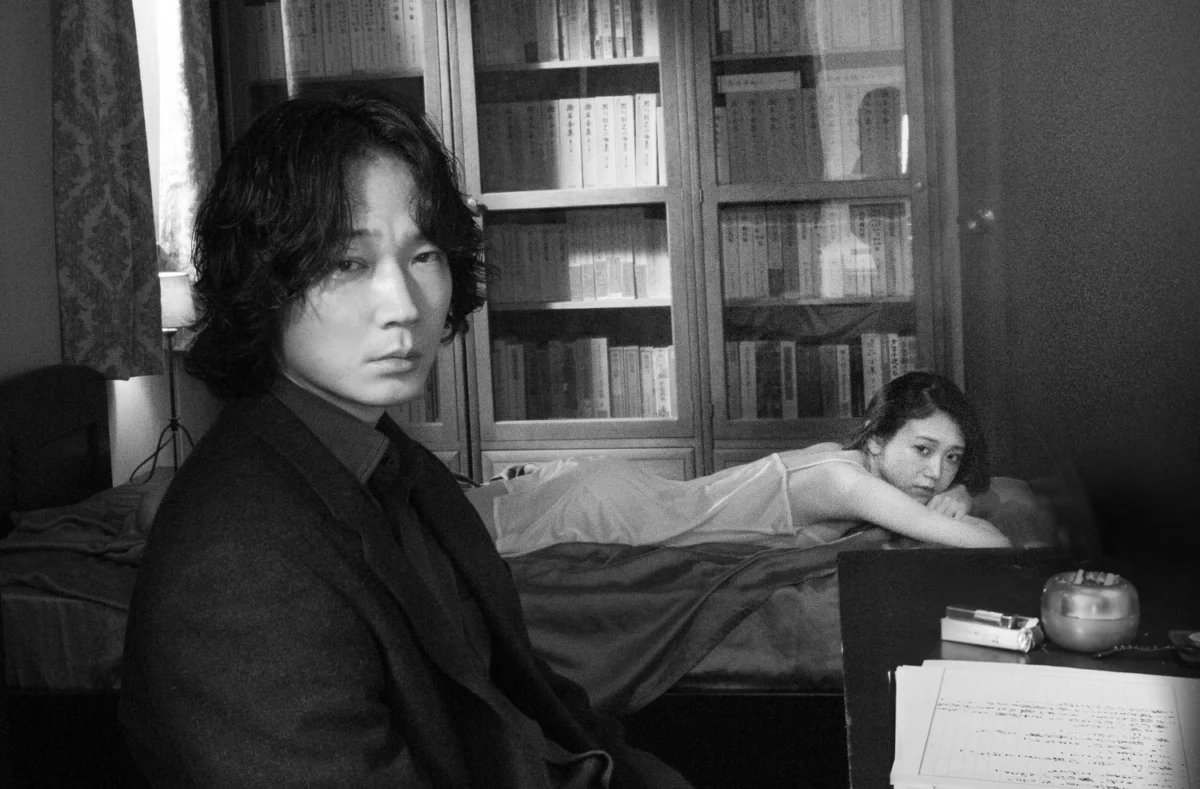
The source material itself, a novel by Junnosuke Yoshiyuki, dates back to 1966, further cementing the film’s ties to the intellectual and artistic currents of the mid-20th century. Visually, the film employs a grainy black and white palette, reminiscent of the raw, documentary-like quality often found in New Wave productions. The cinematography frequently utilizes images that are not always explicitly focused, creating a dreamlike, almost ethereal atmosphere that mirrors the characters’ internal states. Occasional, deliberate splashes of red – such as a child’s lips licking a stamp before posting a letter – punctuate the monochrome world, serving as symbolic focal points that underscore the film’s slightly experimental nature and hint at underlying passions or disruptions.
The narrative style also consciously deviates from strict conventionality. Arai employs techniques like displaying lengthy texts written by the main character, Katsuji Yazoe, directly on screen for minutes at a time, effectively pausing the action. This bold choice serves multiple purposes: it offers direct insight into Yazoe’s inner monologue and literary aspirations, challenges traditional storytelling pacing, and forces the audience into a contemplative engagement with the protagonist’s thoughts, blurring the lines between cinematic narrative and literary expression.
The Protagonist and His World: Katsuji Yazoe and the Women in His Life
At the heart of "The Stars and the Moon Are Holes in the Sky" is Katsuji Yazoe (portrayed by Go Ayano), a writer navigating the shifting social landscape of 1969. Yazoe, as he is exclusively referred to in the film, embodies a distinctly patriarchal worldview that, even for his time, appears increasingly anachronistic. For him, women are primarily objects of sexual gratification and intellectual study, judged almost exclusively on their physical appearance. He actively resists any deeper emotional or relational connection, maintaining a carefully constructed emotional armor.
However, as the narrative unfolds, this facade begins to crack, revealing a man burdened by profound emotional wounds. His outward projection of a macho, self-assured literary figure conceals a deep-seated vulnerability. Part of this stems from the departure of his ex-wife 13 years prior, an event that clearly left an indelible mark on his psyche. Another, somewhat more opaque, source of his insecurity is his full set of dentures at the relatively young age of 43, a detail he desperately attempts to conceal from the women in his life. This vulnerability, particularly his dental secret, serves as a poignant metaphor for his broader emotional fragility and his fear of exposure.
Yazoe’s interactions with three distinct women form the core of the film’s relational dynamics:
-
Chieko (Rena Tanaka): A prostitute with whom Yazoe maintains a long-term, transactional relationship. Chieko is depicted as pragmatic and astute, often unimpressed by Yazoe’s posturing. She sees through his superficiality, providing a grounded counterpoint to his intellectualizing and emotional detachment. Their relationship, while intimate, is devoid of romantic illusions on her part, highlighting Yazoe’s inability or unwillingness to forge genuine connections.
-
Noriko (Sakuya): A seemingly devoted student whom Yazoe encounters in an art gallery. Noriko initially appears to be a blank canvas upon which Yazoe can project his desires and intellectual dominance. Their relationship explores rather unconventional sexual preferences, indicative of the era’s burgeoning sexual liberation and the characters’ experimental attitudes. Over time, however, Noriko begins to assert her own mind, challenging Yazoe’s expectations and revealing her independent spirit, further unsettling his carefully controlled world.
-
B-ko (Akari Misaki): A very young girl introduced to Yazoe by Chieko’s boss. Yazoe, in his characteristic manner, renames her "B-ko" and envisions her as the muse and future female protagonist for his long-unfinished autobiographical novel. He believes he can mold her into his ideal woman and literary creation, reflecting his authorial hubris and his desire for control. This relationship, fraught with ethical complexities given B-ko’s youth and Yazoe’s manipulative intent, underscores his problematic views on women and his blurring of art and life.
Critical Reception and Narrative Challenges
While Haruhiko Arai’s directorial intent to provoke and challenge is evident, "The Stars and the Moon Are Holes in the Sky" has elicited a nuanced critical response, particularly regarding certain narrative inconsistencies. A recurring point of contention lies in the perceived lack of clear motivation for the compelling and well-developed female characters to remain attracted to Yazoe. Despite their individual strengths and intriguing backstories, their continued engagement with the moderately attractive, moderately successful, and often boorish Yazoe strains credulity for some viewers. While sexual passion, particularly in the case of Noriko, is presented as a driving force, it doesn’t entirely account for their sustained tolerance of his self-absorbed and often demeaning behavior.
Yazoe’s character, while central to the film’s exploration of masculinity and vulnerability, occasionally veers into self-pity, rendering certain segments of the film tedious or maudlin. While the film explicitly portrays Yazoe as a character out of touch with the evolving times, and much of Arai’s filmmaking serves to provoke thought on these outdated perspectives, the provocation itself can at times lack sufficient edge, leading to a sense of annoyance rather than profound contemplation. The film’s leisurely pace, coupled with its 122-minute runtime, further amplifies these issues, potentially testing the patience of some audiences despite the artistic merits of its style.
Technical Craftsmanship and Outstanding Performances
Despite these narrative challenges, the technical aspects of "The Stars and the Moon Are Holes in the Sky" are consistently praised for their contribution to the film’s distinctive arthouse aesthetic. Cinematographer Koichi Kawakami, a frequent collaborator with Arai, meticulously crafts the film’s visual language. His expertise in creating the grainy black and white texture, coupled with the strategic use of selective color, effectively transports the audience to the late 1960s and evokes the stylistic sensibilities of the Japanese New Wave. Kawakami’s lensing is instrumental in establishing the film’s melancholic and introspective mood, making the visuals a character in themselves.
The film’s musical score is provided by the popular composer Itsuro Shimoda, whose work adds another layer of historical resonance. Shimoda, at the tender age of 23, famously composed the score for Shuji Terayama’s legendary 1971 film "Throw Away Your Books, Rally in the Streets," a seminal work of the Japanese avant-garde. His involvement in Arai’s latest film not only brings a wealth of experience but also subtly reinforces the cinematic lineage Arai is engaging with. Shimoda’s previous collaboration with Arai on "It Feels So Good" (2018) further attests to their established artistic synergy, allowing for a cohesive integration of sound and image that enhances the film’s atmospheric depth.
However, the film’s greatest and most undeniable asset lies in the exceptional performances of its ensemble cast, particularly its actresses. Rena Tanaka delivers a robust and captivating performance as Chieko, portraying her character with a grounded resilience that makes her the least susceptible to Yazoe’s "macho bullshit." Her portrayal is nuanced, intelligent, and deeply human, providing a compelling counterpoint to the protagonist’s self-absorption. The two young actresses, Sakuya as Noriko and Akari Misaki as B-ko, also deliver remarkably convincing performances in their challenging roles, navigating complex emotional landscapes with impressive maturity and subtlety. They imbue their characters with a vulnerability and evolving agency that significantly elevates the film’s exploration of female identity.
Go Ayano, a seasoned television and film actor with over a hundred credits to his name, undertakes the demanding role of Katsuji Yazoe. While his portrayal is technically proficient, there are moments where Ayano appears to struggle with the limitations imposed by Arai’s writing for the character. The script, by design, restricts Yazoe to a somewhat whiny and self-pitying existence, offering Ayano limited scope for broader emotional expression or character development beyond these confines. This artistic choice, while serving the film’s thematic exploration of a deeply flawed individual, occasionally constrains the actor’s ability to fully transcend the character’s more grating qualities.
Broader Context and Implications
"The Stars and the Moon Are Holes in the Sky" positions itself as a significant entry in Haruhiko Arai’s evolving filmography, reflecting a continued commitment to arthouse cinema that is both intellectually stimulating and aesthetically daring. Its international premiere at the Hong Kong Film Festival underscores its appeal to global audiences interested in nuanced character studies and films that engage with cinematic history. The festival’s decision to program such a work highlights a commitment to showcasing diverse voices and challenging narratives from East Asia, reinforcing Hong Kong’s role as a vital hub for regional and international cinema.
The film serves not only as a contemporary exploration of gender dynamics and individual alienation but also as a profound homage to the stylistic and intellectual ferment of the Japanese New Wave. By consciously evoking this era, Arai invites a dialogue between past and present, examining how certain social and psychological archetypes persist or transform across generations. While the film’s narrative choices regarding Yazoe’s character and the motivations of the women around him may elicit varied responses, its technical craftsmanship, stellar acting performances, and bold artistic vision contribute to a thought-provoking cinematic experience. "The Stars and the Moon Are Holes in the Sky" solidifies Haruhiko Arai’s reputation as a filmmaker unafraid to confront uncomfortable truths about human nature and society, further cementing his legacy as a distinctive voice in Japanese cinema.