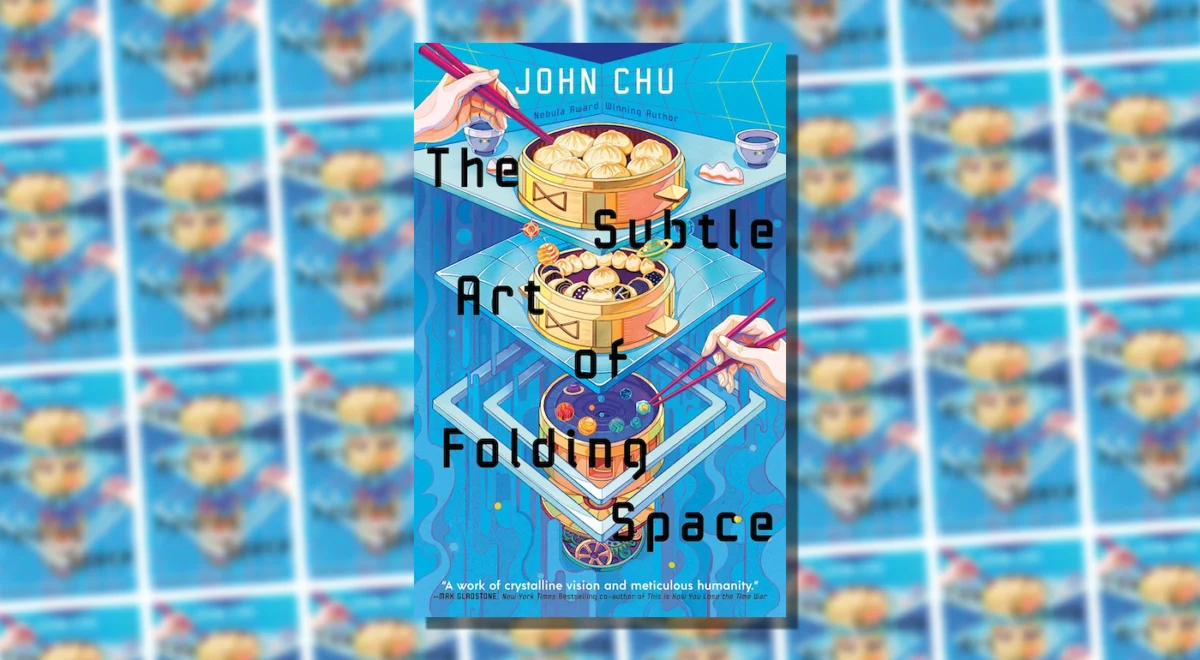
John Chu’s debut full-length novel, The Subtle Art of Folding Space, plunges readers into a universe where the fabric of reality is meticulously maintained, and the ultimate sacrifice might be the only way to preserve existence. The narrative opens with a harrowing dilemma faced by protagonist Ellie: the potential need to end her own mother’s life to save the world. This stark choice forms the foundational ethical quandary that propels the story, but as the novel quickly reveals, the true exploration lies not in the decision itself, but in its profound and far-reaching aftermath.
At its core, The Subtle Art of Folding Space is a meticulously crafted science fiction novel that interrogates the nature of existence, familial obligation, and the psychological toll of trauma. Chu, a celebrated short fiction author for over a decade, demonstrates a remarkable command of complex world-building and character development, weaving a narrative that is both intellectually stimulating and emotionally resonant. The novel’s premise, while rooted in speculative fiction, delves into universally relatable themes of duty, love, and the intricate bonds that tie families together, even when those bonds are fraught with pain.
The Mechanics of Reality: A Universe Under Strain
The novel introduces readers to the concept of "skunkworks," clandestine operations responsible for the maintenance and generation of universes. These cosmic workshops are staffed by individuals with specific roles: architects who design the fundamental structures of reality, builders who implement these designs, and verifiers who ensure accuracy. Ellie operates as a builder, tasked with the crucial but often unglamorous work of patching, bridging, and generating new universes. Her family is deeply involved in this work; her mother, a skilled builder, and her sister, Chris, also a builder, are central figures. Her cousin, Daniel, serves as a verifier, playing a vital role in diagnosing problems for builders to address.
The central conflict ignites when Chris, ostensibly out of familial concern, sends Ellie to investigate a glitch within the skunkworks. This anomaly, Daniel soon discovers, is intricately linked to Ellie’s mother’s deteriorating health. The glitch manifests as "hold-time violations," a phenomenon that has trapped Ellie’s mother in a coma. This state of suspended animation is not merely a personal tragedy; it’s a catastrophic error rippling through the very architecture of the universe. The longer the violations persist, the greater the destabilization, threatening to cascade from minor ripples into a universe-ending tsunami. Ellie is thus faced with an agonizing choice: sever her mother’s connection to the universe, thereby resolving the violations and saving reality, or attempt to revive her, risking the collapse of everything.
The Genesis of Conflict: Familial Trauma and Intergenerational Scarcity
The narrative swiftly pivots from cosmic stakes to the deeply personal, exposing the complex and often toxic dynamics within Ellie’s family. The roots of their dysfunction lie in the immigrant experience of Ellie’s mother, who arrived before her children were born. This history of displacement and the perceived scarcity of opportunity have shaped the family’s internal landscape. Chris, as the eldest daughter, bore the brunt of her mother’s high, often unattainable, expectations. Unable to meet these demands, Chris has made this struggle her defining characteristic, channeling her frustrations into an all-consuming focus on her mother and sister, often at the expense of her own well-being and relationships.
Chris’s dedication to her mother, while framed as filial duty, borders on obsession. She keeps her ill mother confined, dedicating all her energy to her care while neglecting her own life. This dynamic has fostered an environment of deep-seated resentment and manipulation. Throughout Ellie’s childhood, Chris actively constructed elaborate "death traps," both literal and metaphorical, designed to keep Ellie in a state of constant anxiety and distrust. Even when Daniel, kicked out by his parents for being gay, came to live with them, Chris’s manipulative gaze soon turned towards him, though Ellie bore the brunt of her sister’s cruelty. Incredibly, Ellie’s mother offered little intervention, often advising Ellie to be kinder to Chris. This pattern of emotional neglect and conditional affection left both Ellie and Chris deeply unsatisfied, yearning for their mother’s approval, a dynamic that persists into the novel’s present.

The Choice and Its Aftermath: Navigating the Ripples of Decision
While the specific choice Ellie makes remains a pivotal spoiler, the novel emphasizes that this decision is merely the catalyst for the bulk of the narrative. The true story unfolds as Ellie and Daniel are dispatched back into the skunkworks, tasked with rectifying the fundamental error that the perpetrator exploited. Their mission extends beyond mere repair; they must unmask the individual behind the glitch and thwart a disruptive faction seeking to further destabilize reality. As they traverse various universes, their journey becomes an odyssey through their shared and individual pasts, confronting a lifetime of deeply ingrained familial trauma.
The relationship between Ellie and Daniel serves as a compelling counterpoint. Both have endured difficult childhoods marked by abandonment, rejection, and fear. However, Daniel has achieved a remarkable degree of stability. Having found his own "found family," a common practice among LGBTQ+ individuals navigating societal challenges, he has forged a new life on his own terms. Ellie, while possessing a life outside the skunkworks, appears perpetually tethered to her family. Her free time is predominantly spent visiting her ailing mother and enduring Chris’s psychological assaults. She even contemplates sacrificing her limited personal life to return home and assist Chris. This lack of external stability and the freedom that a found family provides leaves Ellie susceptible to the lingering hope that Chris might one day offer genuine acceptance.
Narrative Perspective and Character Representation
Chu employs a third-person narrative that primarily hovers over Ellie’s perspective. This choice subtly amplifies Ellie’s feelings of inadequacy. The narration often describes her in diminishing terms, highlighting her perceived flaws and vulnerabilities. In contrast, Daniel is frequently portrayed with immense praise, almost as an idealized figure. He is depicted as imposing and handsome, a stark contrast to Ellie’s small and unassuming presence. This narrative technique is a clever device, illustrating how deeply Ellie internalizes her perceived inferiority, a feeling exacerbated by Chris’s relentless manipulation. It is not necessarily that Daniel is objectively perfect, but rather that Ellie’s self-perception magnifies his perfections against her own perceived imperfections. However, as the novel progresses, the narration’s focus on Daniel occasionally verges on hyperbole, presenting him as a near-superhero rather than a fully realized individual.
Challenging Conventional Narratives: A Genre-Bending Experience
Readers accustomed to neatly categorized and straightforward narratives may find The Subtle Art of Folding Space a challenging but ultimately rewarding experience. The novel resists easy classification, eschewing conventional fanfic tropes and trendy genre marketing terms. Chu demands active engagement from his readers, eschewing the tendency to over-explain or systematize the world-building into easily digestible concepts. The result is a story that leaves readers with as many questions as answers, prompting deep reflection and a willingness to embrace ambiguity.
The novel also invites discussion about the blurred lines between science fiction and fantasy. Chu’s detailed exploration of the skunkworks’ physics and the mechanics of universe generation can be dense. For readers less inclined towards hard science fiction, these passages might prove challenging, akin to trying to decipher complex choreography during a pivotal scene in a romance novel. This particular aspect, however, is more a reflection of individual reader preference than a flaw in Chu’s writing. Those who appreciate intricate scientific exposition will find ample material to engage with.
Conversely, the novel frequently exhibits elements strongly aligned with fantasy. Ellie possesses the ability to manifest fire from her hands, Daniel can conjure food from nothing, characters teleport, and weave illusions with their minds. The creatures encountered from other worlds often evoke the fantastical sensibilities found in authors like Martha Wells, rather than traditional alien depictions. While the underlying premise firmly places the novel within the science fiction domain, its fantastical elements offer a delightful and engaging duality for lovers of speculative fiction.
A Debut of Significant Achievement
The Subtle Art of Folding Space marks a significant milestone for John Chu, representing his first full-length novel after a decade of acclaimed short fiction. The novel stands as a testament to his creative prowess, offering layers of meaning that unfurl with each reflection, much like delving into the intricate workings of the skunkworks itself. The intricate world-building, coupled with the exploration of profound emotional and psychological themes, establishes Chu as a compelling voice in contemporary speculative fiction. The novel is a complex tapestry of cosmic responsibility and intimate human struggle, leaving an indelible mark on the reader’s imagination.