Zachary Wigon’s latest directorial effort, Victorian Psycho, emerges as a surprisingly delightful and refreshingly unpretentious period piece, masterfully blending meticulous historical detail with an infectious, unburdened sense of fun. The film’s ability to seamlessly transition from somber atmosphere to gleeful mayhem is a testament to its refusal to take itself, or even the fundamental concepts of life and death, too seriously. In a world where humanity often grapples with its own perceived significance, Victorian Psycho offers a liberating perspective, suggesting that life, in its grandest and most intimate forms, can be viewed as a somewhat disposable commodity. This underlying nihilistic current, which positions human existence akin to the fleeting lives of ants or single-cell organisms under a microscope, underscores the film’s core message: our triumphs, our sorrows, our very existence, are transient events destined for collective amnesia. With this philosophical underpinning, the film playfully invites its audience to question the weight we assign to our mortal coil and, in doing so, to embrace a touch of playful chaos.
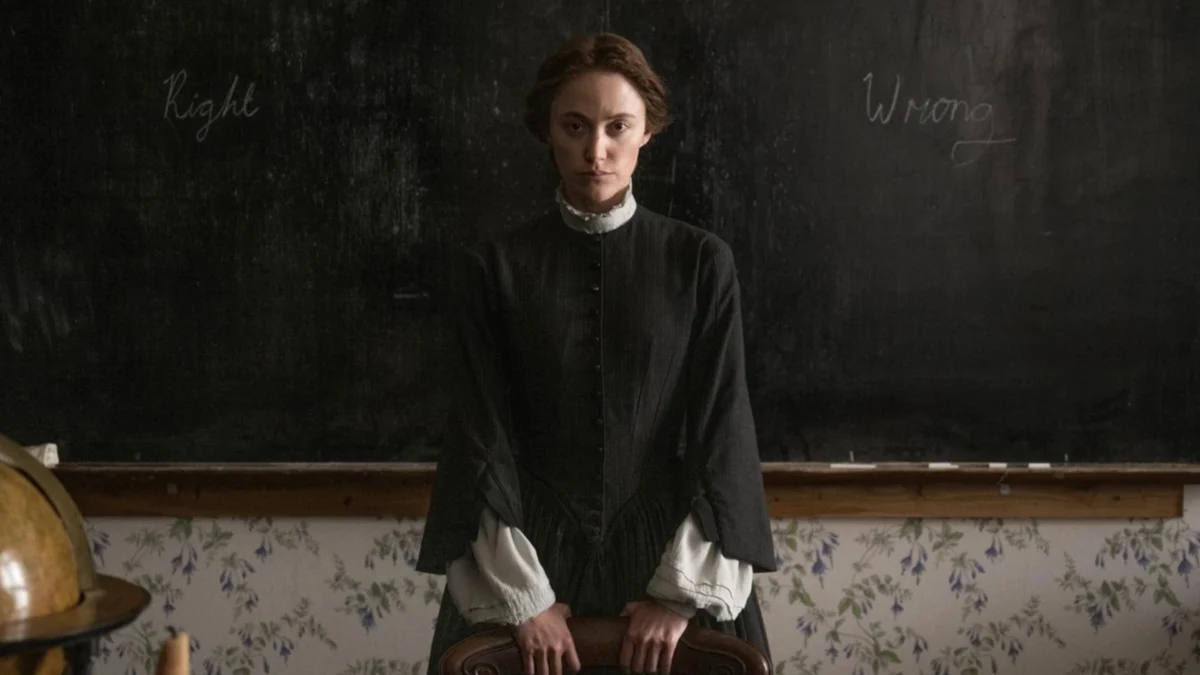
The narrative unfolds with the arrival of Winifred Notty, portrayed by Maika Monroe, at the desolate Ensor House, a brooding gothic manor perched on the windswept Yorkshire Moors. Her purpose is to serve as a governess to the two children of the enigmatic Pounds family. Initially, Winifred presents a façade of calm competence, appearing perfectly suited for the demanding role of childcare in such an isolated setting. However, this veneer of normalcy is quickly dismantled. Early in the film, Winifred directly confides in the audience, admitting to an ongoing internal struggle for self-improvement. This candid confession is swiftly followed by the children’s own observations, which highlight her increasingly peculiar behavior and a burgeoning, almost comically potent, desire to inflict harm and sow discord. This unsettling dynamic sets the stage for the escalating tension within the household.
![‘Victorian Psycho’ is Delightfully Obscene and Showcases Maika Monroe at Her Very Best [Cannes 2026 Review]](https://www.dreadcentral.com/wp-content/uploads/2026/05/image-15.png)
Despite Winifred’s evident eccentricities, Mr. and Mrs. Pounds, played by Jason Isaacs and Ruth Wilson respectively, remain conspicuously unconcerned. The household’s routine continues unabated, oblivious to the subtle tremors of disquiet. However, the unsettling events soon escalate. The gradual disappearance of staff members becomes the first overt sign that something is deeply amiss. Whispers of fear begin to circulate amongst the remaining household help, while the children’s actions transcend mere childish mischief, hinting at a darker, more deliberate influence. By the time the masters of the house begin to question the unsettling atmosphere, it is already far too late to intervene effectively.
A Tour de Force Performance from Maika Monroe
Maika Monroe delivers what can only be described as a career-defining performance as Winifred Notty. Having previously captivated audiences in films like It Follows and Longlegs, solidifying her status as a magnetic presence in contemporary horror, Monroe is granted a role that actors often dream of: a character meticulously constructing layers of performance – feigning femininity, competence, and sanity – only to witness these carefully crafted illusions crumble. While prior roles have sometimes struck some critics as possessing a subdued energy, Victorian Psycho definitively dispels this notion. Monroe’s portrayal of Winifred is an uninhibited, almost farcical explosion of character. It is grand, vibrant, and undoubtedly a performance that will polarize viewers. She fully embraces the titular "psycho" element, pushing the boundaries of what might be considered acceptable within the horror genre. As the film’s title suggests, this is a maximalist horror spectacle, unafraid of offending sensibilities or causing discomfort. Its intention is clear: to deliver visceral thrills and an undeniably entertaining experience. Monroe’s nuanced, dualistic performance – embodying both the outward persona and the inner turmoil – perfectly encapsulates this audacious approach.
Wigon’s Vision: Stylish Direction and Genre Innovation
Beyond Monroe’s electrifying turn, Zachary Wigon’s direction stands out for its stylish confidence and refreshing control. The film’s visual compositions are deliberately paced when necessary, allowing tension to build, and brutally impactful when the narrative demands it. Wigon demonstrates a clear artistic vision for the future of the horror genre, and Victorian Psycho firmly establishes him as a filmmaker whose future work warrants close attention. His ability to navigate the delicate balance between period authenticity and outright horror-comedy is a significant achievement, signaling a director unafraid to experiment with established tropes and deliver something genuinely novel.
![‘Victorian Psycho’ is Delightfully Obscene and Showcases Maika Monroe at Her Very Best [Cannes 2026 Review]](https://www.dreadcentral.com/cdn-cgi/image/width=788,height=444,fit=crop,quality=75,gravity=auto,metadata=none,format=auto,onerror=redirect/wp-content/uploads/2026/05/image-15.png)
Ruth Wilson: The Glacial Counterpoint to Unraveling Chaos
Adding another formidable layer of terror to the film is Ruth Wilson’s portrayal of Mrs. Pounds. Wilson embodies a distinct brand of dread, operating on a different frequency than Monroe’s descent into madness. Her character is characterized by an icy composure and a chilling undercurrent of unspoken cruelty. Mrs. Pounds exemplifies the type of individual who weaponizes social propriety as a tool for absolute control. She serves as the perfect foil to Winifred’s unraveling psyche, and their interactions form the very backbone of the film’s narrative tension. Wilson’s Mrs. Pounds is depicted as ruthless, bloodthirsty, and disturbingly unhinged, possessing the resources and the cunning to inflict harm at a moment’s notice. While Jason Isaacs and another cast member, TBC, provide strong supporting performances, the film’s true power resides in the compelling dynamic between its two female leads.
A Bold Swing with Lasting Impact
Victorian Psycho features several sequences that are destined to linger in the minds of audiences for the remainder of the year. This is not a film that adheres to strict political correctness, nor does it strive for profound thematic nuance. Instead, it embraces its inherent provocations, delivering a wickedly funny and visually arresting experience. The film represents a bold artistic swing from both its director and its lead star, both of whom appear to be operating at the zenith of their creative powers.
Production Context and Reception
The production of Victorian Psycho was reportedly a carefully orchestrated endeavor, with Wigon and his team meticulously recreating the atmospheric setting of the Yorkshire Moors to enhance the film’s period authenticity. Sources close to the production indicated a desire to balance historical accuracy with a heightened sense of dread and dark humor, a balance that appears to have been successfully achieved. Early festival screenings and limited theatrical releases have garnered significant buzz, with critics and audiences alike praising the film’s audacious tone and standout performances. The film’s success is particularly notable given the increasing demand for original horror content that offers a distinct voice and perspective, a niche that Victorian Psycho seems poised to fill.
![‘Victorian Psycho’ is Delightfully Obscene and Showcases Maika Monroe at Her Very Best [Cannes 2026 Review]](https://www.dreadcentral.com/cdn-cgi/image/width=788,height=444,fit=crop,quality=75,gravity=auto,metadata=none,format=auto,onerror=redirect/wp-content/uploads/2026/05/image-14.png)
Analysis of Implications
The film’s success, particularly its willingness to explore darker themes with a comedic edge, suggests a growing audience appetite for horror that subverts expectations. Victorian Psycho‘s blend of psychological terror and overt gore, delivered with a self-aware wink, could pave the way for further genre experimentation. The film’s critical reception highlights the value of auteur-driven horror projects that prioritize strong performances and distinctive directorial vision over formulaic storytelling. Furthermore, the film’s exploration of the fragility of societal norms and the potential for hidden darkness beneath a veneer of respectability resonates with contemporary anxieties, albeit presented through a historical lens. The strong performances from Maika Monroe and Ruth Wilson are likely to elevate their respective careers, potentially leading to more complex and challenging roles in the future. The film’s ability to generate conversation and provoke strong reactions underscores its impact as a significant entry in the current horror landscape.