The science fiction community mourns the loss of William C. Dietz, a writer whose prolific career spanned over three decades and produced more than fifty novels, often exploring themes of military action, adventure, and the gritty realities of space opera. Dietz, who passed away at the age of 77, was known for his ability to craft fast-paced, entertaining narratives that kept readers engaged, drawing comparisons to pulp fiction legends like Lester Dent and Edgar Rice Burroughs. His passing, which occurred on an unspecified date in 2023, marks the end of an era for a significant voice in modern science fiction.
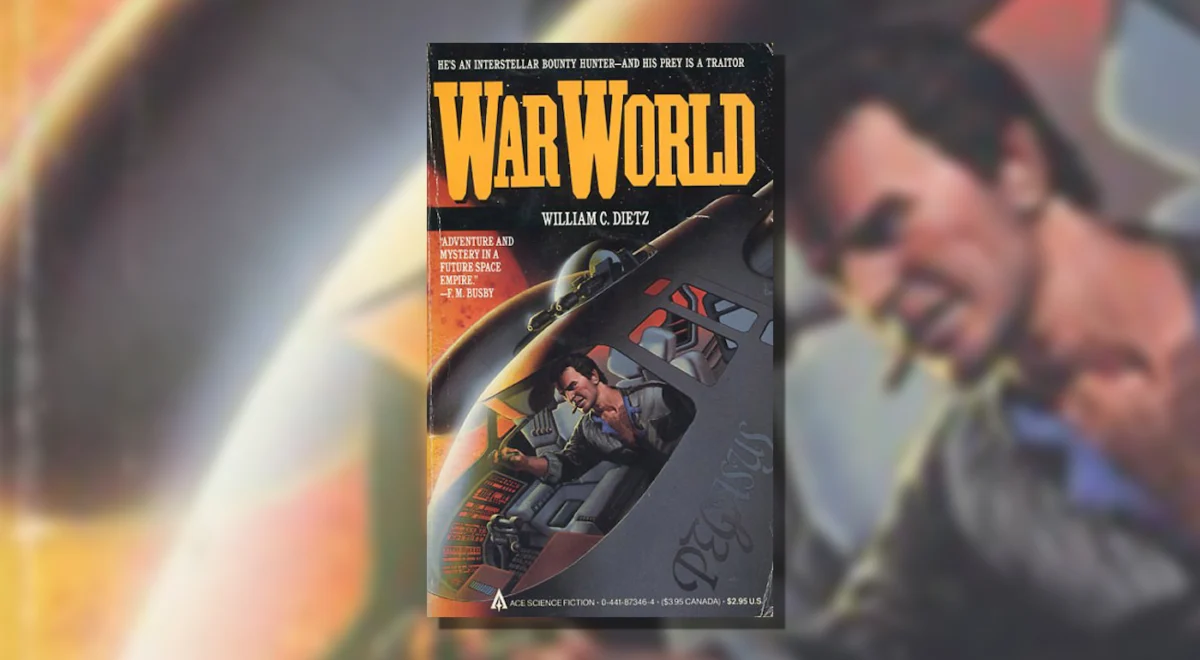
Dietz’s literary journey began in 1986 with the publication of War World, a novel that would not only establish his presence in the genre but also launch a successful series. The book, later retitled Galactic Bounty in some editions to avoid confusion with Jerry Pournelle’s shared world anthology series of the same name, introduced readers to Sam McCade, a hard-bitten bounty hunter navigating the treacherous expanse of the human Empire. The original 1986 Ace paperback edition featured striking cover art by "Miro," depicting McCade in his spaceship, Pegasus, a characteristic cigar clenched between his teeth. This iconic image became synonymous with Dietz’s adventurous spirit and the compelling characters he created.
A Career Forged in Adventure and Service
William C. Dietz’s background significantly informed his writing. Born in 1945, he served as a corpsman with the U.S. Navy and Marines, an experience that undoubtedly provided him with a deep understanding of military life and the psychology of combat. Following his military service, Dietz worked in a variety of civilian fields before dedicating himself fully to writing science fiction. This diverse professional background lent a grounded authenticity to his fictional worlds, even as they were set amongst the stars.
His most enduring contribution to the genre is arguably the "Legion of the Damned" series, a sprawling saga that comprises over twelve books. This series, inspired by the romanticized image of the French Foreign Legion, follows the exploits of a futuristic fighting force, offering readers a consistent and expansive narrative universe. Dietz’s ability to sustain such a long-running series speaks to his skill in character development and plot construction, consistently delivering the action and intrigue his fans came to expect.
Beyond his original creations, Dietz also demonstrated a talent for adapting and expanding established universes. He penned a trilogy of novels based on the popular Star Wars: Dark Forces video game series, immersing fans deeper into that galaxy far, far away. His versatility extended to other beloved gaming franchises, as he also wrote books set within the universes of Halo, Mass Effect, and StarCraft. These forays into established media properties showcased his adaptability and his keen understanding of what makes these fictional worlds resonate with audiences. One of his later original works, the "America Rising" trilogy, explored a post-apocalyptic landscape, focusing on themes of war and survival, further demonstrating the breadth of his storytelling capabilities.
The Enduring Appeal of the Bounty Hunter Archetype
The fascination with bounty hunters, figures who operate in the grey areas between law and outlaw, has long been a staple of adventure fiction. Dietz’s protagonist, Sam McCade, embodies this archetype perfectly. McCade is a pragmatic and resilient individual, often finding himself in seemingly insurmountable situations but relying on sheer stubbornness and a strong moral compass to prevail. His character, though outwardly tough and often depicted with his signature cigar, possesses a core of decency that makes him an approachable and relatable hero for readers.
The concept of bounty hunting, while largely outlawed in most parts of the world today, has a rich history in popular culture. From the cowboys of Western films to the shadowy figures of detective novels, the bounty hunter has always represented a compelling blend of roguish independence and a twisted form of justice. In science fiction, this archetype has achieved iconic status, perhaps none more so than Boba Fett from the Star Wars universe. Introduced as a formidable antagonist in The Empire Strikes Back, Fett’s enigmatic persona and eventual redemption arc, particularly in The Mandalorian series, have cemented his place as a fan favorite and a prime example of the enduring appeal of this character type. The continued popularity of Star Wars: Bounty Hunters, a comic series launched in 2020, further underscores the enduring fascination with these characters.
In the United States, the profession of bounty hunting, or fugitive recovery, continues to be regulated by state governments, with practitioners organized under bodies like the National Association of Fugitive Recovery Agents. The reality television series Dog the Bounty Hunter, starring Duane Chapman, brought this profession into mainstream consciousness, showcasing the often-dangerous work involved in tracking down fugitives. Dietz’s Sam McCade, while fictional, taps into this same primal interest in individuals who pursue justice on their own terms, navigating the fringes of society.
War World / Galactic Bounty: A Debut of Action and Intrigue
William C. Dietz’s debut novel, War World, immediately plunges the reader into a high-stakes world of interstellar intrigue and personal vendettas. The narrative kicks off in a bustling bar, where Sam McCade is on the hunt for Cadien, a professional killer whose reckless actions—specifically, detonating a space yacht carrying the Emperor’s niece—have made him a prime target. The human Empire, depicted as a loosely confederated collection of star systems, lacks a robust interstellar police force, frequently relying on bounty hunters to apprehend fugitives.
McCade successfully neutralizes Cadien but sustains injuries in the process. Upon regaining consciousness, he finds himself face-to-face with Walter Swanson-Pierce, a former shipmate now serving as an Imperial Navy Captain. McCade, facing financial hardship, is presented with a difficult proposition: undertake one more job for the Empire, or forfeit his reward. The mission, however, is deeply personal. Both McCade and Swanson-Pierce once served under Captain Ian Bridger aboard the vessel Imperial. They both recall Bridger’s daughter, Sara, and the circumstances that led McCade to a life of bounty hunting: a court-martial for disobeying orders during the Battle of Hell, a fierce pirate engagement where Bridger lost his wife and daughter. The Empire’s current demand is for McCade to bring in Bridger himself.
The plot thickens as McCade becomes the target of licensed assassins, a grim testament to the Empire’s permissive policies that allow individuals to purchase licenses to kill their adversaries. Though this subplot may seem tangential, it serves to break up potentially exposition-heavy passages and keeps the narrative momentum. Simultaneously, McCade learns of the Empire’s hands-off policy on the frontier, where human pirates are allowed to clash with the Il Ron, humanity’s primary alien adversaries. This policy, while intended to weaken both factions, places frontier populations at the mercy of pirate attacks. Bridger, it is revealed, has stumbled upon a secret that could shift the galactic balance of power and is seemingly willing to sell this information to the Il Ron. Dietz skillfully injects moments of sudden, explosive action, such as the detonation of a lunch cart, ensuring the reader remains on the edge of their seat.
To aid McCade, the Navy assigns Lieutenant Laurie Lowe, Section Leader Van Doren, and a contingent of marines. McCade is granted the use of the Pegasus, a former Navy scout ship that had recently served as a private yacht. The promise of retaining ownership of the Pegasus upon successful completion of the mission underscores the critical importance of his task.
Bridger’s discovery pertains to the War World, a planet rich with artifacts from a long-extinct civilization known as the Builders. These artifacts could grant the Il Ron a decisive advantage in their ongoing conflict with the human Empire. Bridger’s obsession with vengeance against pirates has apparently blinded him to the larger galactic implications, driving him to consider aligning with humanity’s enemies.
Navy Intelligence tracks Bridger to the cargo ship Leviathan. When McCade and Lowe approach, ignoring warnings to stay clear, they are fired upon. An attempt to board the Leviathan results in the tug portion separating from the cargo section and jumping into hyperspace, leaving McCade wounded once more. Following his recovery, McCade, Lowe, and Van Doren journey to Weller’s World, an ice-bound frontier planet with a surprisingly robust local government and military. The Empire’s laissez-faire approach has inadvertently fostered independence among its frontier worlds, a development that may prove problematic in the future. On Weller’s World, they discover that Captain Bridger’s daughter, Sara, had survived her pirate capture and is now a prominent figure in the local government.
Dietz masterfully employs plot twists and reversals of fortune, keeping the reader guessing. The true nature of the War World itself emerges as a significant revelation. A particularly memorable twist involves the introduction of a "Treel," a shape-shifting alien capable of remarkable mimicry, a survival trait developed to evade predators. The dynamic between McCade and the Treel, initially adversarial, evolves into a grudging respect, highlighting the novel’s blend of action and character interaction. Dietz’s battle scenes are described as crisp and exciting, and like Edgar Rice Burroughs, he often places his characters in situations requiring escape, adding to the narrative tension. The novel also incorporates humorous elements that effectively balance the intense action. Despite being Dietz’s first published work, War World reads with a smoothness and confidence that belies its status as a debut, a testament to his nascent talent. McCade, the pragmatic everyman hero, relies on his stubbornness and durability, ultimately proving to be a compelling protagonist for whom readers can easily root. The novel concludes with ample room for sequels, justifying the subsequent books in the series and their repeated reprints.
Legacy and Final Reflections
William C. Dietz leaves behind a legacy of exciting, action-packed science fiction that provided countless hours of entertainment for his readers. While War World may not have delved into profound sociological or scientific speculation, it delivered precisely what its audience sought: rollicking adventure and compelling narratives. His ability to craft accessible yet thrilling stories, coupled with his prolific output, solidified his position as a significant author in the genre. His passing is a loss keenly felt by the science fiction community, a reminder of the vibrant storytelling he brought to the field. Readers who seek escapism and exhilarating tales of spacefaring heroes and daring exploits will find a rich and rewarding body of work in Dietz’s bibliography. His contributions to the genre, particularly his memorable characters and engaging plots, will continue to be appreciated by fans of adventure science fiction for years to come.