The eighth episode of the fifth season of Apple TV+’s critically acclaimed space drama, For All Mankind, titled Brave New World, marks a pivotal turning point in the series’ reimagined history of the 21st century. As the narrative splits its focus between the scientific frontier of Saturn’s moon, Titan, and the escalating civil unrest on Mars, the episode explores themes of colonial identity, the ethics of insurrection, and the heavy burden of generational legacies. The events of this installment signify a shift from the cooperative internationalism that defined earlier seasons toward a fragmented reality where the inhabitants of the Red Planet, now identifying as "Marsees," seek total autonomy from Earth-based governing bodies.
The Titan Expedition and the Baldwin Legacy
The primary scientific narrative of the episode centers on the successful landing of Kelly Baldwin and her team on the surface of Titan. This achievement represents a major milestone in the series’ timeline, extending humanity’s reach further into the outer solar system than ever before. Kelly Baldwin, portrayed by Cynthy Wu, serves as the bridge between the heroic era of the Apollo missions and the modern era of deep-space biological research.
Upon touching down, Baldwin delivers a televised address that resonates across the solar system. Her speech invokes the memory of her father, the late Ed Baldwin, and references the iconic Apollo 11 plaque that read, "We came in peace for all mankind." By connecting the Titan mission to the foundational myths of the space program, Kelly reinforces the idea that scientific exploration remains a unifying force, even as political structures crumble. However, the subtext of her speech is also one of Martian pride. She acknowledges the "brilliant engineers and scientists on Mars" who rehabilitated the mission’s vessel after the Kosmos 1 disaster, effectively crediting the Martian colony rather than Earth’s administrative centers for the mission’s success.
The leadership dynamics on Titan also undergo a significant shift. Walt, the mission commander played by Christopher Denham, suffers from a psychological breakdown fueled by the technical failures that nearly derailed the landing. His obsession with identifying a non-existent calculation error leads him to relinquish command to Kelly Baldwin. This transition to "interim commander" forces Kelly to abandon her internal guilt regarding her own maneuvers to ensure the mission’s survival, focusing instead on the immediate goal: finding evidence of prebiotic life in Titan’s methane lakes.

The Rise of Marsee Identity and the Mars-Earth Trade War
While Titan represents the pinnacle of exploration, Mars has become a hotbed of geopolitical and economic friction. The episode highlights the growing chasm between the Solar System Development Mission (SDM) and the local laborers and scientists who call Mars home. The term "Marsee" has evolved from a derogatory label into a badge of honor and a symbol of nationalistic fervor for the fledgling colony.
The political landscape is further complicated by the ongoing trade war involving the M6 ships—a fleet of Earth-controlled vessels intended to secure asteroid resources. Miles, a central figure in the Martian underground economy played by Toby Kebbell, finds himself caught in a high-stakes power play. Advised by Russian officials Irina and Lenya, Miles is led to believe that the SDM can outlast the current political regime on Earth, provided they maintain their hold on the asteroid resources.
However, the episode introduces a voice of pragmatic skepticism through Aleida Rosales. Portrayed by Coral Peña, Aleida represents the "grounding" force of the season. Her refusal to fully align with either the radical Martian rebels or the Earth-based corporate interests highlights the moral complexity of the situation. From Aleida’s perspective, the technical and safety risks of the conflict far outweigh the political gains. Her role as a neutral engineer emphasizes the mission-critical objective of minimizing fatalities, a goal that becomes increasingly difficult as the Marsees move toward violent resistance.
Tactical Sabotage and the Bombing of the Docking Platform
The central conflict of Brave New World culminates in a clandestine operation designed to prevent Earth’s M6 ships from seizing the Martian-controlled asteroid. The Marsees, led by former MPK officer Celia Boyd (Mireille Enos) and the Russian defector Lenya (Costa Ronin), devise a plan to pilot a "hopper"—a small Martian transport vessel—loaded with fertilizer-based explosives toward the main docking platform.
This tactical decision serves as a case study in asymmetric warfare. The use of agricultural materials as improvised explosive devices (IEDs) underscores the resourcefulness of the Martian rebels and their desperation to achieve sovereignty. The mission is fraught with technical peril, requiring a liftoff through a severe Martian dust storm. Despite Aleida Rosales’s fierce opposition to the plan on the grounds of safety and the potential for unintended casualties, she is ultimately outvoted by the colonial leadership.

The execution of the bombing is a masterclass in tension, as the hopper reaches the docking site just as a reconnaissance team from the M6 ship arrives. The realization that the platform is not abandoned, as previously thought, creates a moral crisis for Celia Boyd. In a moment that defines her character’s shift from a soldier of the state to a leader of a people, she breaks radio silence to warn the incoming soldiers. This act demonstrates that her allegiance lies with human life rather than blind nationalism, though her intervention comes too late to prevent the ensuing tragedy.
Human Cost and the Death of Ruiz
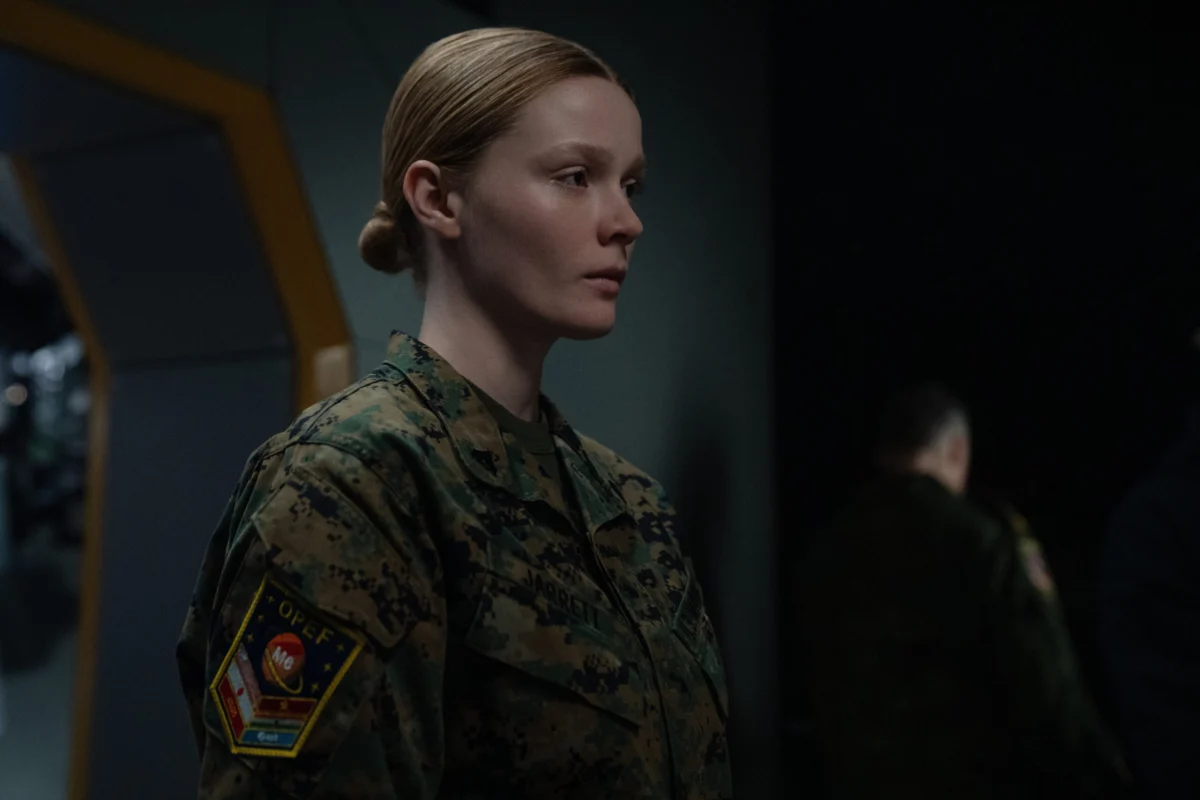
The episode’s most visceral moment occurs during the fallout of the docking platform explosion. Avery (AJ), a young recruit on the M6 ship played by Ines Asserson, and her commanding officer, Ruiz (Keith Miller), are caught in the blast radius while attempting to secure the site. The narrative emphasizes the human element of the "enemy" through the burgeoning relationship between AJ and Ruiz.
Earlier in the episode, Ruiz shares his personal history of generational trauma, offering AJ a sense of solidarity and the confidence to embrace her role in the mission. The loss of Ruiz—killed by a piece of high-velocity debris that shatters his helmet—serves as a grim reminder of the physical vulnerabilities inherent in space combat. The death of a seasoned officer at the hands of civilian-led sabotage marks a point of no return for the conflict, likely triggering a more aggressive military response from Earth’s superpowers.
For Aleida Rosales, witnessing the explosion from the control room is a traumatizing experience. Her fears regarding the "blood on her hands" reflect the broader ethical dilemma of the series: the cost of progress and the price of independence. The episode suggests that while the Marsees may have won a tactical victory by disabling the docking platform, they have incurred a moral and political debt that will be difficult to repay.
Media Warfare and the Role of Lily’s Camera
A secondary but vital thread in Brave New World involves Lily, played by Ruby Cruz. Still grieving the loss of a close friend, Lily rejects the opportunity to return to the safety of Earth. Instead, she chooses to use her skills as a documentarian to change the narrative surrounding the Martian movement.

In the era of the "Brave New World," information is as much a weapon as fertilizer bombs. The Earth-based media has consistently portrayed the Marsees as radical terrorists. Lily’s mission is to record the lived reality of the colonists, providing a human face to the rebellion. This plot point reflects the real-world importance of independent journalism in conflict zones and suggests that the battle for Mars will be fought in the court of public opinion as much as in the vacuum of space.
Broader Implications and Analysis
Brave New World serves as a thematic microcosm for the entire fifth season of For All Mankind. The episode effectively illustrates the "frontier thesis" in a sci-fi setting, where the distance from the metropole (Earth) inevitably leads to the development of a distinct cultural and political identity in the colony (Mars).
The success on Titan proves that humanity’s scientific curiosity remains undiminished, yet the violence on Mars suggests that we have carried our oldest flaws—tribalism, greed, and the tendency toward conflict—into the stars. The "Brave New World" referenced in the title is not just the new moons being explored, but the new, harsher reality of interplanetary war.
Chronologically, the series has now reached a point where the original pioneers of the space race are being replaced by a generation that views Earth not as a home to be protected, but as a distant authority to be challenged. Kelly Baldwin’s leadership on Titan and the Marsees’ rebellion on Mars are two sides of the same coin: a declaration of independence from the old world.
As the season moves toward its finale, several questions remain:

- The Military Response: How will NASA and Roscosmos react to the loss of the docking platform and the death of personnel?
- The Search for Life: Will Kelly Baldwin’s interim command lead to a discovery on Titan that shifts the focus back to science?
- The Political Vacuum: With the Russian presidency in flux and the SDM struggling, who will fill the power vacuum on Mars?
The episode concludes on a note of intense uncertainty. The "win" celebrated at the Helios Bar is tempered by the horror in the control rooms and the silence of the vacuum where Ruiz died. For All Mankind continues to challenge the optimistic "Star Trek" trope of a unified future, suggesting instead that the path to the stars is paved with the same complex, messy, and often violent struggles that have defined human history on Earth. The drama on Mars and Titan has, as the episode suggests, only just begun.