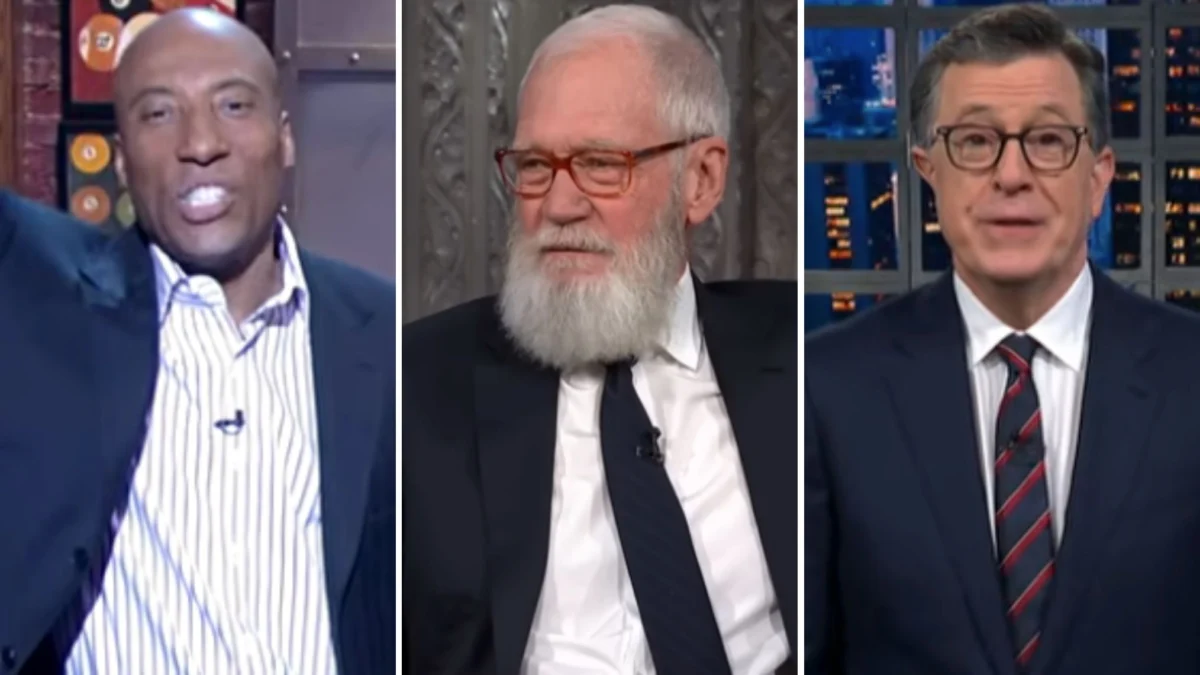
The landscape of American late-night television is poised for its most radical transformation in decades as CBS prepares to transition away from the traditional talk show format pioneered by David Letterman and maintained by Stephen Colbert. Following the network’s announcement that Stephen Colbert will conclude his tenure as host of The Late Show on May 21, 2026, CBS has confirmed a significant programming shift that will see Byron Allen’s Allen Media Group take control of the 11:35 p.m. and 12:37 a.m. time slots. David Letterman, the foundational figure of CBS late night who hosted the franchise for 22 years, has publicly weighed in on the decision, offering a candid assessment of the network’s financial motivations and the changing economics of broadcast media.
The restructuring involves moving Byron Allen’s long-running series Comics Unleashed into the prestigious 11:35 p.m. (10:35 p.m. Central) slot, effectively replacing the high-budget variety and interview format of The Late Show with a more cost-effective comedy panel structure. Furthermore, Allen’s comedy game show, Funny You Should Ask, will occupy the subsequent hour. This move represents a departure from the traditional network model of in-house production and talent development, shifting toward a brokerage-style arrangement where the network sells the time slot to an outside producer who manages production costs and advertising inventory.
The Letterman Critique and the "Cowardice" of Programming Shifts
David Letterman, whose departure from late night in 2015 marked the end of an era for CBS, has not remained silent regarding the network’s trajectory. Speaking on his podcast, Letterman provided an analytical breakdown of the CBS-Byron Allen deal, characterizing it as a move driven purely by the bottom line. According to Letterman, the decision to discontinue The Late Show in its current form reflects a desire to eliminate the massive overhead associated with a daily variety production, which includes high-salaried writers, a house band, a large production crew, and a high-profile host.
"They don’t want to spend any money, so they’re going to make money," Letterman observed, noting that by selling the time slot to Byron Allen, CBS offloads the financial risk and production burden while securing a guaranteed revenue stream. Letterman’s commentary extended to the format of Comics Unleashed itself, which he described as "seated standup." He acknowledged that while the show is a "pretty good idea" for its efficiency—featuring a panel of comedians discussing humorous topics rather than a standard monologue-and-guest format—it signals a definitive end to the prestige era of the 11:35 p.m. slot.
This latest commentary follows Letterman’s more pointed criticisms made earlier in the year, where he reportedly labeled the decision to cancel The Late Show as "cowardice." Letterman argued that the network failed to provide Stephen Colbert with the support and institutional respect befitting the "face of the network." Colbert, who transitioned from Comedy Central’s The Colbert Report to CBS in 2015, successfully navigated the show through a period of immense political polarization, eventually securing a dominant position in the ratings during the late 2010s.
The Chronology of the Late-Night Transition
The transition at CBS is the result of a multi-year strategy aimed at stabilizing the network’s balance sheet amid a broader decline in linear television viewership. The timeline of this shift highlights the rapid pace of change within the industry:
- September 2015: Stephen Colbert debuts as the host of The Late Show, succeeding David Letterman.
- 2017–2020: Colbert achieves ratings dominance, frequently leading the 11:35 p.m. slot in total viewers, fueled by a sharp focus on political satire.
- April 2023: James Corden departs The Late Late Show at 12:37 a.m. CBS chooses not to replace him with another traditional talk show, instead opting for a reboot of the game show @midnight, produced by Stephen Colbert’s production company, signaling the start of the "budget-conscious" era.
- Late 2023: CBS internally decides to retire The Late Show brand following the expiration of Colbert’s contract.
- April 2026: Stephen Colbert is scheduled to begin his final month of broadcasts.
- May 21, 2026: The final episode of The Late Show With Stephen Colbert is scheduled to air.
- May 22, 2026: Byron Allen’s Allen Media Group officially takes over the time slot with Comics Unleashed, marking the beginning of the 2026–2027 television season.
Economic Implications and the Byron Allen Business Model
The deal between CBS and Byron Allen is emblematic of the "syndication-to-network" pipeline that is becoming increasingly attractive to legacy broadcasters. Byron Allen, the Chairman and CEO of Allen Media Group, has built a media empire by acquiring local television stations and producing high-volume, low-cost content that can be distributed across multiple platforms.
In the CBS arrangement, Allen Media Group reportedly pays a fee for the time slot, a practice sometimes referred to as "time-buying" or a "brokerage agreement." Allen then retains the rights to sell a significant portion of the advertising inventory within the broadcast. For CBS, this guarantees a profit margin without the volatility of production costs, which for a show like Colbert’s can exceed $100 million annually.
"I created and launched Comics Unleashed 20 years ago so my fellow comedians could have a platform to do what we all love—make people laugh," Allen stated in a press release. His enthusiasm underscores a strategic victory for his company, which has spent years vying for a foothold in the major network evening blocks. By securing a two-hour block (Comics Unleashed and Funny You Should Ask), Allen becomes one of the most powerful individual producers in the late-night space.
Industry Data: The Decline of the Traditional Talk Show
The shift at CBS is supported by stark data regarding the decline of linear late-night audiences. In the 1990s, during the peak of the Letterman vs. Leno "Late Night Wars," it was not uncommon for the leading shows to pull in 5 to 6 million viewers nightly. In contrast, current leaders like Colbert and NBC’s Jimmy Fallon often average between 1.5 and 2 million total viewers, with the "coveted" 18-49 demographic seeing even more dramatic percentage drops.
Furthermore, the rise of social media and short-form video platforms like YouTube and TikTok has fundamentally altered how audiences consume late-night content. Most viewers now watch monologues or celebrity interviews as individual clips the following morning rather than tuning in for the full broadcast. This fragmentation makes the high production value of a traditional talk show difficult to justify for advertisers who are increasingly moving their budgets to digital platforms.
The "cost-per-viewer" metric has become the primary driver of programming decisions. While a traditional talk show requires a massive writing staff and daily original production, Comics Unleashed can be produced in batches, with multiple episodes recorded in a single day. This creates a library of evergreen content that can be repeated and syndicated with minimal additional investment.
Reactions from Stakeholders and the Creative Community
The reaction within the creative community has been a mixture of pragmatism and mourning. Writers and producers in the late-night space view the CBS move as a harbinger of things to come for other networks. There are concerns that if the Byron Allen model proves successful for CBS, NBC and ABC may follow suit when the contracts for Jimmy Fallon and Jimmy Kimmel eventually come up for renewal.
Staff members at The Late Show have reportedly been aware of the impending transition for some time, allowing for a planned "victory lap" for Colbert during the 2025-2026 season. Colbert himself has remained professional regarding the move, focusing on maintaining the quality of the program until his departure. However, the loss of a major 11:35 p.m. platform for musical guests and long-form celebrity interviews is seen as a blow to the entertainment industry’s promotional ecosystem.
Byron Allen’s supporters, conversely, see this as a democratization of the time slot. Allen Media Group has long championed its ability to provide diverse comedic voices with a platform. "The world can never have enough laughter," Allen remarked, emphasizing that his format prioritizes the comedians themselves over the personality of a single host.
Future Implications for the Broadcast Landscape
As CBS transitions to the Byron Allen era, the industry will be watching closely to see if the audience follows. The primary risk for CBS is a potential loss of "prestige" and a decline in the network’s ability to lead into the late news or maintain a high-profile brand identity. The Late Show has historically been a flagship program that defines a network’s voice; replacing it with a syndicated-style panel show risks making the network feel like a cable channel rather than a premiere broadcaster.
However, from a corporate perspective, the move is a defensive maneuver against the shrinking margins of linear TV. Paramount Global, the parent company of CBS, has been under intense pressure to cut costs as it navigates a shifting landscape dominated by streaming services like Netflix and Disney+. By offloading the costs of late night, CBS is prioritizing financial stability over cultural cachet.
The end of Stephen Colbert’s run in May 2026 will officially close the chapter on the "Prestige Talk Show" era at CBS that began with David Letterman in 1993. Whether Byron Allen’s "seated standup" can capture the imagination of the American public—or if it simply serves as a profitable placeholder in a dying medium—remains the central question for the future of broadcast television. For now, the transition stands as a testament to Letterman’s observation: in the modern media environment, the priority has shifted from making television history to simply making the numbers work.