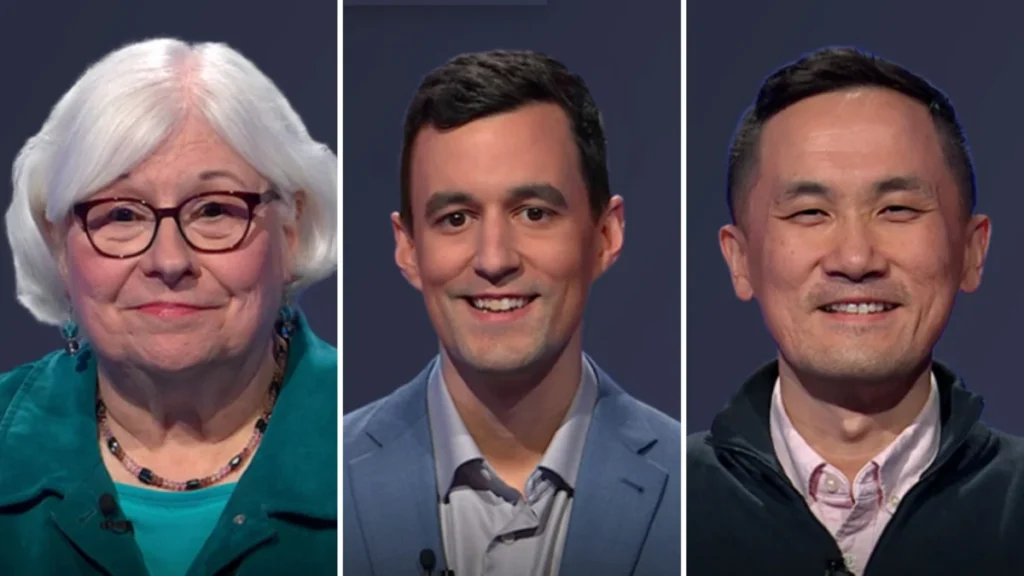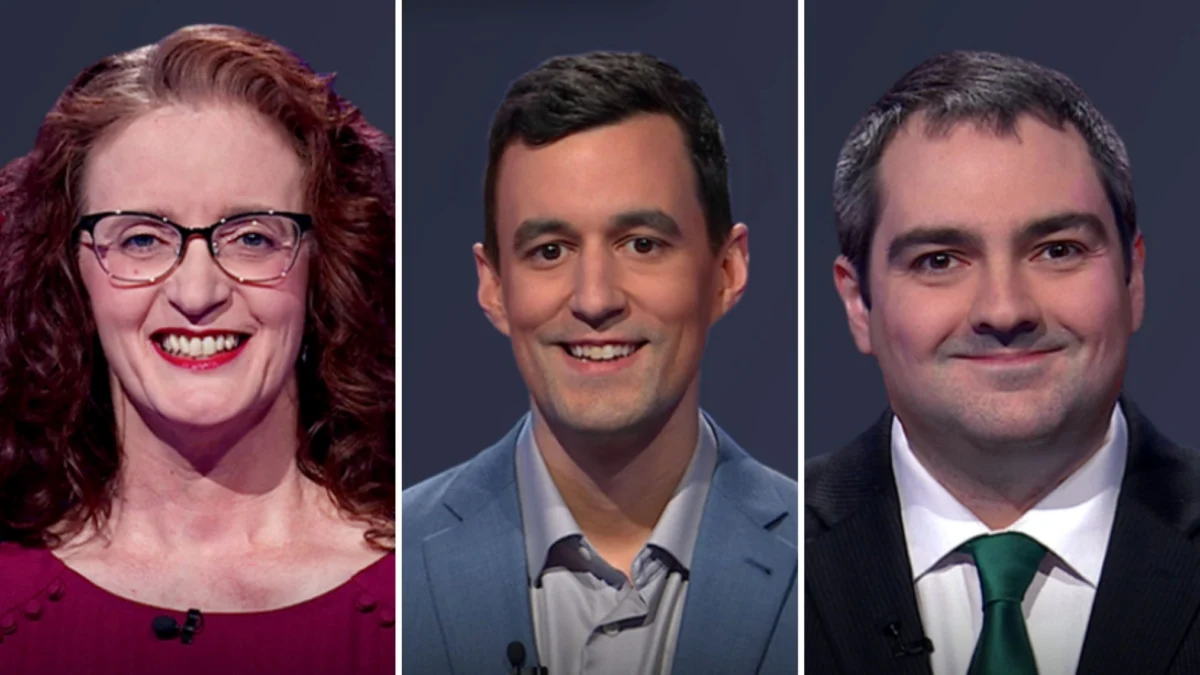
Tristan Williams, a data scientist hailing from Lincoln, Nebraska, continued his dominant performance on the iconic game show Jeopardy! during the May 18 broadcast, securing his ninth consecutive victory and bringing his total winnings to a formidable $188,501. Williams entered the game with an established reputation for precision and calm under pressure, qualities that were tested by a board that both contestants and viewers characterized as having a difficulty level typically reserved for the elite Tournament of Champions. Facing off against Amy Dewey, an entrepreneur and part-time homemaker from Broken Arrow, Oklahoma, and Thomas Trovato, a software developer from London, Ontario, Williams navigated a series of challenging categories and strategic wagering scenarios to maintain his lead. The match was defined not only by Williams’ consistency but also by a series of "Triple Stumpers" and a pivotal missed Daily Double that reshaped the competitive landscape of the game.
The Opening Round: Strategic Wagering and Early Momentum
The first round of play saw a competitive exchange between Williams and Trovato, with both men demonstrating quick buzzer reflexes and a broad knowledge base. Williams struck early, finding the game’s first Daily Double on the sixth clue of the round. At the time, he held a narrow lead with $2,000. Operating in the category "3-Word Cities," Williams opted for a "true Daily Double," wagering his entire $2,000. The clue required him to identify Tanzania’s largest city based on its Arabic translation, "abode of peace." Williams correctly identified the city as Dar es Salaam, doubling his score to $4,000 and establishing an early psychological advantage.
Despite Williams’ successful wager, the round remained a close contest. Thomas Trovato showcased his own expertise, particularly in high-value clues, and by the first commercial break, he had edged ahead of the champion with $4,600 to Williams’ $4,000. However, the momentum shifted back toward the incumbent champion in the latter half of the round. By the time host Ken Jennings signaled the end of the Jeopardy! round, Williams had reclaimed the lead with $8,800. Trovato followed closely with $6,000, while Amy Dewey struggled to find her rhythm against the two high-performing competitors, finishing the round with $1,600.
Double Jeopardy: High Stakes and Increased Difficulty
As the game transitioned into the Double Jeopardy! round, the complexity of the clues increased significantly. Williams continued to hunt for Daily Doubles, finding the first one of the round (the second overall) on the fifth clue in a category titled "All Respect to the Ballet & Opera People." Holding $9,200, Williams wagered $6,000, a move that signaled his intent to lock out his opponents early. The clue focused on a 1942 Aaron Copland ballet choreographed by and starring Agnes de Mille as a "lead cowgirl." Williams correctly answered "Rodeo," bringing his total to $15,200 and widening the gap between himself and his challengers.
The turning point for Thomas Trovato occurred on the 11th clue of the round. Finding the final Daily Double in the category "’LOL’", Trovato had accumulated $7,200. Recognizing that he needed a significant boost to catch Williams, Trovato wagered his entire bankroll. The clue referenced a work by French existentialist philosopher Simone de Beauvoir titled "Brigitte Bardot and the [this] Syndrome," referencing a famous literary character. Trovato was unable to provide a response before the time expired, resulting in a total loss of his earnings and dropping his score to zero. The correct response, "Lolita," proved to be a difficult get under the pressure of the stage. Host Ken Jennings expressed sympathy for the contestant, noting the difficulty of the clue and the unfortunate timing of the miss.
The "Alphabetically Next" Controversy and Viewer Reaction
The latter half of the Double Jeopardy! round became a point of contention among the show’s dedicated fanbase and the contestants themselves. A category titled "Alphabetically Next" proved to be exceptionally difficult, resulting in a series of "Triple Stumpers"—clues that none of the three contestants could answer. The category required contestants to identify a word or name that would logically follow the provided prompt in an alphabetical sequence.
The difficulty was so pronounced that even the $400 and $800 clues went unanswered. One specific clue regarding the chemical element that follows polonium was cited by viewers as being far beyond the standard difficulty for a regular-season game. When Trovato finally broke the streak of silence by correctly identifying "Thursday" as the day following Saturday and Sunday (alphabetically: Saturday, Sunday, Thursday), he jokingly celebrated, saying, "Yay! We got one!" Host Ken Jennings acknowledged the struggle, admitting to the contestants, "I’m with you. These are tough."
Following the episode’s airing, the online Jeopardy! community on platforms like Reddit echoed these sentiments. Fans argued that the board felt like it had been designed for the Tournament of Champions (ToC), where the show’s most successful players return to compete for higher stakes. Trovato himself participated in the online discussion, confirming that from his perspective on the stage, the entire Double Jeopardy! board felt significantly more difficult than a standard game. He noted that he was unable to answer any of the $1,600 or $2,000 clues, underscoring the high barrier to entry for the round’s most valuable questions.
Final Jeopardy and the Path to Super-Championship
Despite the hurdles of the second round, Tristan Williams maintained a dominant lead heading into Final Jeopardy! with $22,400. Amy Dewey had managed to climb into second place with $4,400, while Trovato had recovered slightly to reach $1,200. The category for the final clue was "American Architecture," a subject that often requires a mix of historical knowledge and cultural literacy.
The clue read: "In the 1930s, an automobile showroom occupied the first 2 floors of this building at 42nd & Lexington in Manhattan." All three contestants were successful in identifying the iconic Art Deco skyscraper as the Chrysler Building. The wagering in the final round reflected the disparate scores. Trovato wagered a nominal $17 to finish with $1,217. Dewey opted for a conservative $0 wager, maintaining her $4,400 total. Williams, already assured of the win, wagered $7,600, bringing his daily total to an impressive $30,000.
With this victory, Williams’ nine-day total reached $188,501. The win set the stage for his tenth game, scheduled for May 19. In the parlance of Jeopardy! history, a ten-day winner is often categorized as a "super-champion," a title reserved for an elite group of players who have demonstrated sustained excellence over two full weeks of competition. Williams’ performance has already secured him a spot in the next Tournament of Champions, where he will face the very level of difficulty that he and his fellow contestants navigated during this match.
Analysis of Williams’ Performance and Statistical Standing
Tristan Williams’ success can be attributed to a combination of high "Coryat" scores—a measure of a player’s performance exclusive of wagering—and strategic aggression on Daily Doubles. As a data scientist, Williams appears to approach the game with a mathematical mindset, often selecting clues in a manner that maximizes his chances of finding Daily Doubles before his opponents. His ability to recover from Triple Stumpers and remain unfazed by the difficulty of the board has been a hallmark of his nine-game run.
Statistically, Williams is currently among the top performers of Season 40. While he has yet to reach the stratospheric totals of legendary players like Ken Jennings, James Holzhauer, or Amy Schneider, his nine-day streak places him in the upper echelon of the show’s history. His average winning per game stands at approximately $20,944, reflecting a consistent ability to build large leads and capitalize on Final Jeopardy!
The May 18 game also highlighted the "luck of the draw" inherent in Jeopardy! clue selection. While Trovato’s missed Daily Double was a devastating blow to his chances, it also illustrated the risk-reward nature of the game. Had Trovato answered correctly, the scores heading into Final Jeopardy! would have been much closer, potentially forcing Williams into a more defensive wagering strategy.
Broader Implications for the Show and Its Format
The discussion surrounding the difficulty of the May 18 board touches on a recurring theme in the Jeopardy! community regarding the "leveling" of clues. Under the tenure of executive producer Michael Davies and host Ken Jennings, there has been a perceived effort to keep the show challenging for a modern audience that has access to vast amounts of information. However, when a board results in multiple Triple Stumpers, it can occasionally slow the pace of the game, a factor that Jennings managed with his trademark wit and encouragement.
The episode also served to humanize the contestants, particularly through Trovato’s graciousness in defeat. His post-game comments on social media emphasized the "incredible experience" of appearing on the show, regardless of the outcome. This sportsmanship remains a core value of the Jeopardy! brand, which continues to celebrate intellectual achievement and the pursuit of knowledge.
As Tristan Williams prepares for his tenth game, the focus shifts to whether he can maintain his focus and stamina. The physical and mental toll of filming multiple episodes in a single day is a factor that has ended many long streaks in the past. For now, Williams stands as a formidable champion, having survived one of the most difficult boards in recent memory to move one step closer to Jeopardy! immortality. His journey continues to captivate audiences, proving that even in a digital age, the quest for trivia mastery remains a compelling television draw.