During a tumultuous period in South Korea when fundamental freedoms, including freedom of expression, were severely curtailed, the modernist movement within local cinema emerged as a potent, albeit subtle, vehicle for dissent. Amidst this restrictive environment, filmmaker Kim Soo-yong, collaborating with the astute writing talent of Yong-seong Kim, dared to challenge pervasive state censorship with his dark psychological thriller, "Splendid Outing." Released in 1978, the film was not merely provocative for its era but established a profound and lasting influence, continuing to inspire later generations of filmmakers, notably the acclaimed Lee Chang-dong. Its enduring power is underscored by its inclusion in significant retrospective screenings, such as "Korean Cinema’s Celluloid Fever: The 1970s," presented by Film at Lincoln Center (FLC) and Subway Cinema, allowing contemporary audiences to engage with its intricate layers of social commentary and artistic innovation.
The Yushin Era: A Climate of Control
To fully appreciate the audacious nature of "Splendid Outing," it is essential to contextualize its creation within the political landscape of South Korea in the 1970s. This decade was dominated by the authoritarian rule of President Park Chung-hee, specifically under the Yushin Constitution, enacted in 1972. The Yushin system fundamentally transformed South Korea into a de facto dictatorship, granting Park Chung-hee sweeping powers, including the ability to issue emergency decrees, dissolve the National Assembly, and appoint a third of its members. Freedom of speech, assembly, and the press were drastically suppressed under the guise of national security and economic development. Dissent was met with severe penalties, and an pervasive atmosphere of fear and self-censorship gripped the nation.
In this climate, cultural production, including filmmaking, became a tightly controlled apparatus of the state. The government actively promoted films that aligned with its ideology—often nationalistic, anti-communist, or didactic in their celebration of economic progress (the "Miracle on the Han River"). Any work perceived as critical of the regime, questioning societal norms, or depicting social malaise in a non-sanctioned manner faced immediate scrutiny, censorship, and potential banning. The Motion Picture Law was frequently amended to tighten control, leading to the establishment of powerful censorship committees that reviewed scripts, production plans, and final cuts. Filmmakers operated under constant threat of their work being altered, shelved, or themselves facing professional repercussions. This stringent oversight led to a significant decline in the artistic quality and diversity of Korean cinema during much of the 1970s, as many directors opted for safer, more commercially viable, or government-approved projects.
Korean Cinema Under Duress: The Rise of Modernism as Resistance
Despite the oppressive conditions, the 1970s also witnessed a quiet but significant emergence of modernist tendencies within Korean cinema. Filmmakers, often influenced by European art-house movements and a desire to explore deeper psychological and social realities, began to experiment with narrative structures, visual styles, and thematic ambiguities. This modernist approach served as a crucial, often subliminal, form of resistance. By employing symbolism, allegory, and complex character psychologies, directors could articulate critiques of society and power structures without explicitly crossing the red lines of censorship. Their films often delved into themes of alienation, existential despair, and the crumbling of individual identity in a rapidly modernizing yet repressive state. "Splendid Outing" stands as a prime example of this modernist wave, utilizing its psychological thriller framework to comment on the broader societal and political "splendid outing" that was, in reality, a deeply unsettling journey into an enforced national consciousness.
"Splendid Outing": A Narrative of Subversion
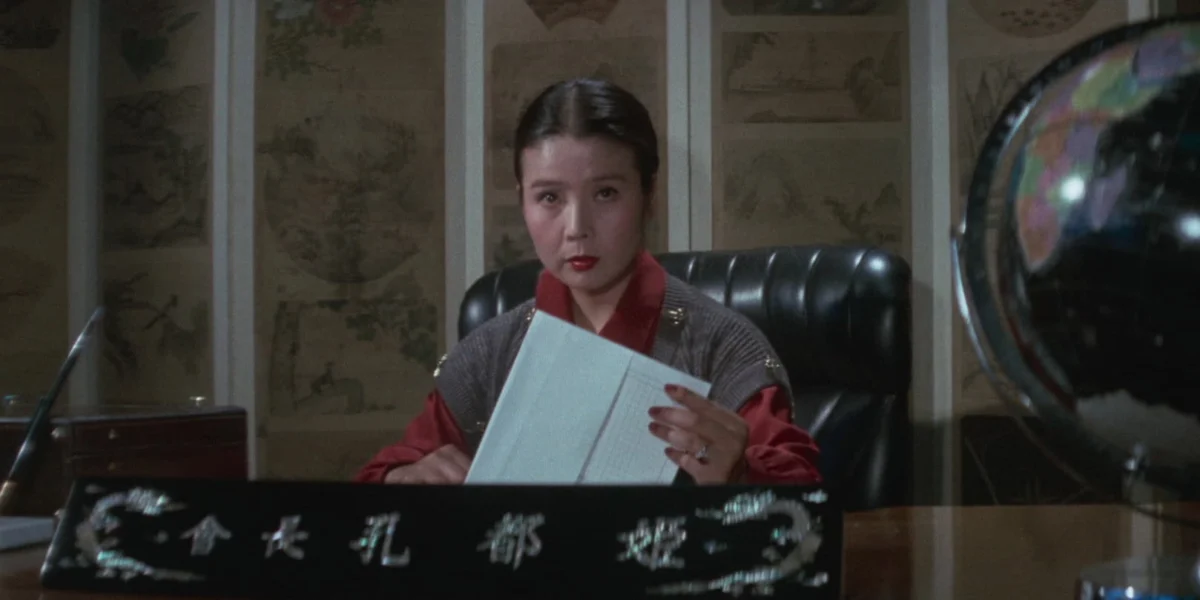
The narrative of "Splendid Outing" immediately plunges the viewer into a world of disquiet and psychological distress. The film introduces Gong Do-hee, portrayed with compelling intensity by Yoon Jeong-hee, as a successful executive businesswoman. Despite her apparent professional achievements and financial stability, she is depicted as overworked, burdened by the pressures of a capitalist, male-dominated urban environment, and haunted by recurrent dreams of her deceased twin sister. Her outward success, framed initially as a symbol of burgeoning feminism in a rapidly developing nation, ultimately proves to be a superficial shield against deeper anxieties and alienation. She has fulfilled the stringent societal expectations placed upon her within the demanding urban landscape, climbing the corporate hierarchy, yet remains profoundly unfulfilled, isolated, and tormented by her past.
The catalyst for her ordeal occurs when she embarks on a drive to the seaside, only to be unexpectedly kidnapped. Her abduction marks a dramatic shift, transporting her from the oppressive but familiar urban corporate world to an equally, if not more, insidious rural prison: an isolated island. Here, she is brutally forced to live with a brutish fisherman who insists she is his runaway wife and the mother of his daughter, a young girl afflicted with polio. Stripped of her identity, autonomy, and familiar surroundings, Gong Do-hee is left with no choice but to navigate these bewildering and terrifying circumstances while desperately searching for an opportunity to escape.
The Protagonist’s Ordeal: Identity, Alienation, and Patriarchy
Kim Soo-yong meticulously establishes the corporate environment of Seoul in the film’s opening as an overbearing and authoritative setting. Gong Do-hee’s success, while seemingly liberating, is presented as a gilded cage. The "weight of success and status in capitalist reality" is depicted as ultimately obsolete in providing true fulfillment, highlighting a critique of the unbridled pursuit of material wealth that characterized South Korea’s rapid industrialization under Park Chung-hee’s economic policies. Even as a "feminist symbol" in a society undergoing profound transformations, her professional achievements cannot shield her from the deeper psychological torment or the societal pressures that breed alienation. Her increasing estrangement from those around her in the city foreshadows the complete isolation she will experience on the island.
The island, in stark contrast to the bustling city, represents a different, more primal form of oppression. Here, Gong Do-hee is entirely stripped of her personal autonomy; her alienation morphs into enforced isolation. This remote setting, surrounded by the vast and indifferent ocean, functions as a social prison. She is reduced to an object, treated not as a person but as property, expected to conform to the traditional roles of wife and mother without question. The psychological torture is compounded by repeated instances of gaslighting from her "husband," portrayed chillingly by Lee Dae-geun, and the other islanders. They relentlessly attempt to convince her that she is mentally unstable and that her true identity is the one they project onto her. This systematic deconstruction of her identity forces her into a constant battle to maintain her sense of self against overwhelming psychological assault. In this hostile environment, only her "daughter," the polio-stricken girl, treats her with a semblance of individual recognition, offering a fragile thread of human connection. The film thus masterfully portrays how both modern urban capitalism and traditional patriarchal structures can be equally suffocating for the individual, particularly for women challenging established norms.
Visual Language and Sonic Landscapes
"Splendid Outing" is not only a narrative triumph but also a visual and auditory marvel, a testament to its modernist aspirations. Il-seong Jeon’s cinematography is central to the film’s "beautiful and unsettling visual identity." He makes marvelous use of color, creating a dreamlike, almost surreal atmosphere that amplifies the psychological tension. The exceptional camerawork plays a crucial role in contrasting the two distinct environments. The modern cityscape of Seoul is presented as an image of accomplishment and progress, yet beneath its gleaming surface, Jeon’s lens reveals a deeper corruption and an underlying sense of unease. The city, despite its modernity, feels cold and impersonal.
Conversely, the island’s traditional, naturalistic environment is transformed into a "primal totalitarian space." The stark beauty of the natural surroundings—the ocean, the rugged landscape—belies the brutal human dynamics at play. Jeon’s camera captures the isolation and the claustrophobia of the island, turning the vastness of the sea into a boundary rather than a liberation. This visual duality underscores the film’s commentary: neither the advanced urban setting nor the traditional rural one offers genuine freedom or solace to the protagonist. The experience is further intensified by the "terrific sound design" and Seok-hie Kang’s "unsettling music score." The soundscape, likely featuring dissonant melodies, eerie silences, and magnified ambient noises, works in tandem with the visuals to plunge the audience into Gong Do-hee’s escalating psychological turmoil, creating an immersive and profoundly disturbing viewing experience.
Modernist Aesthetics as Resistance
The film’s aesthetic choices are deeply intertwined with its political and social commentary. The use of allegory and symbolism, rather than explicit critique, was a common strategy for filmmakers navigating the Yushin regime’s censorship. The "social prison" of the island can be interpreted as a microcosm of South Korea itself under authoritarian rule, where individuals were expected to conform to a prescribed identity and "honor tradition without question," often at the expense of personal freedom and truth. Gong Do-hee’s struggle against gaslighting and the systematic deconstruction of her identity resonates with the broader societal experience of living under a regime that manipulated information and sought to control individual thought.
Kim Soo-yong’s direction, characterized by its "nightmarish direction and atmosphere," elevates "Splendid Outing" beyond a mere genre piece. It becomes a sophisticated piece of cinematic social commentary, reflecting the "political corruption that defined the Fourth Republic of Korea." The film’s psychological depth, its exploration of identity crisis, and its critique of patriarchal power structures align perfectly with modernist sensibilities that prioritized subjective experience and challenged conventional narratives. By portraying a strong female protagonist who endures immense psychological and physical hardship yet continues to resist, the film subtly champions resilience and the struggle for individual autonomy in the face of overwhelming state and societal pressure.
Legacy and Enduring Influence
Decades after its initial release, "Splendid Outing" continues to be recognized as a seminal work in Korean cinema, largely due to its daring themes and masterful execution. Yoon Jeong-hee’s performance as Gong Do-hee is often cited as one of her career-defining roles. Her portrayal is "powerfully convincing," handling the complex material with "superb precision," showcasing a nuanced understanding of a woman navigating both psychological turmoil and deeply entrenched patriarchal systems. Her ability to convey vulnerability, defiance, and a tenacious grip on her sanity makes Gong Do-hee a profoundly sympathetic and memorable character. Lee Dae-geun, as the symbolic figure of tyrannical authority, the "husband," is equally impactful, delivering a performance that is both "terrifying" and "unpredictable," embodying the arbitrary and brutal nature of oppressive power.
The film’s influence extends to subsequent generations of filmmakers. Lee Chang-dong, an internationally acclaimed director known for his profound psychological dramas and incisive social commentary, has openly acknowledged his admiration for Kim Soo-yong’s work, including "Splendid Outing." Themes explored in the film—such as the vulnerability of individuals against societal forces, the search for identity, and the lingering scars of trauma—find echoes in Lee Chang-dong’s own oeuvre, notably in films like "Poetry," where Yoon Jeong-hee delivered her award-winning performance many years later. This intergenerational connection highlights "Splendid Outing"’s role as a foundational text within the lineage of serious, artistically ambitious Korean cinema.
Contemporary Reappraisal and Screenings
The enduring relevance of "Splendid Outing" is underscored by its inclusion in contemporary retrospectives like "Korean Cinema’s Celluloid Fever: The 1970s." Such screenings, courtesy of FLC and Subway Cinema, provide crucial opportunities for a new generation of critics and cinephiles to engage with films that were once constrained by historical circumstances. These re-evaluations often bring renewed critical attention to the subtleties of these works, revealing layers of meaning that might have been overlooked or intentionally obscured during their initial release. The ability to view "Splendid Outing" today, free from the immediate pressures of state censorship, allows for a more complete appreciation of its artistic courage and its profound insights into the human condition under duress.
The film serves as a vital historical document, offering a cinematic reflection of the political corruption and social anxieties that defined the Fourth Republic of Korea. Its narrative of a woman fighting for her identity against forces that seek to erase it becomes a powerful metaphor for the broader struggle for self-determination in a repressed society.
When all these elements—the masterful direction, the exceptional performances, the evocative cinematography and sound design, and the layered thematic content—are encapsulated, "Splendid Outing" emerges not just as a brilliant piece of cinematic social commentary, but as a testament to the resilience of artistic expression. It stands as a pivotal work in Korean cinema history, showcasing how profound artistic statements can emerge even from the most restrictive environments, leaving an indelible mark on the cultural landscape and inspiring dialogues that continue to resonate today. Its ability to transcend its immediate historical context and speak to universal struggles of identity, oppression, and liberation solidifies its status as a timeless classic.