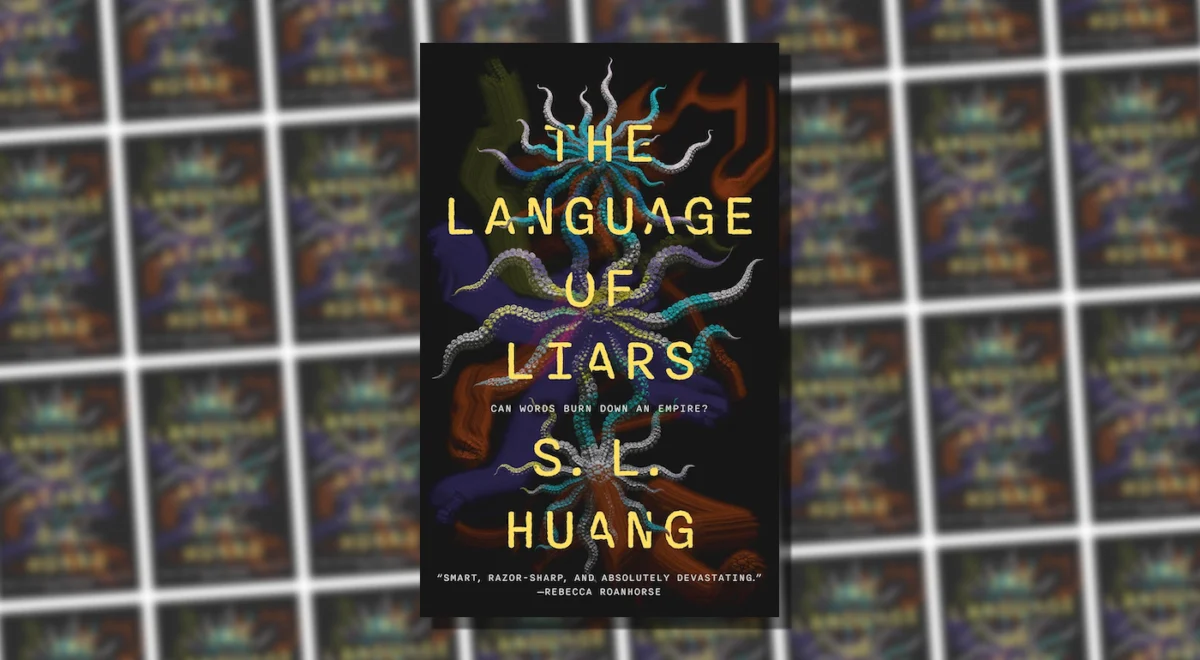
The recent novella, The Language of Liars by S.L. Huang, has ignited a complex dialogue within the science fiction community, not only for its intricate world-building and thematic depth but also for the critical examination of its narrative resolution. While lauded for its ambitious scope and compelling premise, the novella’s climax has prompted significant debate regarding its logical consistency and narrative plausibility, particularly concerning the foundational mechanics of its universe.
At its core, The Language of Liars introduces Ro, a member of the Ponto species, driven by an lifelong ambition to become a Senior Linguist. His ultimate aspiration, however, transcends his professional goals: he dreams of undertaking a consciousness transfer into the body of a Star Eater, the galaxy’s most enigmatic and ancient species. This desire is fueled by the potential to acquire invaluable knowledge for his home planet, Orro, despite acknowledging the profound ethical quandaries of displacing a sentient being from its own form, even temporarily. Ro’s Seniors, however, perceive him as too unfocused for such a monumental undertaking. Against these doubts, he achieves the "jump," a pivotal moment that propels him into the heart of the Star Eater existence.
Upon inhabiting a Star Eater body, Ro confronts stark realities previously concealed by his own species. He uncovers unsettling truths about the Ponto and the broader galactic community, truths that challenge the narrative he has been taught. Despite this revelation, Ro remains committed to his mission of gathering and transmitting information to Orro, all while grappling with the constant fear of discovery as an imposter. The Star Eater language, even to a gifted linguist like Ro, proves exceptionally alien and difficult to master. Furthermore, the Star Eaters themselves are characterized as aloof and singularly focused on their primary activity: the harvesting of meridian, the galaxy’s most coveted and vital resource. Ro, accustomed to the inherent warmth and amiability of the Ponto, finds the austere and reserved culture of the Star Eaters a significant challenge to acclimatize to.
A Universe Beyond Humanity
One of the most striking achievements of The Language of Liars is its deliberate construction of a truly alien galaxy. The narrative eschews human protagonists and even humanoids, presenting a "pure secondary world" where humanity, if it ever existed, is now extinct. This allows Huang to explore the embodied experience of non-human consciousness with remarkable success. While readers might initially envision Ro as akin to a terrestrial creature like a rabbit or an otter, Huang masterfully employs descriptive details that prevent easy anthropomorphism, reinforcing the fundamental otherness of her creations. This deliberate emphasis on their alien nature serves a higher thematic purpose: to highlight the universal "person-ness" that transcends species, background, or biological form.
Linguistics as the Key to World-Building
Huang ingeniously leverages Ro’s expertise in linguistics as a primary vehicle for world-building. Through his observations of the Star Eater language, and by extension, the languages of other species encountered or referenced, readers gain insights into numerous worlds, planets, and their inhabitants. The nuances of slang, the anomalous use of pronouns, and peculiar vowel placements all serve as windows into diverse galactic cultures. This approach imbues the world with a palpable sense of depth and authenticity, making it feel remarkably "stress-testable" – capable of withstanding scrutiny and revealing a solid, well-constructed foundation beneath its surface. This level of detailed world-building is particularly impressive for a novella, a format that often necessitates narrative brevity. The recent flourishing of the novella form within science fiction and fantasy over the past decade has clearly provided a fertile ground for such ambitious storytelling.
Unveiling Backstory Through Excerpts
Huang also employs a clever narrative device to convey the historical context and current status of the Star Eaters within the galactic conglomerate. Each chapter commences with a quote, excerpt, or transcript that directly relates to the Star Eaters. This technique, which could easily become a clunky exposition dump, is handled with remarkable deftness. Transcripts of debates on Star Eater gender, for instance, hint at broader galactic conversations concerning their societal roles and rights. Similarly, commentary from a purported political analyst reveals the underlying currents of xenophobia and acquisitiveness that fester beneath the veneer of galactic civilization. These fragments, woven seamlessly into the narrative, provide crucial background without disrupting the flow of Ro’s personal journey.
The Weight of Expectation
Despite a history of admiration for S.L. Huang’s previous works, particularly the Cas Russell series, and a strong anticipation for The Language of Liars due to its thematic focus on linguistics and "atrocities"—two elements the reviewer highly values in science fiction—a surprising disconnect emerged. The novella, which was confidently predicted to be a top-five favorite of the year, ultimately failed to fully resonate, leading to a re-evaluation of the reviewer’s own expectations and capacity for joy in literature. This personal reflection underscores the subjective nature of critical reception, even when grounded in a deep appreciation for an author’s prior contributions.
Spoiler Warning: The Galactic Deception
A detailed discussion of the novella’s central twist necessitates a clear spoiler warning. The revelation is fundamental to understanding the narrative’s thematic resonance and the critical points of contention that have arisen.
The Big Reveal:
At the conclusion of The Language of Liars, it is disclosed that there are no longer any living Star Eaters. The Ponto, and indeed numerous other species across the galaxy, have been systematically undertaking consciousness transfers into Star Eater bodies for decades. These invaders utilize the Star Eaters’ forms to harvest meridian and then divert a portion of these resources for their own planets’ benefit. This prolonged, collective deception has, over time, led to the complete displacement of the original Star Eater population. Each individual Star Eater body, it is revealed, has been occupied by an individual from another species, each driven by a perceived need to secure essential resources for their home world, and each justifying their actions as a one-time transgression against Star Eater personhood for the greater good of their own species.

Thematic Resonance vs. Narrative Plausibility
The thematic implications of this reveal are undeniably powerful. It functions as a profound allegory for how seemingly small, individual choices, made by well-intentioned individuals, can, in aggregate, result in a colossal and unrecoverable atrocity. The novella masterfully explores the erosion of ethical boundaries when collective survival is perceived to be at stake. However, the very richness and detail of the world-building, which Huang so expertly crafts, paradoxically creates a conflict with the narrative’s resolution. The reviewer, conditioned by the book’s meticulously constructed reality, found the mechanics of the reveal to be lacking in the specificity and plausibility required to fully support its thematic weight.
Unanswered Questions and Narrative Gaps
Several critical questions arise from the novella’s central twist, primarily concerning the operational mechanics of this galaxy-wide deception.
The Mechanism of Transfer
The novella provides a rudimentary explanation for the Ponto’s ability to "jump" into Star Eater bodies, framing it as a core element of their society. However, the question of how this process is replicated across "oodles and oodles of very different species all across the galaxy" remains largely unanswered. The narrative offers little in the way of a universal or even a diverse set of transfer mechanisms that would explain such widespread adoption. A more detailed explanation of the underlying science or psionic principles would have strengthened this crucial aspect of the plot.
Demographic and Biological Anomalies
Furthermore, the narrative implies a consistently perfect demographic balance: each Star Eater body is occupied by a single invader, and these invaders generally live out the lifespan of the occupied body. The reviewer questions whether this mathematical precision has always held true. Has there never been an instance where an invading individual lived out their natural lifespan and died, leaving a Star Eater body vacant and thus potentially revealing the deception? The sustained, flawless execution of this galactic-scale operation across potentially vast timescales and diverse species strains credulity without further substantiation.
The Silence of the Scholars
Perhaps the most significant point of contention lies in the perceived lack of inter-species communication and discovery among the researchers involved. Even assuming a consistent transfer mechanism and demographic stability, the novella does not adequately address how such a widespread phenomenon could remain hidden from a galactic community that clearly engages in shared scholarship and inter-planetary communication.
If Star Eater scholarship is indeed shared across species and planetary boundaries—a fact implied by Ro’s own reliance on non-Ponto researchers—then every frontline researcher would have been compelled to fabricate or conceal the true origin of their Star Eater informants. This scenario necessitates a universal, decades-long conspiracy of silence among a vast network of academics and scientists. The reviewer posits that this level of sustained secrecy is highly improbable, asserting that "nerds talk." The casual exchange of information, the formation of friendships, and the inevitable inter-academic gossip would likely have exposed such a massive deception long before Ro’s investigation. The notion that Ro is the first Star Eater occupant to foster genuine connections and thus pave the way for the truth to surface also appears statistically unlikely given the purported scale of the operation.
The Human Element of Cruelty and Connection
The reviewer acknowledges humanity’s capacity for profound atrocity, even when cloaked in justifications of progress, protection, or scholarship. However, the central argument against the novella’s conclusion is the implausibility of sustained, planet-wide, and species-wide silence. The inherent human drive for connection, for sharing discoveries, for gossiping, and for forming bonds is presented as an insurmountable obstacle to such a complete and enduring deception. The novella’s thematic exploration of cruelty, while potent, is undermined by the omission of the equally potent human drives for connection and communication. The reviewer states, "I cannot stare into the bleak and stony heart of human cruelty while pretending that the squishy and endearing and aggravating parts don’t also exist."
A Bold Endeavor in a Growing Field
Despite these critical reservations regarding narrative coherence, The Language of Liars remains a testament to the ambitious and thought-provoking work being produced within the Tordotcom novella line. Huang’s novella is lauded for its dizzying scope and moral complexity. While the narrative’s resolution may not have fully landed for every reader, the willingness of writers like Huang to tackle such vast and challenging themes in the current media landscape, where content is often driven by algorithmic satisfaction, is cause for significant celebration. The pursuit of ambitious narratives, even those that ultimately falter in their execution, is crucial for the continued evolution and richness of the science fiction genre. The novella, as a form, has proven itself capable of housing these expansive ideas, and The Language of Liars stands as a compelling, if debated, example of this potential.