The film, directed by Zachary Wigon and written by Virginia Feito, represents a significant expansion of the psychological horror genre, blending the rigid social structures of the mid-19th century with the visceral, internalised violence often associated with modern slasher cinema. Set in 1858, the narrative follows Winifred Notty, portrayed by Maika Monroe, an unconventional governess who arrives at the isolated Ensor House. Tasked with the education and refinement of the household’s children, Winifred must navigate the complexities of Victorian etiquette while suppressing a burgeoning psychopathic identity. As the domestic staff begins to vanish under mysterious circumstances, the veneer of propriety within the estate begins to erode, leading to a confrontation between societal expectations and primal, violent impulses.
Narrative Overview and Character Dynamics
The plot of Victorian Psycho is anchored in the arrival of Winifred Notty at the gothic manor of Ensor House. Her primary responsibilities involve teaching the children, Drusilla (Evie Templeton) and Andrew (Jacobi Jupe), the nuances of table manners and family history. However, the film quickly establishes that Winifred is an unreliable narrator of her own life. The story is punctuated by her internal monologues, wherein she addresses her darker impulses as a personified entity named "Fred." This psychological schism serves as the central engine of the film, as Winifred attempts to reconcile her desire for social acceptance with her inherent bloodlust.
The household is rounded out by a cast of characters who represent the various strata of Victorian society. Mr. and Mrs. Pounds, played by Jason Isaacs and Ruth Wilson, embody the eccentricities and casual cruelties of the landed gentry. Their interactions with Winifred are marked by a blend of condescension and obliviousness, which serves to exacerbate her sense of alienation. Meanwhile, the family maid, Miss Lamb (Thomasin McKenzie), acts as a foil to Winifred, representing the vulnerability of the working class within the estate’s walls. The disappearance of staff members serves as the primary external conflict, forcing the owners to eventually question the true nature of their new employee.
Production Background and Source Material
Victorian Psycho is an adaptation of the novel of the same name by Virginia Feito. Feito, who also penned the screenplay, has gained a reputation in the literary world for her ability to depict psychological instability and social satire. Her debut novel, Mrs. March, received critical acclaim for its exploration of a woman’s descent into paranoia, and Victorian Psycho continues this thematic trajectory by placing a psychopathic protagonist in a historical setting where female agency was severely restricted.
The collaboration between Feito and director Zachary Wigon marks a continuation of Wigon’s interest in power dynamics and psychological tension. Wigon’s previous work, Sanctuary (2022), was a two-hander that explored the intricate relationship between a dominatrix and her client. In Victorian Psycho, Wigon shifts his focus to a larger ensemble and a broader historical canvas, yet maintains the same precision in exploring how individuals exert control over one another in confined spaces. The production utilised authentic historical locations and period-accurate costume design to ground the film’s more surreal and violent elements in a tangible reality.
Chronology of Development and Release
The development of the film followed the rapid success of Feito’s literary career. After the publication of her first novel, several production companies expressed interest in her subsequent work. The film rights for Victorian Psycho were secured early in the novel’s life cycle, with Zachary Wigon attached to direct shortly thereafter. Casting was finalised in late 2023 and early 2024, bringing together a mix of established veterans like Jason Isaacs and Ruth Wilson with rising stars such as Maika Monroe and Thomasin McKenzie.
Principal photography took place in various locations designed to evoke the oppressive atmosphere of 1850s England. The film’s 90-minute runtime suggests a lean, focused narrative that prioritises character interiority over sprawling subplots. Following its completion, the film entered the festival circuit, where it was positioned as a genre-bending entry that appeals to both horror enthusiasts and fans of period dramas.
The "Good for Her" Subgenre and Cultural Context
Industry analysts have categorised Victorian Psycho as a prominent entry in the "Good for Her" cinematic universe. This informal subgenre typically features female protagonists who, after enduring systemic oppression or personal trauma, resort to extreme or violent measures to reclaim their agency. Films such as Midsommar, The Witch, and Pearl are often cited as benchmarks for this trend.
In Victorian Psycho, the protagonist’s violence is not merely a reaction to external threats but an intrinsic part of her identity that she uses to navigate a world that would otherwise render her invisible. The film satirises the Victorian era’s obsession with "feminine virtue" and domestic order by placing a killer at the heart of the home. By doing so, it addresses contemporary conversations regarding female rage and the ways in which historical narratives have often sanitised the lived experiences of women who did not conform to societal norms.
Technical Execution and Aesthetic Language
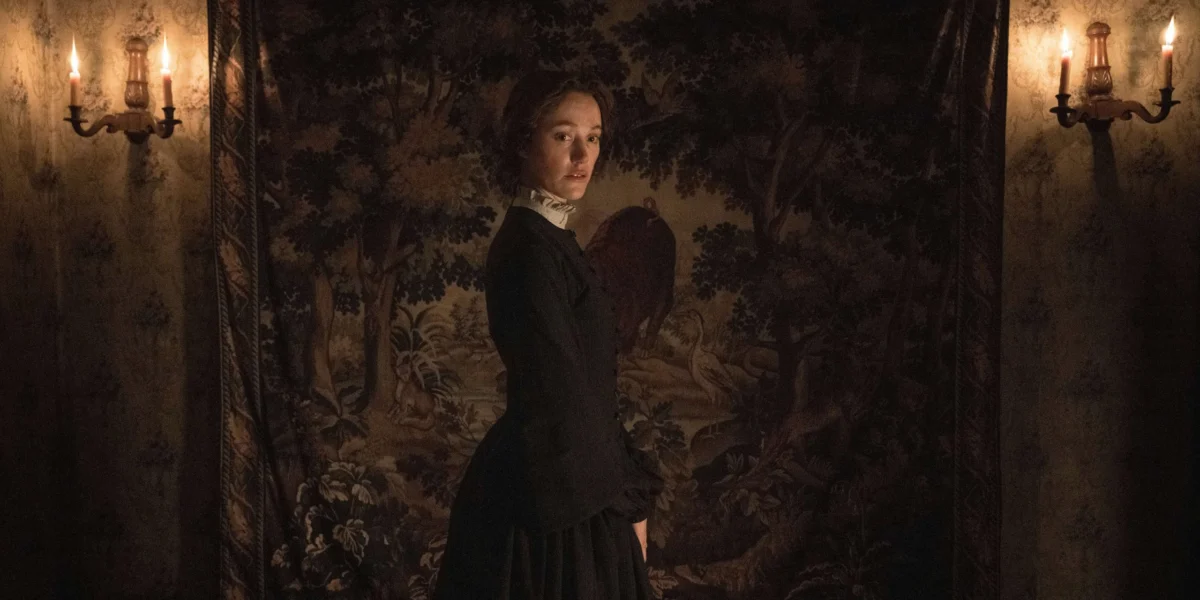
The visual language of the film, crafted by cinematographer Nico Aguilar, balances the traditional aesthetics of gothic horror with avant-garde flourishes. The use of candlelight and shadow within Ensor House pays homage to classic films like The Innocents (1961), creating an atmosphere of perpetual unease. However, the film departs from traditional period piece aesthetics during scenes of violence or psychological distress.
One notable technical choice is the use of abstract and hallucinatory framing to represent Winifred’s fractured psyche. This includes unconventional point-of-view shots—such as a sequence filmed from the perspective of a severed ear—that force the audience into an uncomfortable intimacy with the protagonist’s actions. The score, composed by Ariel Marx, complements this visual style. Marx, who previously collaborated with Wigon on Sanctuary, employs a lyrical and haunting soundscape that fluctuates between Victorian elegance and dissonant, modern textures.
Performance Analysis: Monroe and the Ensemble
Maika Monroe’s performance as Winifred Notty has been highlighted as a transformative turn for the actress. Known for her roles in "elevated horror" films like It Follows and Watcher, Monroe brings a disciplined intensity to the role of the governess. Her portrayal involves a complex layering of masks: the dutiful servant, the intellectual mentor, and the hidden predator. Observers have noted that her performance incorporates a "deliberately spotty" English accent, a choice that suggests her character may be performing a class identity to which she does not naturally belong.
The supporting cast provides the necessary friction for Monroe’s character to react against. Jason Isaacs and Ruth Wilson are tasked with portraying the absurdity of the upper class, delivering lines that highlight the disconnect between their character’s perceived morality and their actual behavior. The child actors, Jacobi Jupe and Evie Templeton, are integral to the film’s emotional stakes, representing the innocent (or perhaps not-so-innocent) lives caught in Winifred’s orbit.
Broader Implications and Industry Impact
The release of Victorian Psycho reflects a broader trend in the film industry toward "genre-hybridization," where the tropes of historical drama are infused with the sensibilities of modern horror and dark comedy. This approach allows filmmakers to critique historical periods through a contemporary lens, making the themes of class struggle and gendered power dynamics more accessible to modern audiences.
From a commercial perspective, the film benefits from a 90-minute runtime, which aligns with current audience preferences for tighter, more impactful storytelling in the streaming and independent cinema age. While some critics have pointed out that the film’s final act occasionally succumbs to the repetitive nature of the slasher genre, the overall consensus points toward the film being a successful experiment in tonal balance.
The implications of the film extend to the future of its creative team. For Virginia Feito, it solidifies her position as a dual-threat writer capable of translating complex psychological prose into compelling screenplays. For Zachary Wigon, it confirms his ability to handle larger-scale productions without losing the intimate, character-driven focus that defined his earlier work. As the film reaches wider distribution, it is expected to spark further discussion on the limits of empathy for "villainous" female protagonists and the enduring appeal of the gothic horror tradition in the 21st century.