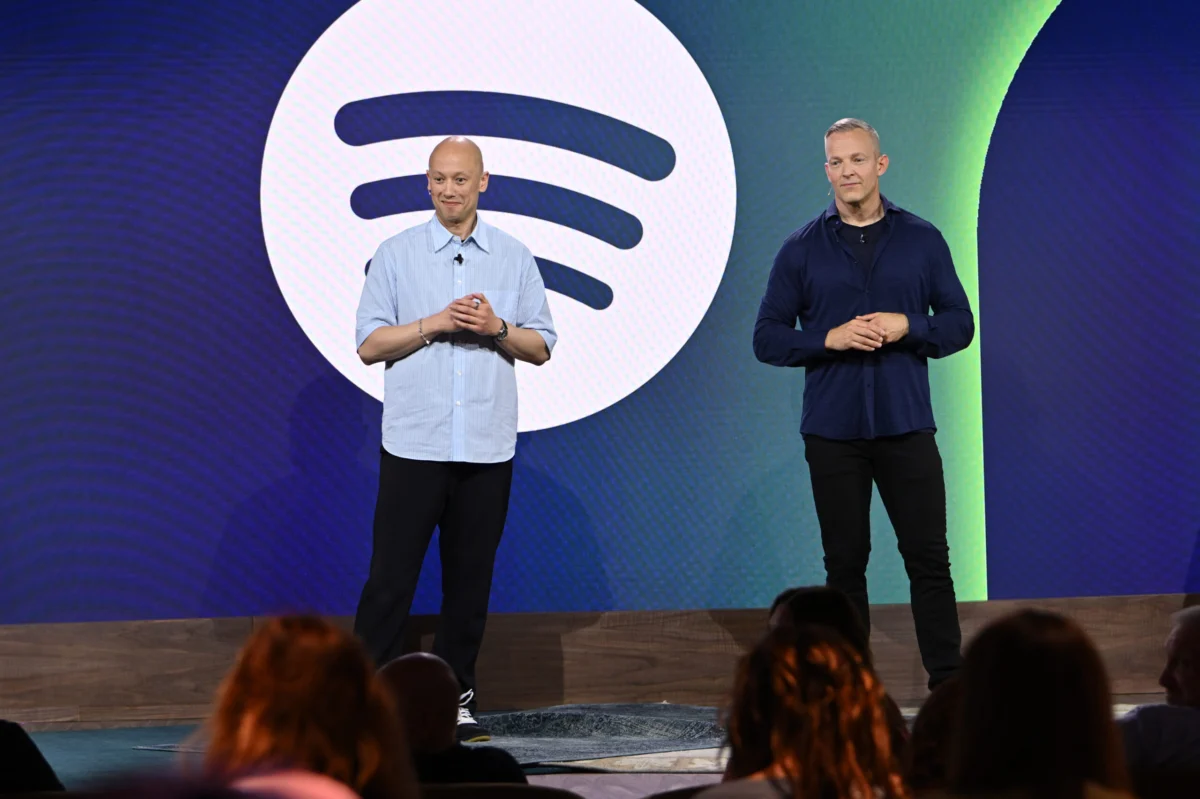
Spotify Technology S.A. utilized its 2026 Investor Day in New York City to signal a fundamental shift in its business model, moving beyond its roots as a music streaming service to become a "generative" media platform. During the presentation, executives outlined an ambitious roadmap to reach one billion monthly active users (MAUs) by 2030, supported by a target of $100 billion in annual revenue. The cornerstone of this strategy is the aggressive integration of generative artificial intelligence (AI), which the company believes will redefine how audio content is created, consumed, and monetized. By moving from a model of curation to one of creation, Spotify aims to capture a larger share of the global entertainment market while significantly improving its profit margins through operational efficiencies and diversified subscription tiers.
The Evolution of the Spotify Platform: From Access to Generation
The centerpiece of the Investor Day presentation, led by co-CEO Gustav Söderström, was the conceptual evolution of the Spotify user experience. Söderström categorized the company’s history into three distinct eras. The first was the "Access" era, where the primary value proposition was providing users with a comprehensive library of the world’s music. The second was the "Personalization" era, defined by algorithmic curation and features like "Discover Weekly," which transformed the platform from a directory into a personalized concierge.
The company is now entering what Söderström calls the "Era of Generation." In this new phase, content is no longer merely selected from a pre-existing catalog; it is generated in real-time based on user intent, taste, and environmental context. Söderström argued that while the industry has perfected the media player for static content, there is currently no dominant "media player for the generative era." Spotify’s objective is to fill this void, allowing users to interact with AI tools to create bespoke audio experiences that did not exist moments prior. This shift is intended to increase user "stickiness," as the platform becomes a tool for creation rather than just a utility for playback.
AI-Powered Product Innovations and the Generative Toolkit
To realize this vision of a generative platform, Spotify unveiled several new features designed to leverage large language models and synthetic media technologies. Among the most prominent announcements was the introduction of AI-generated personalized podcasts. This feature allows the platform to synthesize audio content tailored to an individual’s specific interests, pulling from various data sources to create a "private" podcast feed.
In addition to synthesized speech, Spotify is leaning into the burgeoning market for user-generated content (UGC). The company announced upcoming features that will allow users to create AI-powered covers and remixes of existing songs. This initiative, developed in part through ongoing discussions with major labels such as Universal Music Group, seeks to formalize and monetize the trend of "fan-made" remixes that have historically lived in a legal gray area on platforms like TikTok and YouTube. By providing these tools within the Spotify ecosystem, the company hopes to keep users engaged on its platform while ensuring that rights holders receive a share of the resulting revenue.

The company also expanded its "AI DJ" concept with a new desktop application. This tool is designed to act as a productivity assistant, capable of scanning a user’s emails, calendars, and schedules to generate a personalized daily audio briefing. Whether it is a summary of the day’s meetings or a curated news podcast based on the user’s professional interests, the feature aims to integrate Spotify more deeply into the user’s daily workflow. These products join the existing suite of AI tools, including "Prompted Playlists," which allow users to generate music selections based on complex natural language descriptions.
Financial Performance and Growth Projections
CFO Christian Luiga provided a detailed breakdown of Spotify’s financial trajectory, emphasizing that the path to $100 billion in revenue is paved with diversified income streams. As of the latest reporting period, Spotify boasts 761 million global monthly active users, a significant increase that puts the company on track for its 2030 goal. Of these users, 293 million are paying subscribers. The company reported annual revenue of approximately $18.5 billion for 2025, suggesting that a nearly five-fold increase is required over the next five years to meet its ambitious targets.
A critical component of this growth will be the expansion into emerging markets. Spotify executives highlighted Brazil, India, and the Philippines as primary engines for future user acquisition. These regions represent high-growth potential due to increasing smartphone penetration and a rising middle class with a growing appetite for digital subscriptions. To capture these markets, Spotify plans to use AI to localize content more rapidly, translating podcasts and music metadata into local dialects and creating region-specific AI personalities to guide the user experience.
The Transformation of Podcasting and Audiobooks
The podcasting segment, which was once a drag on Spotify’s profitability, has shown remarkable signs of recovery. CFO Luiga noted that the gross margin for podcasting was "deeply negative" in 2021 but has climbed to 20 percent in 2026. The company now sees a clear path to a 40 percent gross margin in this category. This improvement is attributed to a shift in strategy from high-cost exclusive content deals to a more balanced approach involving both first-party production and third-party distribution via the Spotify for Podcasters platform.
Simultaneously, Spotify’s foray into audiobooks is yielding immediate financial results. The company announced that its Audiobooks+ subscription tier is on track to reach $100 million in annualized recurring revenue (ARR) by July 2026. Under the current model, Premium subscribers receive 15 hours of audiobook content per month, with the Audiobooks+ add-on providing an additional 15 hours. Within less than a year of launch, over one million users have converted to paid audiobook services. To further capitalize on this momentum, Spotify announced the creation of additional tiered offerings, allowing heavy listeners to purchase more hours at higher price points.
Strategic Diversification and New Verticals
Beyond audio, Spotify is exploring new verticals to maximize the time users spend on the platform. The company recently integrated fitness content through a partnership with Peloton, allowing users to stream workout videos directly within the Spotify app. Executives stated that they believe fitness has the potential to become a "meaningful vertical" in its own right, signaling that Spotify is no longer content being just an audio company.

This diversification is part of a broader "add-on" strategy. By offering specialized tiers for fitness, audiobooks, and high-fidelity audio, Spotify aims to increase the average revenue per user (ARPU) without relying solely on broad price hikes for its base Premium service. However, the company noted that recent price increases have seen minimal "churn," or subscriber cancellations, suggesting a high level of brand loyalty and price inelasticity among its core user base.
Operational Efficiency Through AI Integration
While the public-facing AI tools are designed for user engagement, Spotify is also utilizing AI internally to streamline its operations. The company has moved away from a strategy of scaling through increased headcount, focusing instead on "scaling by increasing the impact of the people we already have." This involves using AI to automate routine coding tasks in research and development, as well as using machine learning to optimize marketing spend.
For the upcoming second and third quarters, Spotify plans to increase its investment in marketing and R&D to support its new generative features. CFO Luiga indicated that while the company maintains a "build-first" strategy, it remains open to mergers and acquisitions (M&A) that could accelerate its technological capabilities in the AI space.
Implications and Market Context
Spotify’s pivot toward a generative AI model reflects a broader trend in the tech industry where platforms are evolving from passive distributors to active creators. By empowering users to remix music and generate their own podcasts, Spotify is positioning itself to compete with social media giants like TikTok, which have successfully captured the attention of younger demographics through UGC.
However, the shift is not without risks. The use of AI to generate covers and remixes raises complex questions regarding intellectual property and royalty distribution. While Spotify is working with major labels to navigate these issues, the potential for friction with artists who may be wary of AI-generated versions of their work remains high. Furthermore, the goal of $100 billion in revenue will require Spotify to successfully monetize its non-music verticals at a scale it has yet to demonstrate.
Despite these challenges, the mood at the 2026 Investor Day was one of confidence. Executives emphasized that the company’s focus on "engagement" as a primary metric—tracking how often users return and how many devices they use—is the most reliable indicator of long-term success. As Spotify continues to integrate AI into every facet of its platform, it is betting that the "generative era" will provide the necessary momentum to reach its billion-user milestone and transform the landscape of global media once again.