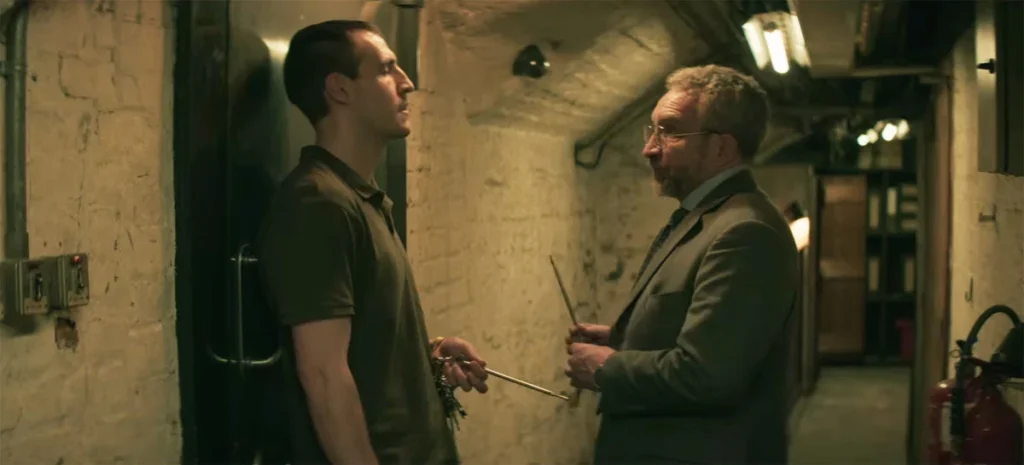
Netflix has officially unveiled the first trailer for Little Brother, a high-concept comedy slated for a global streaming release on June 26, 2026. Directed by Matt Spicer, the filmmaker recognized for his sharp social commentary in Ingrid Goes West and his work on the series Angelyne, the film marks a significant collaboration between two of the industry’s most distinct comedic forces: John Cena and Eric Andre. The trailer provides a comprehensive look at the film’s premise, which centers on the volatile reunion of two brothers whose life paths have diverged into polar opposites. As the centerpiece of Netflix’s early summer comedy slate, Little Brother aims to blend high-stakes physical humor with a grounded exploration of family reconciliation.
Narrative Overview and Character Dynamics
The plot of Little Brother revolves around Rudd, portrayed by John Cena, a man who has meticulously constructed a life of professional stability and social prestige. Rudd operates as a high-end real estate agent, a career defined by curated appearances, negotiation skills, and the maintenance of a "perfect" domestic image. His world is anchored by his wife, played by Michelle Monaghan, and a lifestyle that emphasizes order and control. However, this carefully balanced existence is thrown into disarray when his estranged "little brother," Marcus (Eric Andre), unexpectedly returns to his life.
Marcus is introduced as a literal and metaphorical "agent of chaos." Unlike Rudd’s structured environment, Marcus’s life appears to be governed by eccentricity and a lack of social filters. The conflict of the film stems from Marcus’s intrusion into Rudd’s professional and personal circles, leading to a series of escalating disasters that threaten Rudd’s reputation and career. The trailer highlights several comedic set pieces, including disrupted real estate showings and high-tension family dinners, which serve to stress-test the brothers’ relationship. The central thematic question posed by the film—"What happened to the guy I married who said the only thing that matters is family?"—suggests that beneath the slapstick humor lies a narrative regarding the sacrifices made for professional success and the enduring, if often frustrating, bonds of kinship.
Creative Team and Production Background
The film is directed by Matt Spicer, whose previous work, Ingrid Goes West (2017), earned critical acclaim for its satirical take on social media culture and obsessive behavior. Spicer’s transition to a broader, studio-style comedy with Little Brother indicates an evolution in his directorial scope, moving from indie-skewing satire to a more populist, high-energy format. The screenplay was penned by the writing duo Jarrad Paul and Andrew Mogel, who are well-versed in the "uncomfortable comedy" subgenre, having previously collaborated on projects like The D (2015) and the television series The Grinder.

The production is supported by a robust team of industry veterans. David Bernad produced the film under the Middle Child Pictures banner, alongside Ruben Fleischer, the director known for Zombieland and Uncharted. The involvement of Bernad and Fleischer suggests a production value that balances character-driven moments with the kinetic energy required for modern action-comedies. Netflix’s acquisition and promotion of the project underscore the platform’s ongoing strategy to secure star-driven, mid-budget comedies that have historically performed well with global audiences during the summer months.
An Ensemble of Comedic Talent
While the primary draw of Little Brother is the pairing of Cena and Andre, the film features an extensive supporting cast comprised of seasoned comedic and dramatic actors. Michelle Monaghan plays a pivotal role as Rudd’s wife, serving as the emotional anchor and the voice of reason amidst the escalating sibling rivalry. Christopher Meloni, known for his versatile roles in both Law & Order: Special Victims Unit and the absurdist comedy Happy!, appears in a role that promises to leverage his unique brand of intensity.
The ensemble is further bolstered by Sherry Cola (Joy Ride), Ego Nwodim (Saturday Night Live), and Caleb Hearon, representing a blend of established stars and rising comedic voices. The cast also includes Ben Ahlers, Bryce Gheisar, and Pilot Bunch. This diverse assembly of talent suggests that the film will utilize a variety of comedic styles, from Nwodim’s character-driven humor to the physical comedy traditionally associated with Cena’s filmography.
The Evolution of the Leads: Cena and Andre
The pairing of John Cena and Eric Andre is a study in comedic contrast. John Cena has spent the last decade successfully transitioning from a professional wrestling icon to a top-tier Hollywood leading man. His comedic timing was first widely recognized in Trainwreck (2015) and has since been refined in projects like Blockers and the HBO Max series Peacemaker. Cena’s ability to play the "straight man" while simultaneously engaging in self-deprecating physical humor has made him a staple of the modern comedy landscape. In Little Brother, his role as Rudd allows him to play against his imposing physique by portraying a character driven by anxiety and a need for social validation.
Conversely, Eric Andre is synonymous with avant-garde, surrealist humor. As the creator and host of The Eric Andre Show, he has built a career on unpredictability and the subversion of traditional talk-show formats. His film roles, such as in Bad Trip (2021), have demonstrated his ability to translate this chaotic energy into a narrative structure. In Little Brother, Andre’s Marcus serves as the perfect foil to Cena’s Rudd. The chemistry between the two—premised on the friction between order and disorder—is the primary engine of the film’s humor.

Production Timeline and Release Strategy
The development of Little Brother followed a standard production cycle for a major streaming original. Principal photography took place throughout late 2025, with post-production concluding in early 2026 to meet the June release window. The trailer release on May 20, 2026, marks the beginning of a month-long intensive marketing campaign by Netflix, utilizing digital platforms and social media to capitalize on the stars’ significant online followings.
Netflix’s decision to release the film on June 26 is a calculated move to capture the peak of the summer viewing season. Traditionally, late June is a competitive period for theatrical releases; however, streaming platforms have found success by offering high-profile alternatives to cinema blockbusters. By positioning Little Brother as a "must-watch" comedy, Netflix aims to drive engagement and subscription retention during a period when home viewership typically surges.
Industry Analysis: The State of the Streaming Comedy
The release of Little Brother reflects broader trends within the entertainment industry, specifically the migration of mid-budget comedies from theatrical distribution to streaming services. Over the past several years, traditional studios have pivoted toward "tentpole" franchises, leaving a vacuum in the market for original comedies. Netflix has aggressively filled this gap, investing in projects that rely on star power and high-concept premises to attract viewers.
Data from previous years suggests that comedies featuring established stars often dominate the "Top 10" lists on streaming platforms. For instance, films like Red Notice and Murder Mystery showcased the platform’s ability to turn star-studded features into massive viewership wins. Little Brother follows this blueprint by pairing a globally recognized action-comedy star (Cena) with a cult-favorite comedian (Andre), thereby appealing to multiple demographic segments.
Furthermore, the involvement of a director like Matt Spicer indicates a desire for these films to maintain a level of stylistic sophistication. While the trailer emphasizes the "zany" and "dumb" elements of the humor, Spicer’s track record suggests a narrative that may offer more depth regarding the psychological toll of maintaining a "perfect" image in a modern, hyper-competitive society.

Anticipated Impact and Implications
As the June 26 release date approaches, industry analysts will be watching Little Brother to gauge the continued viability of the "odd couple" comedy trope. The film’s success will likely be measured not just by raw viewership numbers, but by its ability to generate "viral" moments—a task for which Eric Andre is particularly well-suited.
The film also serves as a benchmark for the careers of its leads. For Cena, it is another opportunity to prove his range as a leading man capable of carrying a character-driven narrative. For Andre, it represents a step toward more mainstream narrative filmmaking while retaining his signature edge. For Netflix, it is a crucial component of their 2026 content strategy, aimed at maintaining their dominance in the competitive streaming landscape.
In conclusion, Little Brother arrives as a highly anticipated entry in the 2026 summer movie season. With a proven creative team, a star-studded cast, and a premise that promises both laughter and a degree of emotional resonance, the film is positioned to be a significant cultural touchstone for the streaming audience this June. The trailer has set the stage for a confrontation between order and chaos, leaving viewers to wonder if Rudd’s life will survive the return of his "little brother."