The recent rekindling of interest in Ursula K. Le Guin’s expansive literary universe, particularly her seminal Earthsea series, has prompted a deeper examination of her impact across various artistic mediums. While a definitive anime adaptation of her work has yet to fully capture the nuanced spirit of her storytelling, the landscape of anime offers compelling parallels, thematically, emotionally, and narratively, to Le Guin’s profound explorations of identity, society, and the human condition. This exploration delves into specific anime series and films that, in their own distinct ways, resonate with the philosophical depth and imaginative power characteristic of Le Guin’s writing.
Ursula K. Le Guin (1929-2018) was a towering figure in speculative fiction, renowned for her intellectual rigor, lyrical prose, and fearless deconstruction of societal norms. Her works, often categorized as science fiction and fantasy, transcended genre boundaries, offering incisive commentary on issues such as gender, power, anarchism, and environmentalism. Her influence is particularly pronounced in her ability to weave complex philosophical ideas into richly imagined worlds, creating narratives that are both intellectually stimulating and deeply moving.
Le Guin’s literary journey began in the mid-20th century, a period marked by significant social and political upheaval. Her early works, like The Left Hand of Darkness (1969), published while the author was still in her late thirties, challenged prevailing notions of gender and sexuality with a sophistication that prefigured later discussions. The novel, set on the ambisexual planet of Gethen, presented a society where individuals shifted between biological sexes, forcing readers to confront deeply ingrained assumptions about human identity. Similarly, The Dispossessed (1974) offered a nuanced portrayal of an anarchist society, exploring the complexities and challenges of creating a truly equitable world.

Despite the critical acclaim and profound impact of her novels, the transition of Le Guin’s work to visual media has been a complex endeavor. The sole anime adaptation of her Earthsea series, Tales from Earthsea (2006), directed by Goro Miyazaki, the son of Studio Ghibli co-founder Hayao Miyazaki, is widely considered to have fallen short of expectations. While visually stunning, a hallmark of Studio Ghibli productions, the film reportedly made significant deviations from the source material. These changes, while perhaps intended to appeal to a broader anime audience, alienated devoted fans of Le Guin’s original narrative. The condensed plot and altered character arcs contributed to a story that felt convoluted to some, and lacking the subtle philosophical underpinnings that define Le Guin’s writing. This divergence highlights the inherent difficulty in translating the introspective and philosophical nature of Le Guin’s narratives into a medium often characterized by faster pacing and more overt action.
However, the absence of a perfect adaptation does not diminish the potential for Le Guin’s thematic concerns to find resonance within the vast tapestry of anime. Many series and films, crafted by visionary directors and storytellers, grapple with similar questions of identity, societal structures, morality, and the profound consequences of human actions. These works, while not direct adaptations, serve as powerful echoes of Le Guin’s enduring literary spirit.
For Fans of Earthsea: Vinland Saga
For readers captivated by the profound character journeys and intricate world-building of Ursula K. Le Guin’s Earthsea cycle, the historical epic Vinland Saga presents a compelling thematic resonance. While not a fantasy in the traditional sense, Vinland Saga, based on the manga by Makoto Yukimura, offers a meticulously researched and deeply philosophical exploration of its setting, the Viking Age. The series, which began publication in 2005 and has seen two critically acclaimed anime adaptations by Wit Studio and MAPPA, delves into the life of Thorfinn Karlsefni, a young Icelandic warrior.
Similar to Le Guin’s protagonist, Ged, who grapples with the shadow of his own making, Thorfinn is a character haunted by trauma and driven by a relentless pursuit of vengeance. The brutal murder of his father at the hands of the mercenary leader Askeladd shapes Thorfinn’s youth, transforming him into a formidable, yet deeply troubled, warrior. His journey involves a complex relationship with Askeladd, a figure he initially despises but eventually comes to admire, blurring the lines between enemy and surrogate father. This intricate character development, mirroring Ged’s internal struggles with his power and its consequences, provides a rich emotional landscape.

Yukimura’s world-building in Vinland Saga is as meticulously crafted as Le Guin’s archipelago of Earthsea. The series eschews simplistic portrayals of Vikings, instead offering a nuanced look at their culture, their beliefs, and the harsh realities of their existence. The narrative, which spans decades and explores themes of pacifism, the futility of violence, and the search for a peaceful land, offers a sprawling epic that can fill a similar void for Le Guin enthusiasts seeking profound character arcs and expansive, thoughtfully constructed worlds. The sheer scope of the narrative, taking Yukimura over two decades to complete, mirrors the enduring nature of Le Guin’s own creative output.
For Fans of The Dispossessed: Terra E (Toward the Terra)
Ursula K. Le Guin’s The Dispossessed (1974), a novel that garnered significant critical attention for its exploration of utopian ideals and the complexities of societal organization, finds a striking parallel in the 2007 anime film Toward the Terra. Based on the award-winning manga by Keiko Takemiya, which first appeared in 1977, Toward the Terra is a science fiction narrative that, much like Le Guin’s work, feels remarkably prescient. Set in the 31st century, the story depicts a future Earth governed by an artificial intelligence known as Superior Dominance, which meticulously controls every aspect of human life, from genetic traits to parental assignments and adolescent mind-wipes.
The narrative follows a faction of humanity that develops psychic abilities and flees Earth to establish colonies among the stars, yearning for their ancestral home. The story unfolds across various timelines, but centers on two young men, Soldier Shin and Soldier Blue. This dynamic echoes the ideological clash presented in The Dispossessed, where characters navigate the tensions between an authoritarian regime and a nascent anarchist society. The anime, like Le Guin’s novel, questions the very definition of utopia, revealing its inherent ambiguities and the compromises often required to maintain societal order.
Keiko Takemiya, a pioneer of the "Year 24 Group" of female mangaka who redefined the shoujo genre in the 1970s, also brought a feminist perspective to her work that resonates with Le Guin’s own engagement with gender and societal roles. Takemiya is particularly noted for her contributions to shounen-ai manga, and is credited with creating one of the first depictions of a gay kiss in manga. Her celebrated work, Kaze to Ki no Uta, is an iconic tragedy about young love in a French boarding school. The relationships depicted in Toward the Terra, particularly between Shin and Blue, are often interpreted as queer-coded, even within the more sanitized storytelling conventions of the era in which the manga was originally written. This nuanced portrayal suggests a deliberate subversion of norms, a quiet statement of queer existence ahead of its mainstream acceptance, a characteristic that aligns with Le Guin’s own groundbreaking approach to representing diverse identities.

For Fans of The Word for World Is Forest: Land of the Lustrous
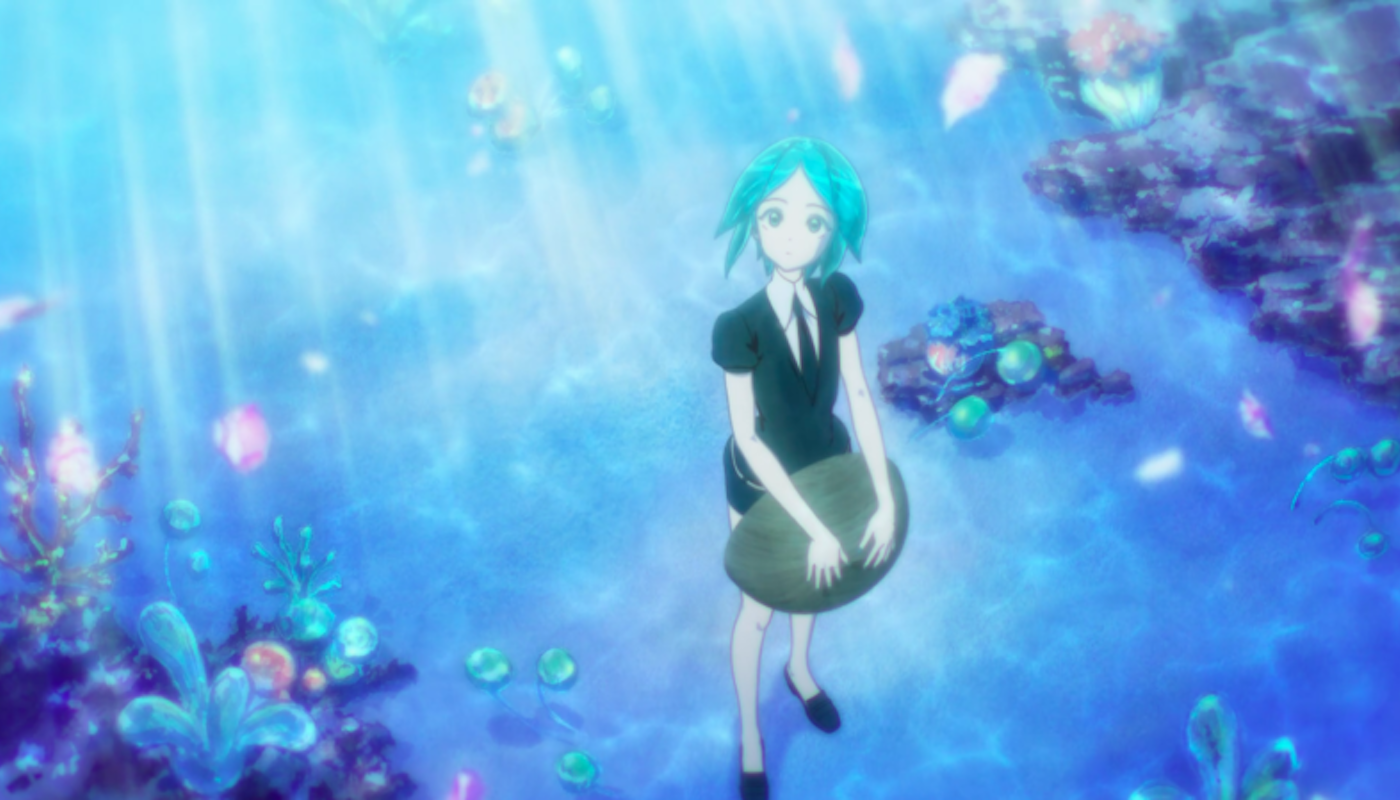
Le Guin’s powerful novella The Word for World Is Forest (1972), a furious response to the Vietnam War and a stark depiction of colonial exploitation, explores themes of oppression and the struggle for survival. While Land of the Lustrous (2017), an anime series produced by Orange, is a visually distinct work, it grapples with similar issues of identity, conflict, and the consequences of exploitation. The series features a race of gem-like beings, the Lustrous, who exist in humanoid forms and defend their world from the Lunarians, entities who seek to harvest them for their crystalline bodies.
The series’ exploration of gender is particularly noteworthy. The Lustrous are explicitly described as agender and nonbinary. However, the anime’s production choices, including the casting of exclusively female voice actors and the character designs that lean towards conventionally feminine aesthetics (slim torsos, long eyelashes), have led to discussions about the representation of these nonbinary characters. While the intention may have been to explore androgyny, some viewers and critics felt that the execution inadvertently reinforced gendered stereotypes. This complexity mirrors the debate surrounding The Word for World Is Forest, a work undeniably powerful in its anti-colonial message but perhaps less subtle in its thematic execution compared to Le Guin’s other works like The Left Hand of Darkness.
Despite these production-related critiques, Land of the Lustrous resonates with the core themes of survival against overwhelming odds and the inherent tragedy of conflict, much like Le Guin’s depiction of the Athsheans’ plight. The narrative’s focus on the commodification of beings for their intrinsic qualities and the resulting existential threat echoes the exploitation of the Athsheans for their planet’s resources. The story’s enduring relevance, much like The Word for World Is Forest, underscores the unfortunate, persistent reality of colonization and violence in the world.
For Fans of The Lathe of Heaven: Paprika
Ursula K. Le Guin’s The Lathe of Heaven (1971) presents a mind-bending premise: a man whose dreams have the power to alter reality. This concept of permeable boundaries between dreams and reality, and the philosophical implications thereof, finds a vibrant and surreal echo in Satoshi Kon’s critically acclaimed 2006 anime film, Paprika. The film follows Atsuko Chiba, a psychotherapist who develops a revolutionary device, the "DC Mini," allowing her to enter patients’ dreams. When the device is stolen, a "dream terrorist" begins to unleash chaotic nightmares into the waking world, blurring the lines between the subconscious and objective reality.

While Le Guin uses her premise primarily as a vehicle for exploring philosophical themes of Taoism, morality, and the nature of reality, Kon’s Paprika is deeply rooted in the anxieties of the early 21st century, particularly the burgeoning influence of the internet and its potential to warp perception. The film’s visual language is a dazzling display of surreal imagery, whimsical characters, and unsettling juxtapositions, reflecting the chaotic and often illogical nature of dreams. The narrative functions as a thrilling exploration of the consequences when the fabric of reality itself becomes malleable, a sentiment that resonates with the dread and philosophical inquiry present in The Lathe of Heaven. Both works, despite their different approaches—Le Guin’s as a philosophical thought experiment, Kon’s as a surreal thriller—compel viewers to ponder the nature of consciousness and the fragility of existence.
For Fans of The Left Hand of Darkness: Kaiba
Ursula K. Le Guin’s The Left Hand of Darkness is a singular achievement, a novel that profoundly interrogates what it means to be human and the role of physicality in identity. The story of Genly Ai’s journey on the ambisexual planet of Gethen and his complex relationship with Estraven is a masterclass in exploring alienation, understanding, and the creation of self through interaction with the "other." Masaaki Yuasa’s 2008 anime series, Kaiba, while stylistically very different, shares a thematic kinship with Le Guin’s exploration of identity, memory, and embodiment.
Kaiba is an avant-garde science fiction work that presents a universe where memories can be stored as data on chips and minds can be transferred between bodies. The protagonist, a nameless, amnesiac young man with a literal hole in his chest, wakes up in this bizarre world and embarks on a journey to reclaim his memories. He is propelled by the will of others who protect him, a stark contrast to his own initially absent agency. As he gradually regains his past, he becomes entangled in the societal divisions of this future, where the wealthy exploit memories and the poor struggle for viable bodies.
The series’ central questions about the essence of self—whether it resides in the mind, the body, or something more ephemeral—directly echo the inquiries posed in The Left Hand of Darkness. Just as Genly Ai grapples with the alienness of Gethen and its inhabitants, the protagonist of Kaiba, later named Warp, navigates a world where physical form is mutable and identity is fluid. Both narratives highlight the arduous work of understanding others to ultimately achieve self-understanding. The visual style of Kaiba, reminiscent of Osamu Tezuka’s pioneering work, further enhances its unique and thought-provoking artistic merit, making it a compelling choice for those who appreciate Le Guin’s intellectual depth and innovative storytelling.

The enduring appeal of Ursula K. Le Guin’s work lies in its timeless exploration of fundamental human questions. While the journey to a perfect anime adaptation may continue, the diverse and imaginative landscape of anime offers numerous avenues for audiences to connect with the spirit and thematic richness of her extraordinary literary universe. These series and films, in their own unique ways, serve as testaments to Le Guin’s lasting influence, proving that her visions continue to inspire and provoke thought across generations and artistic disciplines.