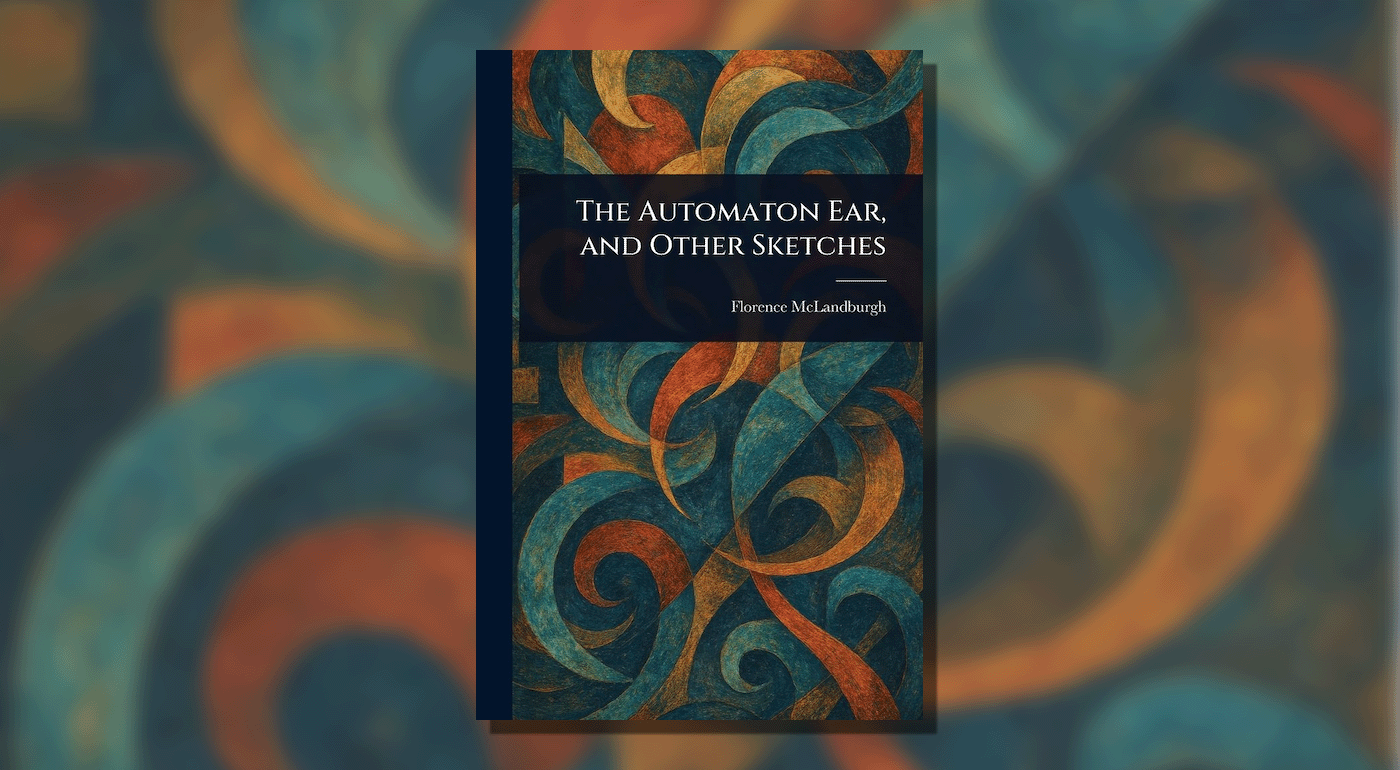
This week, Reading the Weird delves into Florence McLandburgh’s 1873 short story, "The Automaton Ear," a foundational piece in the "Acoustic Time Travel" subgenre. Published in Scribner’s Monthly, the narrative explores themes of scientific obsession, the nature of sound, and the potential for technology to transcend human sensory limitations, all while blurring the lines between genius and madness.
The Genesis of an Obsession: A Fateful Passage
The story centers on an unnamed professor, whom we will refer to as ProfX, a scholar at a college near London. One tranquil summer afternoon, seeking solace in the natural world, ProfX finds himself in a secluded woodland, reading a book. He is initially absorbed by the ambient sounds of nature – the "changeful voice of the forest and the river" – before a particular passage in his book arrests his attention.
The quoted passage, which forms the narrative’s inciting incident, posits a radical theory about the persistence of sound: "As a particle of the atmosphere is never lost, so sound is never lost. A strain of music or a simple tone will vibrate in the air forever and ever, decreasing according to a fixed ratio. The diffusion of the agitation extends in all directions, like the waves in a pool, but the ear is unable to detect it beyond a certain point. It is well known that some individuals can distinguish sounds which to others under precisely similar circumstances are wholly lost. Thus the fault is not in the sound itself, but in our organ of hearing, and a tone once in existence is always in existence."
While ProfX had encountered this idea before, on this particular day, its implications resonate with him profoundly. He begins to contemplate the possibility of creating instruments that could amplify these imperceptible, lingering sounds, thus overcoming the inherent limitations of human hearing. This thought germinates into an ambitious project: to build a device that could capture and reproduce sounds from the distant past.
The Pursuit of the Impossible: From Ear-Trumpets to Abandoned Churches
Driven by this singular vision, ProfX dedicates the remainder of his academic term and the ensuing vacation to his clandestine research. He immerses himself in the study of acoustics and the philosophy of sound, determined to "labor quietly until it was perfected," fearing ridicule from the wider scientific community. His initial foray into improving sound perception involves acquiring an ear-trumpet in London. He discovers that the instrument amplifies existing sounds, allowing him to detect more distant noises. However, his attempts to modify it to diminish sound prove unsuccessful, leading him to seek a more acoustically isolated laboratory.
His search leads him to an abandoned church tower, situated in a desolate graveyard, its four facing windows offering a panoramic, albeit eerie, vantage point. Gaining entry through a coal chute, he establishes his workspace, transferring his tools and books. Despite his efforts, significant breakthroughs elude him until he conceives of a radical new approach: utilizing only sound-transmitting metals for his instrument.
The first test of this new design results in a temporary paralysis of his hand, followed by an unsettling silence. A critical accident, the loss of the trumpet’s ivory ear-piece, leads to an accidental discovery. When the metal of the instrument is applied directly to his ear, he is overwhelmed by a cacophony of discordant sounds. He realizes that a truly functional instrument would amplify present sounds so intensely that they would drown out all others. This revelation, however, does not deter him; rather, it refines his objective: to control the amplification, discerning sounds from specific time periods.
A Symphony of the Past: Triumphs and Terrors
ProfX modifies his instrument, incorporating controls that allow him to adjust for temporal distance. He then bravely undertakes a second, more ambitious test, setting the controls to the furthest possible temporal reach. His success is immediate and astonishing. He witnesses, through sound, the exodus of the Israelites from Egypt and the catastrophic destruction of Pharaoh’s army. He hears Miriam’s jubilant song of freedom, the ethereal song of a nightingale long extinct, the echoes of centuries-old banquet conversations, and the celebrated performance of carillon virtuoso Mathias Vander Gheyn on July 1, 1745.
However, his auditory journey is not limited to grand historical events. He also overhears deeply personal moments: a dying writer discussing his completed manuscript with his mother. This access to the entire spectrum of auditory history, from the monumental to the intimate, becomes an all-consuming passion.
Achieving his lifelong goal, ProfX eschews any desire for public recognition, content to remain the sole guardian of his invention. A profound fascination grips him, accompanied by waves of paranoia. He resigns from his academic post and takes up residence near his laboratory, neglecting his health in his insatiable hunger to listen to the "Ear." The stark reality of his physical deterioration becomes apparent when, during a rare moment of introspection, he sees his wasted reflection in a mirror. The overheard comment from a student – "the professor ain’t just right in his head" – plants a seed of doubt: has his obsession eroded his sanity? Is the "Ear" merely a product of his delusion?
The Ultimate Test: Mother Flinse and the Crisis of Reality
Tormented by uncertainty, ProfX embarks on a desperate experiment to validate his creation. He lures an elderly, deaf-mute woman, known as Mother Flinse, to his abandoned church. His plan is to set the "Ear" to its full power in the present time. If this device can overcome her seventy years of silence, he will have irrefutable proof of its efficacy.
Upon placing the instrument to her ear, Mother Flinse undergoes a dramatic transformation. Her face contorts, then appears to radiate youthful beauty. For the first time in seven decades, she is enveloped by the "Spirit of Sound." ProfX experiences a moment of elation, which quickly turns to horror when she refuses to relinquish the device. In the ensuing struggle, he strangles her to death, disposes of her body in a churchyard tomb, and returns the "Ear" to its sanctuary, treating it with an almost living reverence.
Yet, when he attempts to listen again, he hears only the grating shrieks of Mother Flinse. Initially believing she is haunting him, he attempts to destroy the "Ear." A jarring sound, he realizes, is merely the frantic wing-beating of a beetle. This incident, paradoxically, alleviates his doubts. He sleeps peacefully, only to be confronted the next morning by the sight of Mother Flinse walking through the college gates. His frantic search of the tomb reveals it undisturbed, and his attempt to re-enter the church reveals the entrance securely nailed shut and cobweb-curtained.
The Aftermath: Monomania and the Question of Sanity
The encounter with the seemingly resurrected Mother Flinse shatters ProfX’s grip on reality. He experiences a fragmentation of his "substance in [his] brain," recognizing the "fetters of monomania" that have ensnared him since that fateful paragraph. He offers silent, intense praise to the "Great Creator" for preserving him from madness, his silent gratitude as profound as Miriam’s song by the sea.
Cyclopean Wonders and Degenerate Dutch
The narrative’s description of Miriam’s song, as perceived by ProfX, is imbued with awe: "Higher, sweeter, it seemed to break the fetters of mortality and tremble in sublime adoration before the Infinite." This passage evokes a sense of the sublime, a glimpse of the transcendent. Conversely, the story includes elements of what might be termed "Degenerate Dutch," referencing ProfX’s immediate identification of "the rich, uncultivated soprano of the Southern slave making strange wild melody." His unease also extends to the potential "adaptive uses" of his hearing aid, hinting at societal anxieties and prejudices of the era.
The Toll of Obsession
The story intricately explores the psychological toll of extreme obsession. The question of how one differentiates between reality and delusion becomes central. ProfX’s journey highlights that madness can manifest not only through hallucinations but also through the all-consuming nature of an obsessive pursuit, leading to profound isolation and a distorted perception of reality.
Historical and Scientific Contexts
The genesis of ProfX’s obsession can be traced to a specific passage that McLandburgh paraphrases from Charles Babbage’s "On the Permanent Impression of Our Words and Actions on the Globe We Inhabit," featured in the Ninth Bridgewater Treatise (1837). Babbage, a mathematician and inventor, theorized that sound waves, once created, persist indefinitely, their influence spreading like ripples in a pond. He metaphorically described the air as a "vast library" where all human utterances are perpetually recorded.
Another potential influence on McLandburgh’s story is the work of Hermann von Helmholtz, a German physician and physicist. His 1862 treatise, On the Sensations of Tone, delved into the mechanics of the human ear and its sensory thresholds – precisely the boundaries ProfX sought to overcome.
A persistent, though likely apocryphal, anecdote suggests Guglielmo Marconi entertained similar ideas. Greg Milner’s Perfecting Sound Forever: An Aural History of Recorded Music (2009) recounts the story of Marconi’s late-life conviction that "no sound ever dies. It just decays beyond the point that we can detect it with our ears." His ambition was reportedly to build a device capable of recovering such sounds, even to capture Christ’s Sermon on the Mount. This enduring myth underscores a universal human desire to leave an indelible mark and a yearning to access the entirety of our shared history.
Modern scientific understanding, however, posits that sound waves do not endure indefinitely. Their organized vibrations eventually dissipate into the random thermal motion of air molecules, rendering them irretrievable.
Critical Analysis: The Unreliable Narrator and Ambiguous Endings
From a critical perspective, "The Automaton Ear" is recognized as a seminal work in "Acoustic Time Travel." The interpretation of the ending often hinges on the protagonist’s potential descent into systematized delusions, a characteristic of bipolar disorder. The narrative’s climax, where the murdered Mother Flinse reappears, serves as the catalyst for ProfX’s perceived recovery. The sudden clarity that the tomb was undisturbed and the church entrance sealed suggests his entire experience of murder and disposal was a hallucination, a product of his fractured psyche.
This resolution, while intended to demonstrate ProfX’s escape from "black waves of insanity," has been critiqued for its abruptness. The abruptness of the reveal, despite the author’s attempts to foreshadow ProfX’s doubts about his sanity, can feel jarring. The story’s final line, comparing ProfX’s silent praise to Miriam’s song, leaves a lingering ambiguity. Is this comparison a genuine reflection of his healed state, or a subtle hint that he did, in fact, achieve a connection to eternal sound waves, even if the narrative framework suggests otherwise? This dual interpretation, while perhaps unsettling for some readers, adds a layer of complexity to the story’s conclusion.
The Broader Impact: Sound, Memory, and Technology
The story resonates with contemporary anxieties surrounding the mediation of experience through technology. Ruthanna points out the lineage from obsessive Victorian scientists to modern algorithmic horror. McLandburgh’s tale anticipates a world where technology grants access to an unprecedented archive of preserved sounds. The idea of having access to "the voices of the dead, the best symphonic orchestration, even recreations of neolithic music" readily available on demand, and the notion of this power being exclusive to one individual, presents a chilling prospect.
ProfX’s monomania, with its layers of invention, jealousy, and the desperate need for validation, speaks to the potential for even the most groundbreaking discoveries to lead to profound personal and societal disruption. The story suggests that the pursuit of an idealized past can devalue the present, and that the capacity to hear "everything" might paradoxically lead to an inability to truly appreciate anything. The ultimate question remains: even if the "Ear" was a delusion, the story masterfully captures the human yearning to transcend our ephemeral existence and connect with the echoes of time.