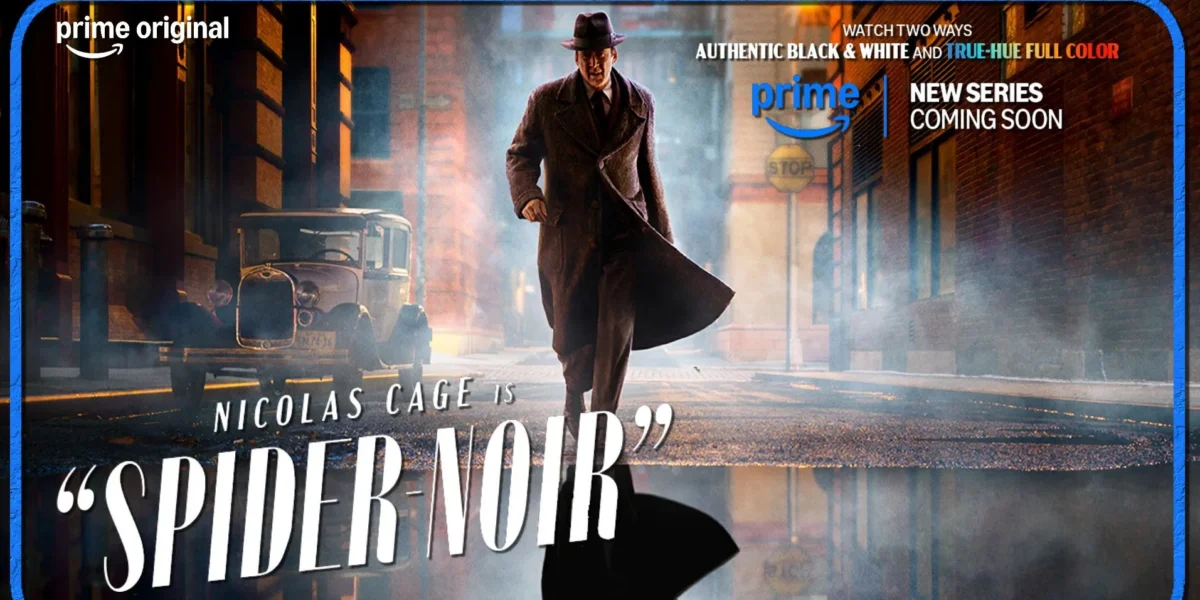
The transition of the Spider-Man Noir character from a breakout animated supporting role to a live-action headliner marks a significant pivot in the expansion of Sony’s Spider-Man Universe and its partnership with Amazon MGM Studios. Nicolas Cage reprises his role as the monochromatic web-slinger, though this iteration diverges from the "Spider-Verse" films by placing the actor directly in the frame as Ben Reilly. Set against the backdrop of a meticulously reconstructed 1930s New York City, the series serves as both a gritty detective procedural and a deconstruction of superhero mythology. The narrative follows an aging, disillusioned private investigator who is forced to confront his former identity as the city’s sole superhuman defender during the height of the Great Depression and the Prohibition era.
The Narrative Foundation and Character Reimagining
In this adaptation, the protagonist is Ben Reilly, identified here as "The Spider." Long after retiring from his role as New York’s protector following a deeply personal tragedy, Reilly has descended into the life of a stereotypical noir private eye. His existence is defined by a struggle to maintain his office and a reliance on alcohol to numb the memories of his past. This version of the character leans heavily into the "hard-boiled" archetype, presenting a hero whose physical and mental prime is behind him.
The central conflict is ignited by the arrival of Cat Hardy, played by Li Jun Li. While comic book aficionados will recognize the name as an alias for the Black Cat, this version reimagines her as a sophisticated lounge singer and classic femme fatale. She enlists Reilly’s services for a missing-person investigation that serves as the gateway into a sprawling web of municipal corruption. As the investigation deepens, it becomes clear that the disappearance is linked to Silvermane, portrayed by Brendan Gleeson. Gleeson’s Silvermane is a ruthless crime lord who has exploited the five-year absence of "The Spider" to consolidate power over the city’s criminal underworld, law enforcement, and political infrastructure.
The series explores the philosophical burden of heroism through a subversion of the classic Spider-Man mantra. Reilly’s outlook is summarized by his cynical observation: "With no power comes no responsibility." This thematic shift highlights the character’s internal struggle to find relevance in a world that has moved on from the idealism of his youth.
A Chronology of the Spider-Man Noir Property
The path to the "Spider-Noir" live-action series began over a decade ago, evolving through various media formats before reaching its current prestige television status:
- February 2009: Marvel Comics debuts Spider-Man Noir #1, created by David Hine and Fabrice Sapolsky with art by Carmine Di Giandomenico. The four-issue miniseries was part of the "Marvel Noir" line, reimagining iconic heroes in a 1930s pulp fiction setting.
- September 2010: The character gains wider recognition in the video game Spider-Man: Shattered Dimensions, where he is voiced by Christopher Daniel Barnes.
- December 2018: Nicolas Cage voices the character in the Academy Award-winning animated film Spider-Man: Into the Spider-Verse. The character’s popularity surges due to Cage’s unique vocal performance and the character’s stark visual contrast to other variants.
- February 2023: Sony Pictures Television and Amazon MGM Studios officially announce a live-action series based on the character, with Oren Uziel attached as writer and executive producer.
- May 2024: Production updates confirm Nicolas Cage will lead the series, marking his return to Marvel-related live-action for the first time since the Ghost Rider films.
- Late 2024: Filming commences under the direction of showrunners Oren Uziel and Steve Lightfoot, the latter of whom previously served as showrunner for Marvel’s The Punisher on Netflix.
Performance Analysis: The "Nirvana" of Nicolas Cage
Industry analysts have noted that "Spider-Noir" represents a culmination of Nicolas Cage’s career-long obsession with the Golden Age of Hollywood. Cage’s performance is a deliberate homage to screen legends such as Humphrey Bogart and James Cagney. He utilizes a non-rhotic, Mid-Atlantic-inflected New York accent typical of 1930s cinema, creating an auditory experience that anchors the show’s period setting.
However, the performance is not merely an imitation. Cage reportedly integrated influences from "Bugs Bunny" to provide a sense of manic energy beneath Reilly’s weathered exterior. This juxtaposition allows for a performance that oscillates between somber melancholy and theatrical exuberance. Critics have described this as a "performance nirvana" for the actor, where the genre’s tropes provide a structured playground for his signature "Western Kabuki" acting style.
The Supporting Ensemble and Casting Dynamics
The series is bolstered by a supporting cast that reflects the diversity and archetypes of 1930s New York. Lamorne Morris portrays Robbie Robertson, a dedicated reporter striving for journalistic integrity in a city dominated by propaganda and fear. Morris provides a grounded counterpoint to Reilly’s cynicism, representing the hope for civic reform.
Karen Rodriguez plays Janet Ruiz, a character who evolves beyond the traditional "secretary" role often found in noir fiction. Functioning as the emotional core of the series, Ruiz is depicted as the intellectual equal of the protagonist, frequently anticipating the moves of both Reilly and his adversaries. Her dynamic with Reilly draws comparisons to the relationship between Sam Spade and Effie Perine in The Maltese Falcon.

Brendan Gleeson’s portrayal of Silvermane provides the series with a formidable antagonist. Gleeson brings a sense of gravitational weight to the role, portraying a villain who is as much a businessman as he is a mobster. The cast is rounded out by Jack Huston and Abraham Popoola, who fill out the ranks of the city’s power brokers and enforcers.
Technical Craftsmanship and Visual Presentation
The production of "Spider-Noir" is defined by its commitment to the aesthetic of classic noir. Cinematographers Darran Tiernan and Peter Deming utilized lighting techniques that emphasize high contrast, shadows, and silhouettes—elements essential to the monochromatic storytelling of the 1930s and 40s.
A unique aspect of the series’ distribution is the dual viewing options provided to audiences. While the show was designed, lit, and composed for a black-and-white presentation, Amazon Prime Video also offers a version titled "True-Hue Full Color."
- Black-and-White Version: This is the intended artistic format. It masks the digital nature of modern visual effects and enhances the atmospheric tension of the period setting.
- True-Hue Full Color Version: This version is intended for viewers who prefer contemporary visual standards. While it allows for the appreciation of the detailed costume work and production design, some critics have noted that it makes certain CGI elements more apparent, occasionally detracting from the immersion.
The costume design and production design are highlighted as standout features, effectively recreating a Depression-era New York that feels lived-in and authentic rather than a sanitized Hollywood set.
Industry Implications and Broader Context
"Spider-Noir" arrives at a critical juncture for Sony’s Spider-Man Universe (SSU). Following the mixed reception of several live-action film spin-offs, this series represents a move toward high-budget, prestige television as a means of sustaining the brand. The collaboration between Sony and Amazon is part of a broader deal to develop multiple series based on the 900+ Marvel characters to which Sony holds the rights.
The show also benefits from the creative leadership of Steve Lightfoot. His experience with The Punisher is evident in the show’s more mature, violent, and grounded approach to superheroics. By distancing itself from the interconnected "multiverse" cameos that have characterized recent Marvel projects, "Spider-Noir" functions as a standalone character study, a move that may signal a shift in how studios approach superhero intellectual property.
Critical Assessment and Award Prospects
The series has debuted to generally positive reviews, currently holding a consensus score of approximately 7/10 among early reviewers. The primary praise is directed at Cage’s performance and the technical execution of the noir atmosphere. However, the writing has faced some scrutiny for its adherence to genre conventions, particularly in the latter half of the season. Some analysts suggest that the narrative’s predictability is a byproduct of its deep reverence for the films it seeks to emulate.
Despite these narrative hurdles, "Spider-Noir" is expected to be a strong contender in the technical categories for the upcoming television awards season. Specifically, industry insiders point toward "Outstanding Cinematography for a Series (One Hour)" and "Primetime Emmy Award for Outstanding Period Costumes" as likely categories for nomination. The series’ ability to balance the fantastical elements of a "Spider-Man" story with the grim reality of 1930s New York is cited as its most significant achievement.
As the series begins its rollout on Prime Video, it stands as a testament to the enduring appeal of the Spider-Man Noir variant and the unique screen presence of Nicolas Cage. Whether this "strange, stylish experiment" will lead to further seasons remains to be seen, but its impact on the landscape of superhero television is already being noted by fans and critics alike.