The return of veteran filmmaker Volker Schlöndorff to the international stage marks a significant moment for European cinema, particularly with the debut of his latest feature, Visitation. Based on the acclaimed novel Heimsuchung by Jenny Erpenbeck, the film serves as a sprawling multi-generational saga that utilizes a single plot of land by a Brandenburg lake to mirror the tumultuous trajectory of 20th-century German history. Schlöndorff, an Academy Award and Palme d’Or winner known for his seminal work The Tin Drum, brings a seasoned perspective to this narrative, which spans approximately 70 years of social, political, and physical transformation. The film explores the concept of "home" not merely as a physical structure, but as a site of recurring trauma, fleeting sanctuary, and the inevitable passage of time.
Narrative Structure and Historical Scope
Visitation operates as a chronological tapestry, beginning in the Weimar Republic and concluding shortly after the reunification of Germany. The narrative is anchored by a lakeside property that remains the silent protagonist of the film. Through its walls and the surrounding woods, the audience witnesses the rise of the Nazi regime, the devastation of World War II, the subsequent Soviet occupation, the establishment of the German Democratic Republic (GDR), and finally, the fall of the Berlin Wall.
The film opens with a foundational trauma involving a young girl named Klara, whose dowry and dignity are stripped away following a relationship with a local laborer. This "original sin" of the property sets a somber tone for the decades to follow. As the political landscape of Germany shifts, so too do the inhabitants of the house. Each era is marked by a specific family or individual whose presence is dictated by the prevailing ideologies of the time. From an architect seeking favor under Albert Speer’s architectural vision to a Jewish family forced to abandon their modest beach house as the Holocaust looms, the film meticulously documents how macro-political shifts dictate micro-personal tragedies.
The Linguistic and Symbolic Depth of the Title
The transition of the title from the German Heimsuchung to the English Visitation carries significant weight in understanding the film’s intent. In German, Heimsuchung is a complex term that can mean a "visitation" in a biblical or formal sense, but it also translates to "affliction," "plague," or "scourge." This duality is central to Schlöndorff’s interpretation. The house is not merely "visited" by its occupants; it is often "afflicted" by them, or they are afflicted by the history that precedes them.
In France, the film is titled Le Bois De Klara (Klara’s Woods), focusing on the initial character whose experience defines the land’s spiritual legacy. This variation in titling across regions highlights the film’s multifaceted nature: it is at once a historical document, a psychological drama, and a poetic meditation on the nature of possession and dispossession.
Production Background and the Einstein Connection
A notable element of the production is its filming location and the historical parallels it evokes. Reports indicate that the film was shot at or designed to evoke the former summer residence of Albert Einstein in Caputh, Brandenburg. The real-world history of that site—designed by the modernist architect Konrad Wachsmann and eventually seized by the Nazis—adds a layer of authenticity to the film’s exploration of property rights and exile.
The house in the film is portrayed as a living entity. Its construction, the modification of its gardens, and its eventual descent into disrepair when it ceases to be a "home" reflect the vitality and decay of the German state. Schlöndorff utilizes a highly poetic visual style, allowing the environment—the waving trees, the shifting light on the lake, and the sound of distant artillery—to communicate the passage of time more effectively than traditional dialogue.
Ensemble Performance and Character Archetypes
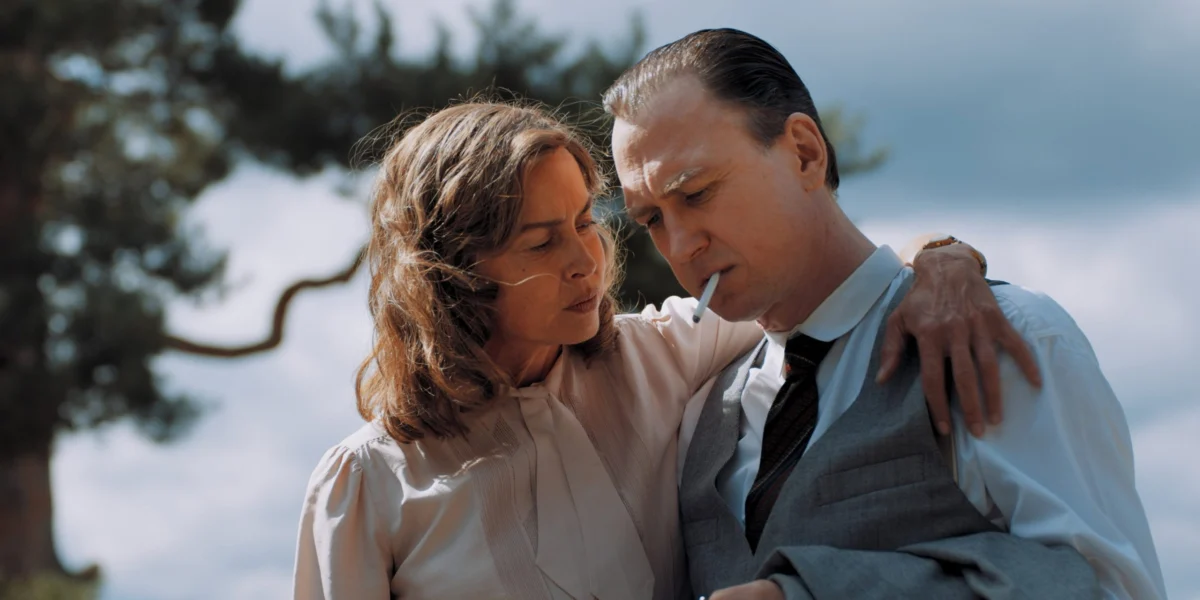
The film features a robust ensemble cast of German cinema stalwarts, including Lars Eidinger, Martina Gedeck, Ulrich Matthes, Michael Maertens, and Susanne Wolff. Rather than following a single protagonist, the audience is introduced to a revolving door of characters who represent different facets of the German experience.
Lars Eidinger and Martina Gedeck provide nuanced performances that bridge the gap between the personal and the political. Eidinger, known for his intensity, portrays the complexities of those who sought to navigate the bureaucratic and moral minefields of the mid-20th century. One of the most compelling recurring figures is a taciturn gardener, played with a sense of ageless permanence. This character serves as a witness to every transition, remaining tied to the land while the "owners" are displaced by war, ideology, or death. His presence suggests that while political regimes are transitory, the land and those who truly tend to it possess a different, more enduring kind of belonging.
Chronological Breakdown of Eras Depicted
To understand the scope of Visitation, one must examine the specific historical markers Schlöndorff highlights:
- The Weimar Era: The initial establishment of the estate during a period of fragile democracy and social liberation.
- The Third Reich: The "Aryanization" of property is depicted through the displacement of a Jewish family. The film captures the chilling normalcy of this process, as the family leaves behind mundane items like towels from their factory, unaware of the fate awaiting them in Poland.
- The Second World War: The setting becomes liminal, caught between the beauty of the lake and the distant sounds of Allied bombing. The physical structure begins to bear the scars of the conflict.
- The Soviet Advance: A pivotal and jarring sequence depicts the arrival of the Red Army. This transition marks the end of the old order and the beginning of a new, often brutal, occupation.
- The GDR and Socialist Reconstruction: The house is repurposed within the framework of the East German state. Here, the film explores themes of bureaucratic manipulation and the struggle to maintain a sense of individuality within a collective society.
- Reunification: The final act incorporates archival-style footage of the fall of the Berlin Wall. This era brings the narrative full circle, as questions of legal ownership and the return of descendants complicate the definition of "home."
Critical Analysis and Director’s Vision
At 87 years old, Volker Schlöndorff remains a vital voice in world cinema. While critics have noted that Visitation may not reach the visceral, revolutionary heights of The Tin Drum, it represents a more contemplative and mature phase of his career. The film is less concerned with shocking the audience and more focused on the subtle "visitations" of memory.
Schlöndorff’s decision to contextualize even the most reprehensible actions—such as those of an abusive father or a conquering soldier—has been a point of discussion. The film does not seek to excuse these actions but rather to provide a deeper insight into the circumstances that produce them. This approach avoids a nihilistic worldview, instead offering a complex look at human survival and the psychological toll of living through constant upheaval.
The incorporation of what appears to be personal or archival-style footage during the reunification scenes adds a layer of nostalgia. It suggests that for Schlöndorff, this is not just a fictional adaptation but a reflection on his own lived experience as a German who has witnessed these transformations firsthand.
Broader Implications for German Cinema
Visitation contributes to the ongoing German cinematic tradition of Vergangenheitsbewältigung—the process of struggling to come to terms with the past. By focusing on a single location, the film avoids the pitfalls of broader historical epics that can sometimes lose the human element in favor of spectacle.
The film’s focus on property rights—who owns the land, who loses it, and who returns to claim it—is particularly relevant in contemporary Europe, where issues of displacement and national identity remain at the forefront of political discourse. The "beach house" becomes a metaphor for the German soul: a place of beauty that has been repeatedly seized, remodeled, and haunted by the ghosts of those who were forced to leave.
Conclusion and Legacy
While Visitation may be viewed as a late-career "footnote" by some, its contribution to the auteur’s canon is substantial. It showcases a director who has retained his gift for eliciting powerful performances and his ability to weave complex historical narratives into a cohesive, poetic whole. The film serves as a reminder that history is not just found in textbooks but in the very soil and structures we inhabit.
As the credits roll on this 118-minute journey, the audience is left with the image of the lake—calm, indifferent, and enduring. The people who called the lakeside house "home" for a few years or a few decades are gone, but the "visitations" of their lives remain etched into the landscape. Schlöndorff has crafted a film that is fundamentally about the persistence of memory and the quiet, often painful, beauty of a land that has seen too much history.