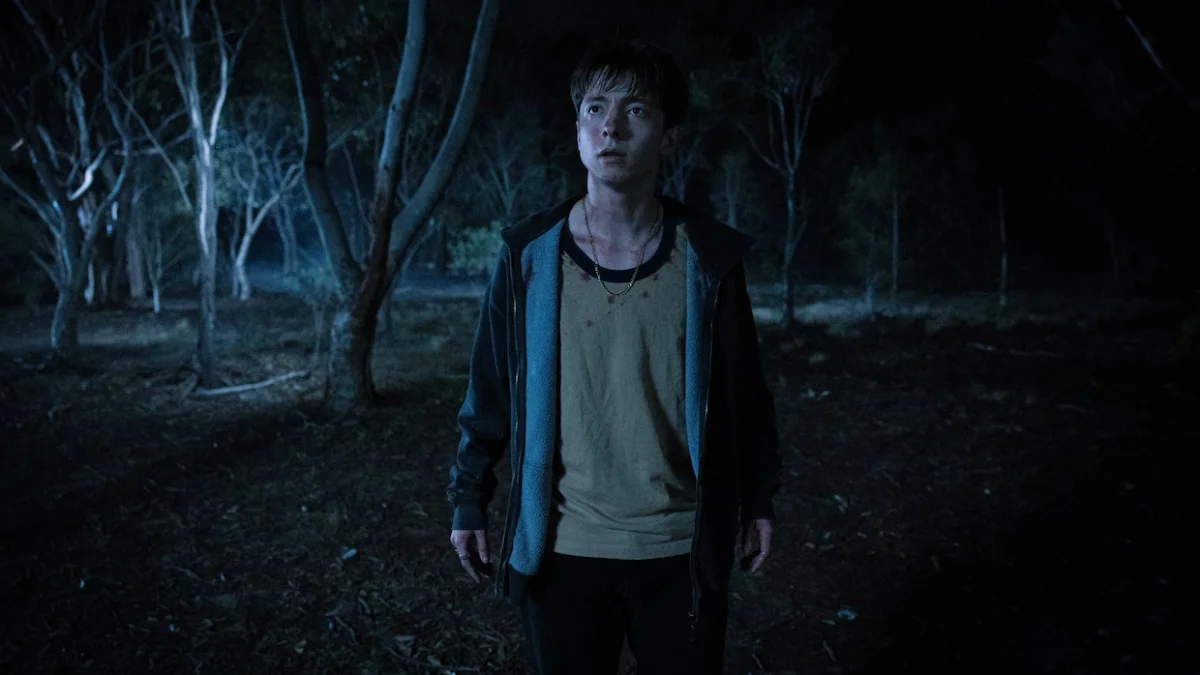
Adrian Chiarella’s debut feature, Leviticus (2026), immediately plunges audiences into an archetypal horror scenario: a "little death" preceding a profound one. The film’s chilling cold open depicts a lesbian lifeguard succumbing to an invisible, alluring presence in a poolside shower, an illicit moment of pleasure violently culminating in her murder. This sinister entity, which preys on its victims by appearing as their most fervent desire, is revealed to be the byproduct of a hex inflicted upon gay teenagers by their local church, ostensibly as a form of conversion therapy. This foundational concept offers a sophisticated reimagining of horror’s traditional association with teenage sexuality and death, rooted in the insidious dictum frequently employed to control queer youth: that their desires are inherently destructive.
The film’s central metaphor for homophobia — portrayed as an inescapable, pervasive force that distorts private yearning into public terror — serves as a potent instrument for identification, appealing for empathy in an increasingly polarized world. Chiarella’s creative impetus for Leviticus stems directly from a perceived surge in anti-LGBTQ+ bigotry, a regressive shift that threatens decades of progress toward the often-elusive goal of queer security and safety. This societal backdrop lends a stark urgency to the film’s narrative, elevating it beyond mere genre exercise to a poignant social commentary.
The Director’s Vision and Historical Context of Queer Horror
Chiarella articulated his motivation during recent discussions, stating, "I started thinking about what would be personal for me, and horror movies were something that I turned to as a young queer teenager. I don’t think I was alone in that. The genre has been important to the community for a very, very long time.” His reflections underscore a long-standing, often overlooked, relationship between the horror genre and the queer community. For many, horror films have historically provided a safe, albeit coded, space to explore themes of otherness, fear, identity, and societal anxieties that resonate deeply with queer experiences. The monstrous, the outcast, and the persecuted often mirror the lived realities of LGBTQ+ individuals confronting societal prejudice.
Chiarella reminisces fondly about the Nightmare on Elm Street series, specifically highlighting Freddy’s Revenge (1985). This installment is widely interpreted by critics and audiences alike as a potent allegory for life in the closet, with protagonist Jesse Walsh’s internal struggle against Freddy Krueger often read as a battle against his repressed homosexual desires. The film’s subtext, whether intentional or not, cemented its place as a significant touchstone in queer horror cinema, speaking to anxieties about self-acceptance and societal judgment.
He also cites John Carpenter’s The Thing (1982), noting its exploration of "the tension between the self and the other, not really knowing if you can trust the person in front of you." This theme of paranoia and internal invasion resonates profoundly with the experience of living as a queer person in a hostile environment, where one’s true self might be perceived as an alien threat, and trust can be a dangerous commodity. Chiarella’s childhood experience of being "always told not to watch those films, which only made me want to watch them more," speaks to the allure of forbidden narratives and the subversive power of horror to address taboo subjects. This forbidden nature often makes horror a natural ally for marginalized groups seeking stories that reflect their complex realities, free from the sanitization of mainstream media.
The Genesis of a Modern Parable: Conversion Therapy and its Scars
While these cinematic lodestars provide a convenient framework for Leviticus, the film’s narrative is deeply rooted in a very specific and painful contemporary reality. Spiritually and spatially, the film is confined to an isolated industrial town in the Australian boondocks, suffocated by a cult-like religious community. This setting immediately establishes an atmosphere of oppressive insularity, where societal norms are dictated by rigid, dogmatic interpretations of faith.
The narrative follows Naim (Joe Bird), a shy newcomer, as he develops a profound connection with his charismatic classmate, Ryan (Stacey Clausen). Their burgeoning romance, however, is not without its internal conflicts. A pivotal scene sees the bolder Ryan taunting Naim, asking, "Is there anything you’re not afraid of?" as he pins him to the floor of an abandoned building. This moment, intended to be a macho skirmish, culminates in a kiss. Yet, mid-lip-lock, Naim catches his own reflection and recoils, a visceral manifestation of the self-loathing and internalized homophobia that entraps the film’s queer characters. This fear of the self, often a direct consequence of societal and religious conditioning, becomes as formidable a foe as any supernatural entity.
The plot thickens with the arrival of Hunter (Jeremy Blewitt), the closeted son of the town’s preacher, who violently interrupts Naim and Ryan’s burgeoning intimacy. Naim, driven by jealousy and a misguided belief in a lesser punishment, betrays Ryan by revealing their relationship. He spends the remainder of the film grappling with the devastating consequences of his actions, a stark illustration of Chiarella’s observation that "Horror movies are always about someone committing a transgression, and whatever horrible thing that comes after is because of this." In Leviticus, the transgression is not just a sexual act but a breach of a community’s oppressive codes, and Naim’s betrayal inadvertently exacerbates the very isolation the hex seeks to impose.
The Isolation and Betrayal: A Reflection of Real-World Vulnerabilities
The "horrible thing that comes after" for the boys powerfully demonstrates the desperate, life-or-death need for queer camaraderie and solidarity. As victims of the hex, they are driven into further isolation. The monster’s nature — appearing only when one is alone, yet capable of replacing a lover when one’s back is turned — forces Ryan and Naim to separate, a cruel irony that underscores the film’s themes of trust and connection.
Their desperate search for answers leads them to the partner of the woman murdered in the opening scene, now haunting a local hospital. In a brutal twist on the "crazed recluse" trope, this woman must constantly surround herself with people to survive the entity, yet her ordeal has left her more alone than ever. This parallels the protagonists’ plight, wrapped in deceptive alliances and predatory affections. Hunter’s sister extends a deceptive olive branch, revealing her true, hostile nature. Even Naim’s mother (Mia Wasikowska) offers a brief, devastating gesture of care immediately followed by abject betrayal. Her chilling line, "We need fear," spoken to her terrified son, blurs the line between maternal protection and the insidious forces of oppression. Chiarella elaborates on this complex dynamic, stating, "I wanted to create a world where you weren’t sure you could trust even the real people around you anymore." This narrative choice reflects the real-world experiences of many LGBTQ+ youth who find themselves isolated and betrayed by the very people who should offer unconditional love and support.
The Devastating Reality of Conversion Therapy and Anti-LGBTQ+ Bigotry
The premise of Leviticus — a hex born from church-sanctioned conversion therapy — is chillingly grounded in reality. Conversion therapy, a pseudoscientific and harmful practice, aims to change an individual’s sexual orientation or gender identity. It has been widely condemned by major medical, psychological, and psychiatric organizations worldwide, including the American Medical Association, the American Psychological Association, and the World Psychiatric Association. These organizations consistently state that such practices are ineffective, unethical, and harmful, often leading to severe psychological distress, depression, anxiety, and even suicide.
In Australia, where the film is set, efforts to ban conversion therapy have gained momentum, but the practice persists in various forms, often within religious communities. States like Victoria and Queensland have enacted bans, while other jurisdictions continue to debate legislative action. Advocacy groups such as Equality Australia and Brave Network have been at the forefront of campaigning against these practices, highlighting the profound damage they inflict on vulnerable LGBTQ+ youth. Statistics from organizations like The Trevor Project consistently show that LGBTQ+ youth who have undergone conversion therapy report significantly higher rates of depression and suicide attempts. A 2020 study by The Trevor Project found that 10% of LGBTQ+ youth reported undergoing conversion therapy, with 78% reporting it occurred when they were under age 18. This data underscores the very real and pervasive threat that conversion therapy poses to the well-being of young queer individuals, making Leviticus‘s allegorical monster a powerful representation of a tangible societal evil.
Chiarella’s concern about a "backward slide in the past decades’ progress toward the ever elusive goal of queer security and safety" is also well-founded. Recent years have seen a global rise in anti-LGBTQ+ rhetoric and legislation, particularly targeting transgender individuals, but also impacting the broader queer community. In the United States, for example, a surge of anti-LGBTQ+ bills has been introduced in state legislatures, focusing on everything from restricting healthcare access for trans youth to limiting discussions of LGBTQ+ issues in schools. Similar sentiments and legislative efforts have been observed in parts of Europe and other Western democracies, fueled by conservative political movements and certain religious factions. This broader societal context imbues Leviticus with a heightened sense of urgency and relevance, positioning it as a timely reflection of current anxieties.
Cinematic Craft and Symbolic Landscapes
Visually, Leviticus is not merely metaphorically rich but vividly cinematic. The isolated boys drift through barren landscapes and weathered architecture, the production design intentionally "dripping with dreary, vacant hostility." These vague, slightly anonymous settings are meticulously crafted to reflect Chiarella’s desire to create a "modern biblical parable" within a landscape that juxtaposes industrial decay with stark pastoral features. He explains, "We wanted to play with this theme of what’s man-made and what comes from the universe," evoking the tension between inherent human nature and "the rules and the edicts we live by." The bleak, unforgiving environment becomes a character in itself, mirroring the internal and external struggles of the protagonists.
Much of the film’s action — furtively glimpsed through windows, mirrors, and surveillance cameras, or passively observed by uncaring bystanders — is dictated by what characters can and cannot perceive. Those unburdened by the hex are often unable to see it, a metaphorical blindness that echoes the willful ignorance and denial that queer teens often experience from those who dismiss their sexuality as "just something they’re putting on, or that other people have convinced them to do," as Chiarella poignantly describes. Even Naim’s own eyes deceive him constantly, mistaking Ryan’s demonic doppelgänger for the real person, highlighting the profound psychological toll of self-doubt and fear. In this film, seeing is not just believing; it is an act of acknowledging a terrifying truth that many refuse to confront. The visual language thus reinforces the film’s core message about the importance of perception and empathy in understanding queer experiences.
Broader Implications and the Enduring Nature of Trauma
Arriving at a time when much of queer media has consciously moved beyond stories of crisis and prejudice, Leviticus stands as a timely and necessary "back-to-basics" confrontation of adversity and disquietude. While progress in LGBTQ+ rights has been significant in many areas, the film serves as a stark reminder that systemic homophobia and the trauma it inflicts are far from relegated to the past. It challenges audiences to acknowledge the ongoing struggles faced by queer individuals, especially those in conservative or isolated communities.
However, the film’s modernity is also evident in its ambiguously hopeful ending, which eschews the "oppressive doom" often found in older queer narratives. Chiarella explains his approach: "We took that idea of how, in the final frame of a lot of horror movies, the monster comes crawling back, and you realize it may not actually be dead." He then applies this convention to the film’s thematic core: "I thought about what that would mean in this film — that whatever trauma these boys have been through may not go away for a very long time. It may never go away." This nuanced conclusion reflects a mature understanding of trauma, acknowledging that healing is often a long, complex process rather than a sudden, definitive resolution. It suggests that while the immediate threat may be averted, the scars of systemic bigotry and internalized homophobia endure, requiring ongoing resilience and support.
Leviticus masterfully fuses horror conventions with a profound figurative design, leveraging the genre’s visceral tremors to unearth something simultaneously terrible, intimate, and deeply true about the queer experience. It is poised to spark important conversations about the ongoing fight against conversion therapy, the psychological impact of homophobia, and the enduring power of horror as a vehicle for social commentary. As Chiarella’s debut, it not only marks him as a significant new voice in cinema but also solidifies the horror genre’s continued relevance as a crucial space for exploring the complex realities of marginalized communities. The film’s anticipated release in 2026 will undoubtedly be a moment for both critical reflection and emotional resonance, contributing a powerful new chapter to the evolving landscape of queer cinema.