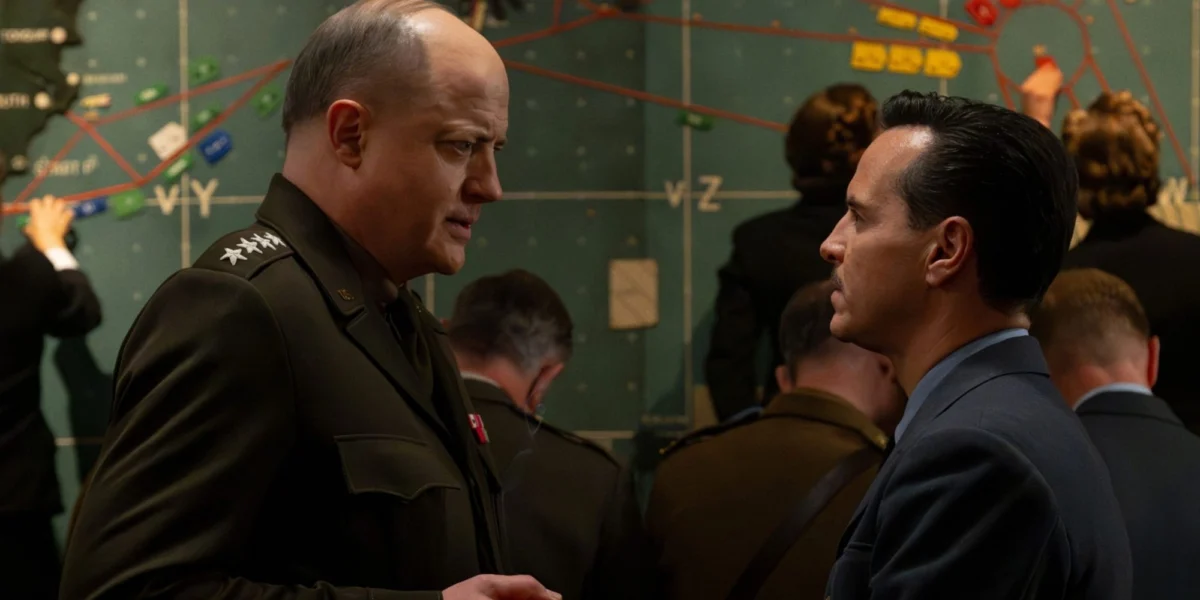
Directed by Anthony Maras and written by David Haig alongside Maras, the film explores the high-stakes decision-making process of General Dwight D. Eisenhower and his chief meteorologist, Captain James Stagg, in the 72 hours leading up to the Normandy landings. This 100-minute war drama, adapted from Haig’s acclaimed stage play, features a central cast led by Andrew Scott as Stagg and Academy Award winner Brendan Fraser as Eisenhower. The narrative focuses on the intersection of military strategy and meteorological science, a factor that ultimately dictated the success or failure of Operation Overlord.
The Convergence of Science and Strategy in Operation Overlord
In the early days of June 1944, the Allied forces had massed over two million troops, thousands of ships, and a massive aerial fleet along the southern coast of England. The logistical complexity of the invasion was unprecedented, yet the entire operation remained at the mercy of the English Channel’s notoriously volatile weather. Pressure examines this vulnerability through the eyes of Captain James Stagg, a Scottish meteorologist tasked with providing a definitive forecast for June 5, the original date set for the invasion.
The film portrays the friction between Stagg’s cautious, data-driven approach and the more optimistic outlook of his American counterpart, Irving P. Krick, played by Chris Messina. Krick, a proponent of long-range forecasting based on historical patterns, argued for a favorable window, while Stagg, analyzing current barometric pressure readings and North Atlantic storm systems, warned of a catastrophic weather front. This conflict serves as the primary engine of the film’s tension, illustrating how the lives of hundreds of thousands of servicemen rested on the interpretation of atmospheric data.
Historical Chronology: The 72-Hour Window
To understand the stakes depicted in the film, it is necessary to examine the actual timeline of events between June 3 and June 6, 1944.
- June 3, 1944: Captain Stagg observes a series of low-pressure systems moving across the Atlantic. While the American team remains confident in a "clear sky" forecast, Stagg identifies a deepening depression that suggests gale-force winds and low cloud cover—conditions that would make an amphibious landing impossible and negate Allied air superiority.
- June 4, 1944 (Early Morning): During a 04:15 briefing at Southwick House, Stagg presents his findings to Eisenhower and the Allied commanders. Despite the massive momentum of the invasion machinery, Eisenhower makes the difficult decision to postpone the operation by 24 hours. This delay necessitated the recall of ships already at sea, a logistical nightmare that risked exposing the fleet to German U-boats.
- June 4, 1944 (Evening): Stagg identifies a brief "lull" or "window" of improved weather predicted for Tuesday, June 6. He forecasts that while conditions would not be perfect, the wind and sea state would subside enough to allow for a landing.
- June 5, 1944: At the final morning briefing, Stagg confirms the predicted lull. Eisenhower, weighing the risks of a further delay—which would have pushed the invasion back by two weeks due to tidal requirements—utters the famous words, "OK, we’ll go."
- June 6, 1944: D-Day commences. The weather is rough, but as Stagg predicted, the conditions are manageable enough for the landings to proceed, catching the German command by surprise.
Meteorological Data and the Technical Challenge of 1944
The film attempts to visualize the technical difficulties faced by 1940s meteorologists. In an era before satellite imagery, computer modeling, or sophisticated radar, Stagg and his team relied on a network of weather stations, ship reports, and reconnaissance flights. The primary tool was the synoptic chart, a hand-drawn map of barometric pressure.
Historical data confirms that the storm Stagg predicted was one of the worst to hit the English Channel in twenty years. Had the invasion proceeded on June 5, the landing craft would have been swamped by high seas, and the lack of air cover due to cloud density would have left the troops vulnerable to German defenses. The film highlights the "pressure" of the title—both the literal barometric pressure indicating the storm’s arrival and the psychological pressure placed upon the individuals responsible for the forecast.
Production Background and Performance Analysis
The transition of Pressure from the stage to the screen brings both opportunities and limitations. Director Anthony Maras, known for his work on Hotel Mumbai, utilizes the expanded canvas to introduce cinematic imagery of storm systems and crashing waves, contrasting the raw power of nature with the confined, claustrophobic atmosphere of the war rooms.
Andrew Scott’s portrayal of James Stagg is characterized by a stoic intensity. The film depicts Stagg as a "black sheep" among the military elite, a man whose expertise is viewed with skepticism by those more accustomed to traditional combat metrics. Brendan Fraser’s performance as Eisenhower has been noted for its focus on the General’s immense burden of command. Rather than a purely heroic caricature, Fraser’s Eisenhower is a man grappling with the moral weight of his decisions, frequently clashing with other high-ranking officials such as General Bernard Montgomery, played by Damian Lewis.
Kerry Condon portrays Kay Summerby, Eisenhower’s driver and personal secretary. While her role is historically significant, providing a rare female perspective in the male-dominated command structure, the film utilizes her character primarily as a grounding force for Stagg, offering him a confidante as he navigates the skepticism of his peers.
Comparative Genre Context and Critical Reception
Pressure enters a subgenre of World War II cinema that focuses on the "behind-the-scenes" procedural elements of the war, similar to The Imitation Game (2014) or Darkest Hour (2017). These films prioritize dialogue and intellectual conflict over battlefield action, seeking to educate the audience on lesser-known aspects of historical events.
Initial critical assessments suggest that while the film is a competent and educational piece of historical drama, it struggles at times with its pacing. The transition from a single-setting stage play to a multi-location feature film results in moments where the tension dissipates. However, the chemistry between Scott and Fraser is cited as a highlight, providing the emotional core necessary to sustain the narrative’s more technical sequences.
Broader Impact and Historical Implications
The story of James Stagg and the D-Day weather forecast remains a pivotal case study in the history of meteorology and military intelligence. It underscores the transition of weather forecasting from an inexact "art" based on historical cycles to a rigorous scientific discipline based on real-time data and physics.
The implications of Stagg’s success were profound. German meteorologists, lacking the same level of data from the North Atlantic, predicted that the weather would remain too poor for an invasion throughout early June. This led to a lapse in German readiness; Field Marshal Erwin Rommel even took leave to celebrate his wife’s birthday, believing the Allies would not strike in such conditions. The "lull" identified by Stagg provided the Allies with the element of surprise, a factor that many historians believe was essential to the success of the Normandy landings.
By focusing on this specific 72-hour window, Pressure aims to remind audiences that the "Greatest Generation" was supported not only by soldiers on the front lines but by scientists and specialists whose work in the shadows changed the course of the 20th century. While the film may follow the established tropes of the historical biopic, its dedication to highlighting the crucial role of meteorological science provides a unique perspective on one of history’s most analyzed events.
Conclusion
Pressure serves as a dramatized record of a moment when the future of Western democracy depended on a barometric reading. Through its exploration of the tension between Stagg and Krick, and the ultimate decision made by Eisenhower, the film provides a detailed look at the intellectual and emotional labor behind military operations. As a history lesson, it offers a deep dive into the specifics of June 1944; as a film, it stands as a testament to the quiet, often overlooked figures who shaped the outcome of World War II. The film is scheduled for release in theaters on May 29, positioning it as a key entry in the seasonal landscape of historical dramas.