The 77th edition of the Cannes Film Festival reached a distinct creative milestone with the presentation of Le Vertige, the latest feature from the prolific French filmmaker Quentin Dupieux. Serving as the closing selection for the Directors’ Fortnight (Quinzaine des Cinéastes), the film represents a departure from Dupieux’s traditional live-action surrealism, marking his first venture into the realm of feature-length animation. Clocking in at a concise 67 minutes, the production utilizes a specific low-fidelity aesthetic to examine the contemporary obsession with simulation theory and the sociopolitical "red pill" metaphors that have permeated digital discourse over the last decade. By leveraging accessible technology such as Blender and iPhone-based motion capture, Dupieux offers a meta-commentary on the nature of reality, the labor of filmmaking, and the increasingly transactional nature of modern ideological movements.
Narrative Overview and Conceptual Framework
The premise of Le Vertige centers on an early morning encounter between two long-time friends, Jacky and Bruno, portrayed through voice and motion capture by Alain Chabat and Jonathan Cohen, respectively. The inciting incident occurs at 05:52 am when Jacky arrives at Bruno’s residence in a state of existential agitation. He presents a radical thesis: the world they inhabit is an artificial construct, a computer simulation plagued by observable glitches.
Unlike traditional science fiction which often builds toward such a revelation as a climax, Dupieux establishes this "glitch in the matrix" perspective as the baseline for the film’s dialogue. Jacky supports his claims with a series of absurdist observations, ranging from a pigeon inexplicably trapped within a manhole to the biological anomaly of Bruno’s wife, Fabienne (Anaïs Demoustier), giving birth in their Parisian apartment without an umbilical cord. The narrative follows Bruno as he initially dismisses these claims, only to find himself increasingly attuned to the perceived inconsistencies of his environment. The screenplay functions as a bouncy two-hander, relying heavily on the established comedic chemistry between Chabat and Cohen to anchor the high-concept philosophy in relatable, albeit heightened, human interaction.
Technical Execution and the Low-Poly Aesthetic
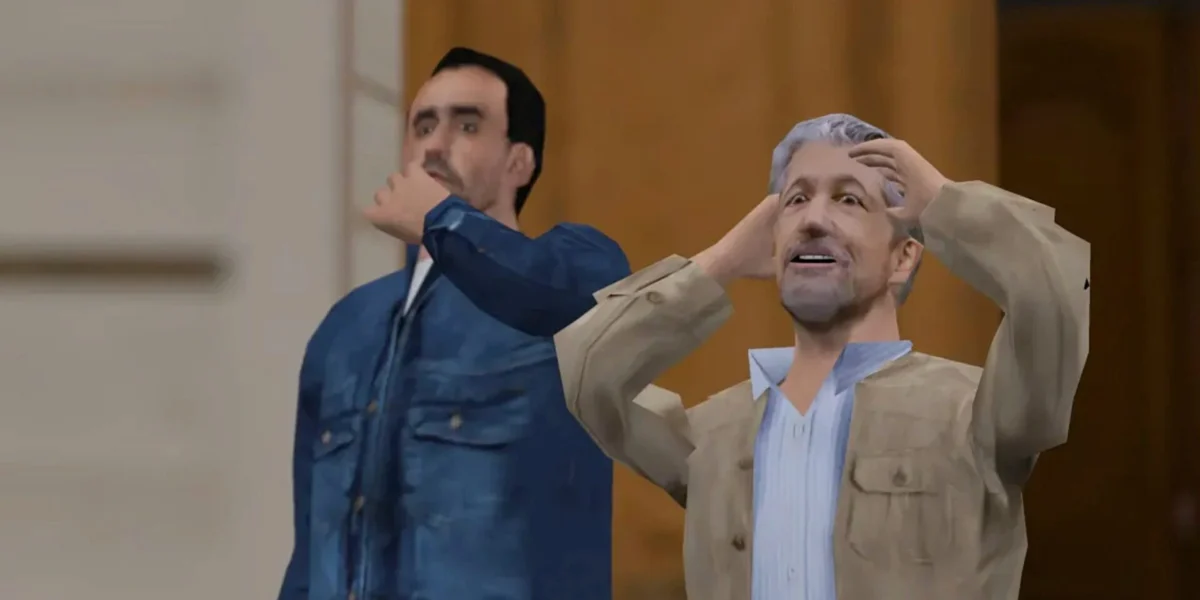
A defining characteristic of Le Vertige is its visual presentation, which intentionally avoids the high-definition polish of contemporary major-studio animation. The film was produced by a streamlined team of five animators using Blender, an open-source 3D creation suite, and a series of iPhone motion capture applications. This technical choice results in an aesthetic reminiscent of the sixth generation of video game consoles, specifically echoing the "low-poly" realism of PlayStation 1 and early PlayStation 2 titles such as Grand Theft Auto: Vice City.
This visual style is not merely a budgetary constraint but a thematic tool. The "plasticky" storefronts, unrendered backgrounds, and stiff, cardboard-like character models serve to reinforce the film’s central question regarding the authenticity of the characters’ world. By presenting the story through a medium that looks inherently "buggy" or incomplete, Dupieux creates a feedback loop between the form and the content. Terms typically reserved for software development, such as "hotfix," "rendering error," and "asset," become part of the characters’ lived reality, allowing the film to operate under a specific "dream logic" where the boundaries between digital error and physical law are blurred.
Chronology of Development and Festival Context
The development of Le Vertige follows a period of intense productivity for Quentin Dupieux. Known for his rapid turnaround, Dupieux has frequently debuted works at major festivals with minimal lead time between projects. This film follows his recent efforts such as Yannick and Second Act, continuing his trend of exploring meta-narratives and the absurdity of the creative process.
- Pre-Production: Following the completion of his 2023 projects, Dupieux began experimenting with motion capture technology as a means to circumvent the logistical hurdles of traditional live-action filming.
- Production Phase: The animation process was handled by a small, specialized team, prioritizing the translation of the lead actors’ physical performances into the digital space. This phase focused on maintaining the "manual" feel of the animation to preserve the director’s signature "DIY" ethos.
- Cannes Selection: In early 2024, the Directors’ Fortnight committee announced Le Vertige as the closing film, highlighting its status as an experimental work from an established auteur.
- Premiere: The film premiered at Cannes to a packed audience, sparking immediate discussion regarding its short runtime and its critique of modern internet culture.
Sociopolitical Implications and the Red Pill Metaphor
The thematic core of Le Vertige engages with the "red pill" ideology, a concept originally popularized by Lana and Lilly Wachowski’s 1999 film The Matrix. Over the last two decades, this metaphor has transitioned from a narrative device about awakening to a cornerstone of the "manosphere" and far-right political discourse. The film acknowledges how simulation theory has been weaponized as a metaphor for political and social dissidence, where adherents view themselves as the only individuals capable of seeing through the "programming" of mainstream society.
Dupieux’s treatment of this theme is contextually predatory, reflecting a post-COVID landscape where skepticism of reality has shifted from theoretical philosophy to a functional tool for online figureheads. The film references the ways in which figures like Andrew Tate have utilized "The Matrix" as a shorthand for institutional opposition. In Le Vertige, the search for glitches is presented as both a comedic pursuit and a transactional one. The film’s resolution suggests that even the realization of living in a simulation is quickly co-opted for profit or personal gain, reflecting the cynical, functional nature of modern "truth-seeking" movements.
Critical Analysis and Industry Impact
While the chemistry between Chabat and Cohen has been praised for its energy, industry analysts have noted that the film’s experimental nature presents unique challenges. The novelty of the PlayStation-era graphics, while initially engaging, faces the risk of diminishing returns over the 67-minute duration. The third act of the film has been described as buckling under the weight of its own premise, as the animation quirks transition from narrative clues to repetitive visual gags.
However, the film’s impact on the industry lies in its proof-of-concept for high-profile, low-budget animation. By utilizing a team of only five people and consumer-grade hardware, Dupieux has demonstrated a model for "iPhone-sized" cinema that can still command attention at the world’s most prestigious film festivals. This approach challenges the traditional barriers to entry for feature-length animation, which typically requires hundreds of artists and multi-million dollar budgets.
Broader Implications for the Auteur and the Medium
The conclusion of Le Vertige features a "Pixar-lite" blooper reel during the credits, which further explores Dupieux’s interest in the relationship between the director and the actor. By showing the digital characters "breaking character," Dupieux reinforces his long-standing theme of actors as props and the filmmaking process as a series of controlled simulations.
The film’s reception at Cannes suggests a growing appetite for shorter, more experimental features that bypass the traditional two-hour theatrical standard. As streaming platforms and digital distribution continue to alter viewing habits, the 67-minute "featurette" may become a more common format for auteurs looking to explore single-premise ideas without the need for narrative padding.
In summary, Le Vertige serves as a satirical examination of the modern psyche’s detachment from reality. It captures a specific cultural moment where simulation theory has moved from the fringes of science fiction into the center of social and political identity. Through its deliberate use of "ugly" animation and its focus on the transactional nature of ideology, Quentin Dupieux has crafted a work that is as much a critique of the digital age as it is a product of it. The film remains a testament to the director’s ability to repackage complex, often dark, societal trends into short, punchy, and visually distinct cinematic experiences.