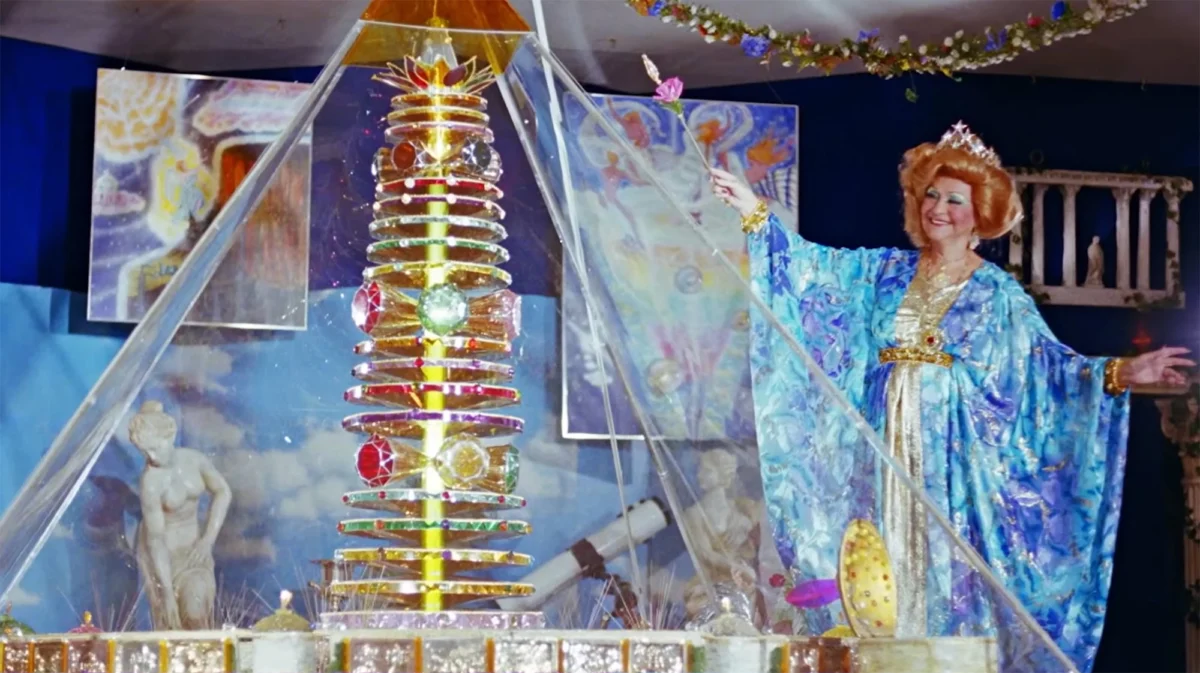
The highly anticipated documentary film Welcome Space Brothers, directed by acclaimed filmmaker Jodi Wille, is set to make its official theatrical debut at the historic Alex Theater in Glendale, California, on June 13, 2026. This release follows a protracted journey from its initial premiere at Beyond Fest in 2023, marking a significant moment for both independent cinema and the study of American fringe spiritual movements. The film, which chronicles the history and cultural output of the Unarius Academy of Science, arrives during a period of heightened public interest in extraterrestrial phenomena, strategically coinciding with the release of Steven Spielberg’s latest science-fiction epic, Disclosure Day.
Produced by a high-profile team including Caryn Capotosto, known for her work on the Academy Award-winning Won’t You Be My Neighbor?, and executive produced by Elijah Wood’s SpectreVision, Phil Lord, Christopher Miller, and the musician Moby, Welcome Space Brothers provides an exhaustive look at one of the most visually and philosophically distinct organizations in the history of New Age spirituality. The theatrical launch will be accompanied by a live performance featuring Moby and the Unarius choir, serving as the kickoff for a comprehensive nationwide roadshow scheduled throughout the summer of 2026.
The Origins and Philosophy of the Unarius Academy of Science
The Unarius Academy of Science—an acronym for Universal Articulate Interdimensional Understanding of Science—was established in 1954 in Los Angeles by Ernest and Ruth Norman. The organization was founded on the principle that the universe is governed by "interdimensional physics" and that human beings are essentially immortal spirits who inhabit a succession of physical bodies across various lifetimes. According to Unarian doctrine, past-life traumas are the primary cause of modern psychological and physical ailments, and "healing" is achieved through the recognition and "clearing" of these historical grievances.
While Ernest Norman provided the intellectual and pseudo-scientific framework for the group, it was Ruth Norman, later known as the "Archangel Uriel," who transformed Unarius into a cultural phenomenon. Following Ernest’s death in 1971, Ruth assumed leadership and relocated the academy to El Cajon, California. Under her guidance, the group transitioned from a quiet study circle into a prolific multimedia collective. Ruth Norman claimed to be in telepathic communication with advanced extraterrestrial beings, whom she referred to as the "Space Brothers." These beings were described as benevolent, highly evolved entities residing on other planets who were prepared to share their advanced technology and spiritual wisdom with humanity once the Earth reached a sufficient level of consciousness.

The Ruth Norman Era and the Rise of Public Access Media
The 1970s and 1980s marked the peak of Unarius’s creative output. Ruth Norman, often appearing in elaborate, sequined gowns and towering crowns designed to reflect her status as an interdimensional ambassador, embraced the burgeoning medium of public-access television. The group established its own production studio, utilizing then-state-of-the-art video equipment to create hundreds of hours of content.
These productions, which director Jodi Wille meticulously restores and highlights in the documentary, were categorized as "psychodramas." These were essentially improvised films in which members would reenact scenes from their supposed past lives—ranging from ancient Atlantis to the court of Henry VIII—as a form of spiritual therapy. The costumes were extravagant, the special effects were hand-crafted, and the performances were characterized by a sincere, if eccentric, dedication to the group’s mission.
During this era, Unarius became a staple of cable television, gaining a cult following among viewers who were fascinated by the group’s aesthetics and the unwavering optimism of Ruth Norman. Unlike many other fringe movements of the time, Unarius was noted for its pacifism and its emphasis on creative expression rather than isolationism or apocalyptic fear. The "Space Brothers" were expected to arrive in 1976 and later in 2001, landing a fleet of 33 spaceships in a "landing site" the group had purchased in the California mountains. Despite the non-occurrence of these events, the group maintained its cohesion through its commitment to artistic production.
Production Background and Creative Pedigree
Jodi Wille, who previously explored alternative spiritual communities in the 2013 documentary The Source Family, spent years gaining the trust of the remaining Unarius members and accessing their massive archival library. The documentary features never-before-seen 16mm footage, behind-the-scenes glimpses of their film sets, and contemporary interviews with long-standing practitioners.
The involvement of Elijah Wood and the production duo of Phil Lord and Christopher Miller signals the film’s crossover appeal. Lord and Miller, known for their work on The LEGO Movie and the Spider-Verse franchise, have frequently expressed interest in narratives that challenge conventional reality and celebrate idiosyncratic creativity. Their support, alongside the musical contribution and executive production of Moby, positions Welcome Space Brothers as a prestige documentary that bridges the gap between outsider art and mainstream cultural analysis.

Caryn Capotosto’s role as producer brings a level of documentary rigor to the project. Having worked on films that humanize larger-than-life figures, Capotosto’s influence is evident in the film’s balanced portrayal of Ruth Norman—depicting her not merely as a "cult leader," but as a visionary artist who utilized the tools of the 20th century to build a community around a shared mythology.
A Chronology of Unarius and the Documentary’s Development
To understand the scope of Welcome Space Brothers, it is necessary to view the timeline of the organization alongside the film’s production cycle:
- 1954: Ernest and Ruth Norman found Unarius in Los Angeles.
- 1971: Ernest Norman passes away; Ruth Norman (Uriel) assumes leadership and moves the headquarters to El Cajon.
- 1975-1985: The "Golden Age" of Unarius filmmaking; the group produces over 100 films and thousands of hours of public access programming.
- 1993: Ruth Norman passes away at the age of 93. Leadership transitions to a board of directors, and the group continues as a non-profit educational foundation.
- 2013: Jodi Wille releases The Source Family, sparking renewed interest in 1970s spiritual movements.
- 2018: Research and filming begin for Welcome Space Brothers, including the restoration of archival tapes.
- 2023: The film premieres at Beyond Fest to critical acclaim but faces delays in securing a wide theatrical distribution deal.
- 2026 (June 12): The official trailer is released globally.
- 2026 (June 13): Theatrical premiere at the Alex Theater in Glendale, CA, followed by a national tour.
Contextualizing the 2026 Release
The timing of the film’s release is not accidental. The year 2026 has been dubbed by some cultural critics as the "Year of the UFO" due to a convergence of cinematic releases and ongoing government disclosures regarding Unidentified Aerial Phenomena (UAPs). Spielberg’s Disclosure Day, which focuses on the societal impact of confirmed alien contact, provides a fictional counterpart to the "true believer" narrative presented in Welcome Space Brothers.
While Disclosure Day explores the geopolitical and scientific ramifications of contact, Wille’s documentary examines the psychological and spiritual human need for such contact. Data from recent sociological studies suggest a rise in "non-traditional spirituality" across the United States, with a 15% increase in individuals identifying as "spiritual but not religious" since 2020. The Unarius Academy represents an early, technicolor precursor to this trend, illustrating how individuals use technology and narrative to find meaning in an increasingly complex world.
Broader Impact and Implications
Welcome Space Brothers serves as more than a historical retrospective; it is a case study in the power of communal myth-making. For the members of Unarius, filmmaking was not about commercial success but about "interdimensional" communication and self-actualization. By treating their archival footage with technical respect and narrative empathy, Wille elevates their work from the realm of "kitschy" public access TV to a form of significant outsider art.

Industry analysts suggest that the documentary’s success could pave the way for more "archival-heavy" films exploring the intersection of media and belief systems. The collaboration between indie filmmakers and major industry figures like Lord and Miller indicates a growing market for documentaries that focus on the fringes of the American experience.
As the theatrical roadshow moves across America this summer, the film is expected to spark discussions on the nature of faith, the evolution of New Age movements, and the enduring human fascination with the stars. Whether Ruth Norman was, as her followers believed, an interdimensional archangel, or simply a woman with a profound imagination and a video camera, Welcome Space Brothers argues that her impact on her community—and on the history of independent media—is undeniable.
The documentary concludes by looking at the contemporary state of the Unarius Academy of Science. Still active today in El Cajon, the group continues to host classes and maintain their archive, waiting for the day when the "Space Brothers" will finally descend. In the meantime, they have left behind a cinematic legacy that, thanks to this documentary, is finally being projected onto the big screen for a new generation to witness.