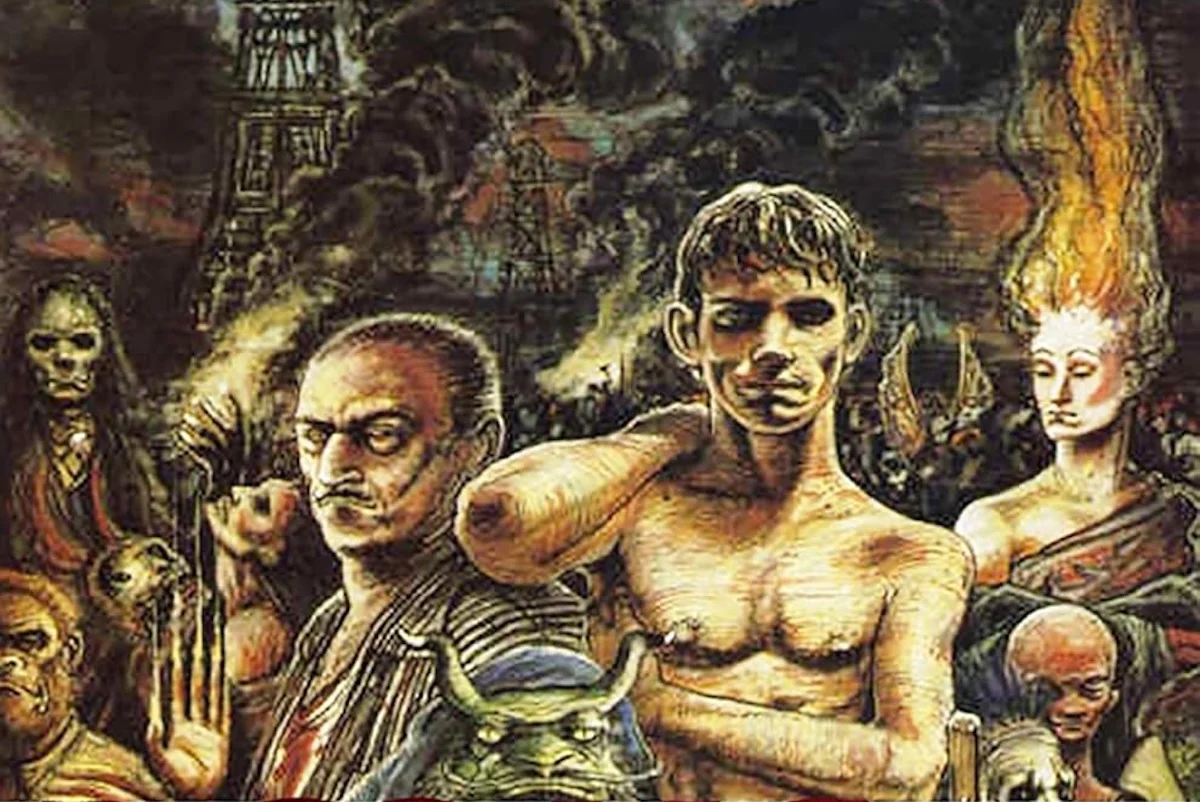
In 1984, the fifth year of Margaret Thatcher’s premiership, two English writers embarked on divergent yet ultimately resonant literary journeys. Clive Barker, born October 5, 1952, shifted his creative focus from the avant-garde theatre scene to prose, submitting a formidable 600-page manuscript of short stories to publishers. Unfamiliar with the industry’s economics, Barker’s unsolicited submission, a testament to his raw ambition, found an unlikely champion. That same year, his collection Clive Barker’s Books of Blood was published in three volumes, marking a startling debut that would redefine British horror.
Joel Lane, born October 2, 1963, followed a more conventional path. His first story, "The God of Clay," appeared in Dark Horizons, a niche publication of the British Fantasy Society. His inaugural collection, The Earth Wire and Other Stories, would not be released until 1994, a decade after Barker’s explosive entrance. Despite these contrasting beginnings, both Barker and Lane emerged as pivotal figures in British genre fiction over the subsequent four decades. Their work, in distinct ways, pushed the boundaries of horror, challenging both thematic and technical conventions. The coincidence of their birthdates falling in October, the month of Halloween, adds a thematic flourish to their shared legacy in dark fiction. More significantly, their experiences as queer men in Margaret Thatcher’s Britain profoundly shaped their literary output, infusing their narratives with particular depths and perspectives.
Joel Lane’s life was tragically cut short in 2013, mere weeks after his collection Where Furnaces Burn received the World Fantasy Award. He did, however, outlive Margaret Thatcher by six months. Clive Barker, though reportedly still engaged in creative endeavors, has been largely absent from fiction publishing for many years due to health issues. As contemporary political discourse increasingly targets LGBTQ+ individuals, a retrospective look at the formative years of Barker and Lane offers valuable insights. The stories they crafted decades ago continue to resonate, demonstrating horror’s capacity to illuminate our emotions, philosophies, and desires amidst times of turmoil and apprehension.
The Genesis of Books of Blood and the Specter of AIDS
The early 1980s were a period of profound social and medical upheaval, particularly for the LGBTQ+ community. On July 3, 1981, The New York Times published a chilling report on page A20: "RARE CANCER SEEN IN 41 HOMOSEXUALS." This marked one of the earliest public acknowledgments of a burgeoning crisis. By April 1984, scientists announced the isolation of the retrovirus responsible for AIDS, later officially named HIV. By the close of 1984, the UK had recorded 108 AIDS cases and 46 deaths, a stark prelude to the epidemic’s devastating trajectory.
It was within this charged atmosphere that Clive Barker conceived his Books of Blood. His editor at Sphere reportedly resisted the inclusion of "In the Hills, the Cities," a groundbreaking story featuring two men in a failing relationship who encounter an ancient ritual of town-wide human colossi. This tale, a recipient of the British Fantasy Award and a celebrated work by both critics and fans, initially featured a heterosexual couple. However, a friend’s observation of a lingering homosexual undertone prompted Barker to revise the story, bringing that subtext to the forefront. In the early 1980s, this was a significant career risk for an unknown author of violent, unconventional horror. The prospect of publishing sexually active queer characters would have been a marketing nightmare for publishers already hesitant about Barker’s genre-bending material. Nevertheless, Barker remained steadfast in his artistic vision.
Douglas E. Winter, in his 2002 biography Clive Barker: The Dark Fantastic, notes that Sphere released Clive Barker’s Books of Blood in March 1984 with minimal expectation or promotion. Initially, the ten-thousand-copy print runs seemed slow to deplete. However, word-of-mouth and sporadic reviews propelled these stories, initially intended for a niche audience, into mainstream success, becoming a significant publishing phenomenon of the decade. Winter attributes this meteoric rise to Barker’s talent intersecting with a receptive literary moment. Following the paperback successes of horror novels like Rosemary’s Baby, The Exorcist, and early Stephen King works in the 1970s, the horror market, while vibrant, had become saturated with formulaic and often poorly executed content. Barker offered a potent antidote: energetic prose, imaginative imagery, fresh perspectives on classic tropes, and unparalleled originality, as exemplified by "In the Hills, the Cities." While his sheer inventiveness was the primary driver of his success, the presence of queer characters in his work, at a time of entrenched white, heterosexual conservative political dominance, resonated with a growing yearning, particularly among younger audiences, for narratives that confronted societal cruelties while acknowledging human diversity.
The Nuances of Queer Representation in Barker’s Fiction
Barker’s story "In the Hills, the Cities" does not present an idealized vision of queer romance. Mick, a dance teacher, finds his journalist boyfriend, Judd, to be both boring and arrogant. While Mick initially tolerated Judd’s right-wing politics within the confines of their shared life, their travels outside their familiar environment exposed the stark intolerance and xenophobia underlying Judd’s worldview. The narrative skillfully shifts perspective, revealing Judd’s contemptuous view of Mick as a "shallow queen," his mind "no deeper than his looks." This portrayal avoids simplistic romanticization, instead offering a complex, often uncomfortable, examination of a relationship under strain.
Mick and Judd’s narrative arc concludes not with reconciliation or a conventional happy ending, but with their destruction by forces beyond their comprehension. Their fate is not a punishment for their homosexuality but a consequence of their obliviousness to surrounding dangers and their inability to adapt. Their sexuality is rendered irrelevant to the ancient rituals and primal forces that dictate their end. Barker’s conclusion echoes Anton Chekhov’s "Gusev," where the deceased protagonist’s body is consumed by the ocean’s cycle of life and death. Barker, more explicitly, depicts a similar cosmic insignificance as the dead body becomes part of a natural cycle of decomposition and rebirth, where individual identities and opinions fade into insignificance. The story’s final line, "Darkness, light, darkness, light. He interrupted neither with his name," underscores this theme of existential continuity beyond human concerns.
"In the Hills, the Cities," likely written before the full impact of the AIDS epidemic was felt in Britain (Terrence Higgins, the first publicly acknowledged UK AIDS victim, died in July 1982), predates widespread public awareness. It was in the sixth volume of Books of Blood, published in the summer of 1985 during the writing of his first novel, The Damnation Game, that Barker addressed themes that strongly evoked the AIDS crisis, albeit without explicit mention. "The Life of Death" tells the story of Elaine, a woman who, after recovering from life-threatening surgery, discovers a derelict church and a sealed tomb containing well-preserved corpses. She becomes a carrier of a plague, seemingly immune, but witnesses her friends falling ill and dying.
Readers in 1985 would have readily associated Elaine’s plight with the prevailing discourse surrounding AIDS, often framed as a plague and divine retribution. The story sympathetically portrays Elaine’s struggle to reconcile her survival with the lingering fear and the fragility of her future. Her attempt to romanticize death, to strip it of its terror, is a psychological maneuver that offers temporary solace but ultimately proves illusory. Her descent into the plague pit forces a confrontation with the stark materiality of death, devoid of artifice. The story concludes with Elaine realizing her romanticized vision of Death is a fantasy, and her end, while possessing a Chekhovian transcendence, is ultimately more mundane than she anticipated. The narrative probes the question of whether the nature of death truly matters, suggesting that in the grand cycle of existence, individual outcomes hold little consequence.
While the endings of "In the Hills, the Cities" and "The Life of Death" share a thematic resonance with Chekhov’s "Gusev" through their point-of-view shifts and cosmic perspectives, Barker’s narrative style remains distinct. His work aligns more closely with the tradition of well-crafted tales by authors like Guy de Maupassant and O. Henry, characterized by gripping beginnings, incident-rich middles, and conclusive endings.
Joel Lane: The Chekhovian Voice of British Weird Fiction
Joel Lane, in contrast, possessed a distinctly Chekhovian sensibility, particularly in the structural underpinnings of his horror and weird fiction. Though Chekhov is not explicitly referenced in Lane’s published essays or interviews, his stories embody the Russian master’s approach: a focus on the "middle" of a narrative, where character frustration, nostalgia, loneliness, pretension, or despair illuminate a singular moment in a life. Lane’s stories are typically shorter, less densely plotted, and more introspective than Barker’s. They often leave the reader with a lingering question, a sense of incompletion that is precisely the point.
This structural divergence contributes to Barker’s wider recognition and readership. While Barker’s Books of Blood offer a more traditionally satisfying storytelling experience, both writers found profound ways to articulate the experiences of queer men navigating the social and political landscapes of the 1980s and 1990s. Their differing techniques offer complementary perspectives, enriching the landscape of British genre fiction without demanding a singular choice from the reader.
Barker’s Monsters and Lane’s Mysteries
Clive Barker’s enduring fascination with monsters forms a central tenet of his work. He frequently posits that those most ostracized by society are often the most compelling and sympathetic. This theme is vividly explored in his short novel Cabal and its film adaptation, Nightbreed. In Books of Blood, "The Skins of the Fathers," a story that riffs on Western tropes, showcases wondrous mutants persecuted by prejudiced townsfolk. Barker’s monsters rarely act out of an inherent evil; rather, their monstrousness is a product of societal misunderstanding, prejudice, and rejection.
Joel Lane, while also attuned to social forces, approached his subjects with a different sensibility, akin to a poet versus Barker’s dramatist. Lane, who published poetry collections and won an Eric Gregory Award, infused his fiction with a more ethereal and mysterious quality. His creatures are often glimpsed, ethereal, and rarely offer clear, didactic meanings. In his 1989 story "Albert Ross" (collected in The Earth Wire), the titular character develops wings. The story offers no explanation for this transformation, nor does it present a grand allegorical purpose beyond the pain and ostracism it incurs. Ross’s reaction is remarkably blasé; the wings are simply another burden. Lane deliberately omits background details for both Ross and the healer, Lochran, focusing instead on atmosphere, implication, and the reader’s imaginative engagement. This poetic approach, characterized by juxtapositions, rhythmic imagery, and the subtle accumulation of sensation, distinguishes Lane from the more character-driven and theatrically detailed narratives of Barker.
The supernatural elements in Lane’s stories, like Albert Ross’s wings, function as metaphors without definitive referents, unsettling conventional reading practices. They disrupt meaning by withholding the expected explanatory framework. However, they serve a crucial narrative purpose, bringing Ross and Lochran together, fostering an intimate, albeit conflicted, relationship. The conflict is understated, arising not from their actions but their circumstances. Ross seeks love, but Lochran, older and wiser, recognizes the divergence between Ross’s desires and his needs. Their situation is framed as a twist of fate, with neither man to blame. The story concludes with Lochran’s departure, leaving Ross with a semblance of definition as "the boy with wings," while Lochran, unwinged and uncertain, "takes flight" into his own unknown future.
"The Clearing," a rare science-fictional story by Lane, also found in The Earth Wire, explores a near-future ravaged by a contagious disease. Amidst the decay of civilization, youth gangs roam, echoing the scarcity and societal anxieties prevalent during the Thatcher years. Martin, grieving his friend’s death from the disease, embodies the anomie and despair common to both the AIDS crisis and the era’s political climate. The story posits a world where the oppressions faced by marginalized communities are amplified and universalized. Compulsory hospitalization for cancer victims is described as a "turning point," a "popular fear made into law," which could be interpreted as a veiled reference to anti-LGBTQ+ legislation like Section 28 or the calls for quarantining AIDS patients. The sentiment that caring for the terminally ill is a "waste of resources" mirrors sentiments expressed in tabloids of the 1980s. The title "The Clearing" resonates with themes of societal and personal emptying, but also with the potential for clarity and revelation.
Martin’s journey culminates in the realization of the need for community. Shattered social bonds are tentatively reforged as he joins a gathering in an empty parking garage, a silent protest against isolation and a shared expression of impossible mourning. This imagery serves as an inversion and echo of moments from Barker’s "The Life of Death," where characters confronting mortality find solace in shared humanity.
Echoes of Crisis and Connection
Lane’s 1994 story "The Pain Barrier," later reprinted in The Lost District, shares thematic ground with "The Clearing." England, under martial law, grapples with a new blood disease. Lee, recently released from prison, is "thin-blooded" and likely doomed. He encounters Tony, an actor from illicit films that mixed sex and violence. Their conversation about the reality of pain in art leads to an intimate encounter, culminating in their bodies merging in the morning. Lee escapes, seeking a transfusion to stave off death. Tony, an exile who sought community but found exploitation, talks about Walter Benjamin and his own fugitive status.
AIDS is directly addressed in Lane’s 1991 story "Power Cut," published in The Terrible Changes. This tale, a straightforward fable about a closeted gay politician encountering a young man who orchestrates his downfall, is unusually direct for Lane. Its perceived weakness highlights Barker’s strength in developing complex characters and intricate plots. Barker, while not overtly addressing AIDS in Books of Blood, would later explore its impact in novels like Imajica (1991) and Sacrament (1996), the latter featuring a gay protagonist and a poignant depiction of community response to the epidemic.
A significant shared influence on both Barker and Lane was the acclaimed horror writer Ramsey Campbell. Lane, in his posthumously collected essays in This Spectacular Darkness, frequently noted Campbell’s mastery of blending different horror styles, particularly "existential horror" (human nature and mortality) with "ontological horror" (the alienness of reality). Lane identified Campbell’s unique achievement as weaving these traditions to illuminate the modern world. Campbell’s protean example helped Lane avoid the trap of traditionalist, sanitized horror that emerged in the 1980s and 1990s. Lane himself resisted calls for "harmless and polite" weird fiction, stating, "Making weird fiction harmless and polite didn’t seem to me a particularly creative approach."
In their disparate yet complementary ways, Clive Barker and Joel Lane exemplify how to maintain the "weirdness" of weird fiction and the "horror" of horror. They demonstrate the genre’s potent capacity for creative, transgressive, artistic, and innovative expression, proving that even the most impolite and challenging themes can yield profound artistic insights.