The Tribeca Film Festival recently served as the premiere platform for Finnegan’s Foursome, the latest cinematic endeavor from writer, director, and actor Edward Burns. Centered on the intricate dynamics of an Irish-American family, the film explores themes of grief, legacy, and sibling rivalry through the lens of a high-stakes golf pilgrimage to Ireland. Following in the footsteps of his previous explorations of suburban life and ethnic identity, Burns returns to familiar territory, attempting to capture the "magic" that initially defined his career during the independent film boom of the mid-1990s. The film, which runs for approximately 120 minutes, features a cast led by Burns himself, alongside Broadway veteran Brian d’Arcy James, Erica Hernandez, and Brian Muller. While the narrative serves as a tribute to paternal influence and the sport of golf, the production has faced early critical scrutiny regarding its execution and script depth.
Narrative Overview and Plot Development
The story of Finnegan’s Foursome revolves around the Finnegan family, specifically two brothers, Freddy (Edward Burns) and Teddy (Brian d’Arcy James). The brothers are the sons of Jack Finnegan, portrayed by Ian McElhinney, a professional golfer who instilled a rigorous, often suffocating, love for the game in his children. The film opens with the tension of a long-standing family tradition: an annual golf tournament that has become more of a burden than a bonding experience for the protagonists. Freddy, characterized as the more disgruntled of the two, expresses a desire to withdraw from the competition, feeling the weight of his father’s overbearing expectations.
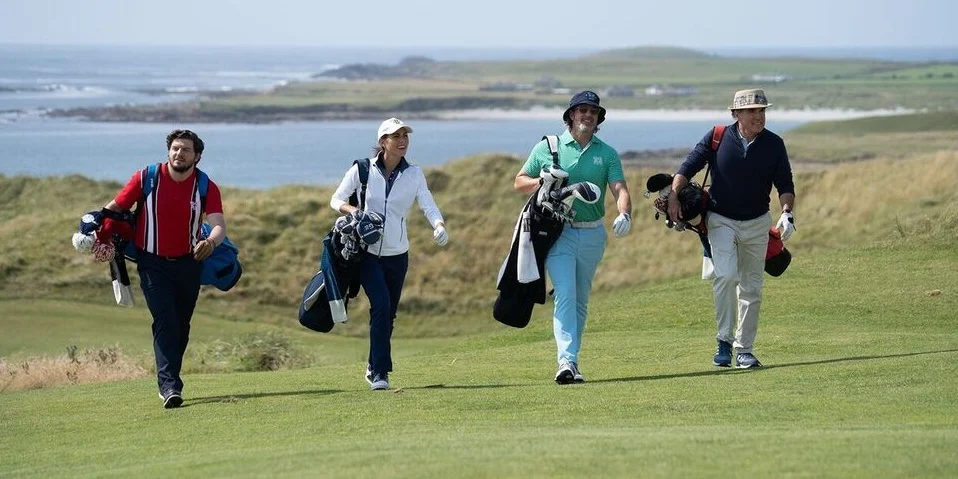
The inciting incident occurs when Jack Finnegan passes away suddenly at the start of what was intended to be his final tournament. This tragedy shifts the narrative from a domestic comedy into a road-trip dramedy. In accordance with Jack’s wishes, Freddy and Teddy—joined by their respective children, Marie (Erica Hernandez) and Frankie (Brian Muller)—travel to Ireland. Their mission is twofold: to complete the tournament in their father’s honor and to scatter his ashes across the legendary Irish links that defined his professional career.
As the group navigates the lush, green landscapes of their ancestral homeland, the internal friction between the brothers comes to the forefront. The competitive nature Jack fostered in them manifests as constant bickering and "sniping" on the greens. However, the introduction of Marie into the foursome marks a significant shift in family tradition, as she becomes the first woman to participate in the historically male-dominated Finnegan tournament. This subplot provides a modern counterpoint to the "old school" sensibilities that dominate the brothers’ interactions.
The Evolution of Edward Burns’ Independent Career
To understand the context of Finnegan’s Foursome, one must look at the trajectory of Edward Burns’ career, which spans nearly three decades. Burns first rose to prominence in 1995 with The Brothers McMullen, a film produced on a shoestring budget of approximately $25,000. That film went on to win the Grand Jury Prize at the Sundance Film Festival and grossed over $10 million, making it one of the most successful independent films of its era.
Since that debut, Burns has maintained a unique position in Hollywood. While he has appeared in major studio productions—most notably Steven Spielberg’s Saving Private Ryan (1998) and the action-thriller 15 Minutes (2001)—his primary focus has remained on writing, directing, and producing his own independent features. He is often cited as a pioneer of the "micro-budget" movement, frequently utilizing his own capital to fund projects that major studios might deem too niche or character-driven.
Finnegan’s Foursome represents a continuation of this DIY ethos. By operating outside the traditional studio system, Burns retains total creative control, a hallmark of his filmography. However, this independence also means his films often bypass wide theatrical releases in favor of festival circuits and digital distribution. The premiere at Tribeca—a festival co-founded by Robert De Niro to revitalize lower Manhattan—underscores Burns’ status as a quintessential New York filmmaker.
Character Analysis and Casting Dynamics
The strength of Finnegan’s Foursome relies heavily on the chemistry of its central quartet. Brian d’Arcy James, a three-time Tony Award nominee, brings a grounded sensibility to the role of Teddy, a writer struggling with a creative block. His performance offers a foil to Burns’ Freddy, whose character arc is defined by unresolved resentment toward his father. The interplay between the two veteran actors captures the specific rhythm of sibling rivalry, alternating between sharp-tongued insults and moments of begrudging reconciliation.
Erica Hernandez’s portrayal of Marie has been noted as a highlight of the production. As the sole female presence in the "foursome," her character challenges the hyper-masculine environment established by the Finnegan patriarch. Hernandez provides an energetic contrast to the more somber or cynical tones of her co-stars. Meanwhile, Brian Muller’s Frankie represents the younger generation’s search for identity, as his character deals with the fallout of a failed musical career and a recent breakup.
Despite the solid performances, some analysts suggest the screenplay lacks the depth required to make these characters truly three-dimensional. Each character is assigned a primary trait—writer’s block, resentment, or aimlessness—but the narrative often resolves these complex life issues through simplified dialogue or "Hallmark-esque" sentimentality. This has led to comparisons with televised movies rather than the gritty, realistic dramas that defined Burns’ early work.
Technical Execution and Visual Representation of Golf
From a technical standpoint, Finnegan’s Foursome utilizes the natural beauty of the Irish coastline to enhance its visual appeal. Cinematographer Jeff Mulshtok captures the sweeping vistas and meticulously maintained greens of the Irish links, providing a cinematic quality that elevates the film’s modest production values. Ireland has long been a premier destination for golf tourism, contributing over €440 million annually to the Irish economy, and the film serves as an unintentional showcase for the country’s sporting infrastructure.
However, the depiction of the sport itself has been a point of contention among viewers and critics. Filming golf is notoriously difficult, requiring a balance between technical accuracy and narrative pacing. In Finnegan’s Foursome, the sequences involving actual play have been described as visually repetitive. The script frequently resorts to "telling" rather than "showing," with characters explaining the score and the stakes of each hole in a manner that can feel redundant to the audience. This stylistic choice may stem from a desire to make the film accessible to non-golfers, but it risks alienating those looking for a more sophisticated sporting drama.
The Role of the Tribeca Film Festival and Industry Impact
The inclusion of Finnegan’s Foursome in the Tribeca Film Festival lineup highlights the ongoing importance of festivals in the life cycle of independent films. In 2024, the independent film market continues to face challenges, including shifting audience habits and the dominance of streaming platforms. Festivals like Tribeca provide vital visibility, allowing filmmakers like Burns to secure distribution deals and gauge audience reactions.
Data from recent film markets suggests that while big-budget "tentpole" movies dominate the box office, there is a consistent, albeit smaller, demand for "comfort cinema"—films that focus on family, tradition, and sentimental themes. Finnegan’s Foursome fits squarely into this category. While it may not achieve the cultural zeitgeist of The Brothers McMullen, it serves a specific demographic that values character-driven storytelling over high-concept spectacles.
Chronology of Production and Release
The timeline for Finnegan’s Foursome follows a standard independent production trajectory:
- Development (2022-2023): Edward Burns penned the script, drawing on his own Irish-American heritage and interest in the sport of golf.
- Principal Photography (Late 2023): Filming took place on location in Ireland and parts of the United States. The choice of Irish locations was essential for the film’s authenticity and visual identity.
- Post-Production (Early 2024): Editing and sound mixing were completed in time for the spring festival season.
- Premiere (June 2024): The film debuted at the Tribeca Film Festival in New York City, accompanied by Q&A sessions with Burns and the cast.
- Distribution: Following its festival run, the film is expected to seek a limited theatrical release or a placement on a major streaming service.
Critical Analysis and Broader Implications
The critical reception of Finnegan’s Foursome has been mixed, reflecting a broader conversation about the evolution of the "indie" voice. Early reviews suggest that while the film is "enjoyable" and "sincere," it lacks the sharp edge and narrative tension found in Burns’ earlier titles like She’s the One (1996) or Sidewalks of New York (2001). The humor, largely derived from family bickering on the golf course, is seen by some as "tiresome" over a two-hour runtime.
Furthermore, the film’s reliance on eulogies and emotional speeches to convey its themes has been criticized for ringing "hollow." In the context of modern cinema, where audiences are increasingly accustomed to complex, "prestige" television and nuanced indie dramas, the straightforward, almost theatrical approach of Finnegan’s Foursome may feel dated to some.
However, from a professional standpoint, the film demonstrates Burns’ unwavering commitment to his craft. In an industry where many directors eventually succumb to the lure of franchise filmmaking, Burns remains a rare example of a "total auteur" who manages to get his personal stories told year after year. The film serves as a reminder of the enduring appeal of the "family reunion" trope in American storytelling, even if the execution in this instance does not fully meet the high bar set by the director’s previous successes.
Conclusion and Future Outlook
As Finnegan’s Foursome moves beyond its festival debut, its ultimate success will likely be measured by its performance on digital platforms and its reception among Burns’ loyal fanbase. The film’s exploration of the Irish-American experience and the universal themes of grief and reconciliation ensure it has an audience, particularly among those who share the characters’ passion for golf and family tradition.
For Edward Burns, the film marks another chapter in a prolific career that shows no signs of slowing down. While some critics suggest a return to the "McMullen" universe might be a strategic move for his next project, Finnegan’s Foursome stands as a testament to his ability to find new ways to explore the same foundational themes of home, heritage, and the complicated bonds of brotherhood. The film remains a factual record of a specific moment in independent cinema, where the personal interests of the filmmaker take precedence over commercial trends, resulting in a work that is, if nothing else, authentically Edward Burns.