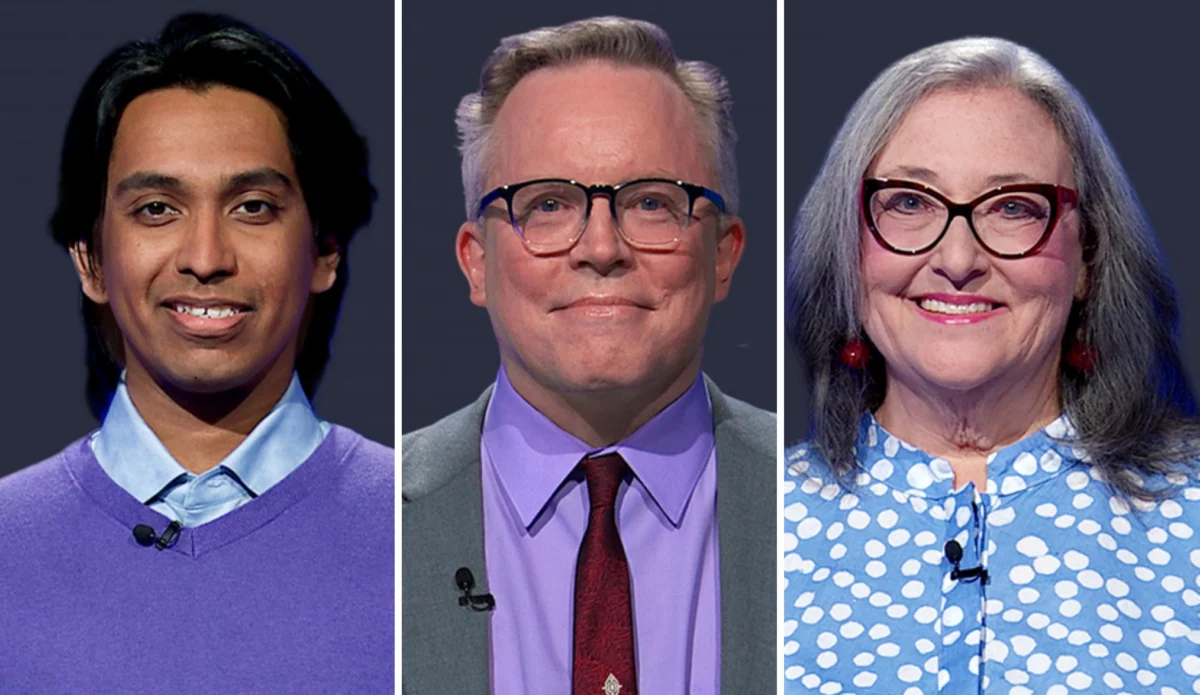
In a display of consistent intellectual prowess and strategic wagering, Adam Remsen, an attorney and theater producer from Memphis, Tennessee, successfully defended his title for a third consecutive game on the June 16 broadcast of the long-running syndicated quiz show Jeopardy! Entering the match with a two-day winnings total of $35,801, Remsen faced off against two formidable challengers: Nabil Rahman, a government employee hailing from Queens, New York, and Sarah McCleskey, an academic librarian based in Astoria, New York. By the conclusion of the half-hour program, Remsen had not only maintained his position as champion but had also increased his cumulative three-day winnings to $57,601, solidifying his status as a notable competitor in the show’s 40th season.
The episode, hosted by Jeopardy! legend Ken Jennings, highlighted the high-stakes nature of the competition, particularly through the volatility of the Daily Double clues. Remsen’s victory was characterized by a "runaway" lead going into the final segment, a mathematical situation where the leader’s score is more than double that of the second-place contestant, effectively guaranteeing a win regardless of the Final Jeopardy outcome.
Profiles of the Competitors
Adam Remsen’s journey to the Alex Trebek Stage is a testament to the persistence required of many Jeopardy! contestants. During the mid-show interview segment, Remsen revealed that he had been attempting to appear on the program for over two decades. His first audition took place in 2003 via the "Brain Bus," a mobile audition unit that traveled across the United States to recruit potential players before the advent of the ubiquitous online "Anytime Test." Although he received a call to appear shortly after that initial audition, a scheduling conflict prevented his participation. It took another 23 years of periodic testing and auditioning before he finally secured his spot behind the podium.
His opponents brought diverse backgrounds to the competition. Sarah McCleskey, an academic librarian, shared a personal anecdote regarding her aspirations for her potential winnings. She and her wife are currently in the process of building a home in Scotland, and McCleskey humorously noted that her primary financial goal for the game was to earn enough to fund the construction of their new kitchen.
Nabil Rahman, a government employee from Queens, provided a lighter moment during the interviews by discussing his travel experience. The trip to the Sony Pictures Studios in Culver City, California, marked the first time Rahman had ever traveled by airplane. Referencing a classic trope in stand-up comedy, Rahman joked that despite Jerry Seinfeld’s famous critiques of airline food, he found the in-flight meal service quite satisfactory.
Chronology of the Match: The Jeopardy! Round
The game commenced with the "Jeopardy!" round, featuring categories such as "Colorful Language" and "Go With the Flow." Remsen established an early lead by correctly identifying the "Brown Bomber" as the nickname of heavyweight boxing champion Joe Louis. The momentum of the first round was significantly impacted by the discovery of the first Daily Double.
Nabil Rahman uncovered the Daily Double under the $600 clue in the "Go With the Flow" category. At the time, Rahman held $2,200 and opted for an aggressive "true Daily Double," wagering his entire bankroll. The clue described a river joined by the Dong Nai and Ben Cat, noting that the river retains its original name while the former capital it flows through does not. Rahman incorrectly guessed the "Mekong," whereas the correct response was the "Saigon" River (the former capital, Saigon, was renamed Ho Chi Minh City in 1976). This loss reset Rahman’s score to zero, though he managed to rebuild his total to $1,600 by the end of the round.
At the first break, the standings reflected Remsen’s control of the board. He ended the round with $8,000, while McCleskey held a respectable $3,600 and Rahman trailed in third.
Double Jeopardy! and Strategic Dominance
As the game moved into the Double Jeopardy! round, the intensity increased with higher dollar values and two additional Daily Doubles hidden on the board. Rahman found the second Daily Double early in the round under the category "5-Letter Adjectives" for $1,600. With $2,800 in his account, Rahman again chose to wager his full amount. The clue asked for a colorful adjective used to describe both a lion’s coat and a specific type of port wine. Rahman provided the answer "brown," but the correct response was "tawny." This second major loss hindered Rahman’s ability to challenge Remsen’s lead for the remainder of the game.
Remsen eventually secured the third and final Daily Double in the "Whose What?" category at the $1,200 level. With a commanding lead already established, he wagered $4,000 on a clue regarding a Moscow landmark also known as the Church of the Intercession on the Moat. Remsen correctly identified the landmark as "St. Basil’s Cathedral," bringing his total to $16,800.
By the time the round concluded, Remsen had amassed $28,400. McCleskey sat in second place with $6,000, and Rahman remained in third with $1,600. Because Remsen’s score was more than double McCleskey’s, the match was declared a "runaway," ensuring his victory before the final clue was even read.
Final Jeopardy! and Results
The Final Jeopardy! category was "Hollywood Names," a topic that often requires a blend of film history and contemporary trivia knowledge. The clue read: "He’s got 12 Oscar nominations & 2 wins & a Henry Mancini Award from ASCAP & in 2018 received the German Order of Merit."
The responses were mixed:
- Nabil Rahman correctly identified the individual as "Hans Zimmer." Zimmer, a prolific German film score composer, is well-known for his work on The Lion King, Inception, and Dune. Rahman wagered a conservative $25, finishing the game with $1,625.
- Sarah McCleskey incorrectly guessed "John Williams," a logical but incorrect choice given the Oscar nomination count. She lost $2,700, ending with a final score of $3,300.
- Adam Remsen provided the incorrect name "Frankenheimer" (likely referring to director John Frankenheimer). However, due to his massive lead, his wager of $6,600 did not jeopardize his win. He finished the day with $21,800.
With this victory, Remsen’s three-day total reached $57,601. His performance was lauded by host Ken Jennings, who noted that Remsen’s current winning percentage—having won three out of three games played—technically exceeded Jennings’ own career winning percentage at that specific moment in time.
Supporting Data and Statistical Context
Remsen’s performance follows a trend of "strong" champions in the current season of Jeopardy! A runaway game is a significant statistical indicator of a player’s "Coryat score"—a measure of a player’s performance that disregards wagers and focuses solely on correct responses. Remsen’s ability to control the board and find the final Daily Double prevented his opponents from gaining the necessary capital to mount a comeback.
Comparatively, the average three-day total for a Jeopardy! champion fluctuates, but $57,601 places Remsen in a solid position. While not yet reaching the record-breaking heights of legendary players like James Holzhauer or Matt Amodio, Remsen’s consistency and depth of knowledge across diverse categories—from Russian architecture to pugilism—mark him as a disciplined player.
Historical Context: The Evolution of Auditions
Remsen’s mention of the "Brain Bus" serves as a nostalgic reminder of how the Jeopardy! production has evolved. For decades, the Brain Bus was a customized Winnebago that traveled to malls and public squares across North America. Thousands of hopefuls would line up for a chance to take a 10-question preliminary test. Those who passed would move on to a 50-question written exam and a mock game.
Today, the process is almost entirely digital. The "Jeopardy! Anytime Test" allows anyone with an internet connection to audition at their convenience. This shift has vastly increased the pool of potential contestants, making the feat of actually reaching the podium even more statistically impressive than it was during the Brain Bus era. Remsen’s 23-year wait highlights the persistence often required to navigate the show’s rigorous casting process.
Broader Impact and Implications
The continued success of contestants like Adam Remsen contributes to the enduring popularity of Jeopardy! as a staple of American television. Since the passing of longtime host Alex Trebek and the subsequent transition to Ken Jennings as the permanent host, the show has maintained high ratings, often leading the pack in syndicated television viewership.
Remsen’s victory also underscores the importance of the "Daily Double" strategy. Nabil Rahman’s two "all-in" wagers demonstrated the high-risk, high-reward nature of the game. Had Rahman been correct on either of those clues, the dynamic of the Double Jeopardy! round would have shifted significantly, potentially preventing Remsen’s runaway. In modern Jeopardy! strategy, popularized by players like Arthur Chu and James Holzhauer, the hunt for Daily Doubles is often as important as the knowledge of the clues themselves.
As Adam Remsen prepares for his fourth game, the "Jeopardy! community" and viewers in his hometown of Memphis will be watching to see if he can cross the threshold into a five-day champion, a milestone that traditionally guarantees an invitation to the prestigious Tournament of Champions. For now, the attorney and producer remains the man to beat, carrying a combination of veteran poise and decades of preparation into his next match.