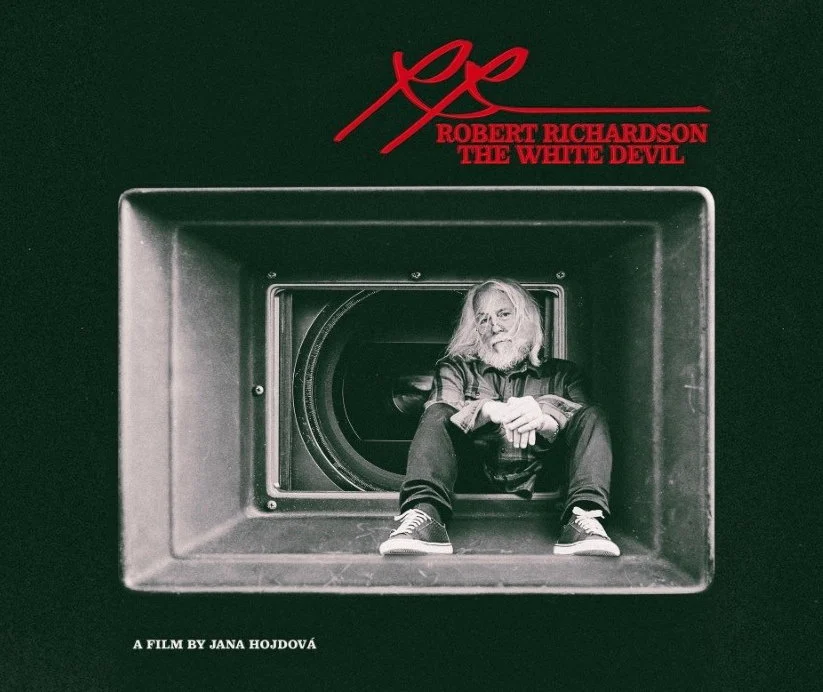
Barletta Productions has officially released the first trailer for Robert Richardson: The White Devil, a feature-length documentary that explores the life, craft, and personal sacrifices of one of the most decorated cinematographers in the history of motion pictures. Directed by Czech filmmaker and cinematographer Jana Hojdová, the film is scheduled to make its world premiere at the 2026 Karlovy Vary International Film Festival (KVIFF) in Czechia. The documentary offers an unprecedented look into the psychological and professional world of Robert Richardson, a three-time Academy Award winner whose collaboration with directors such as Oliver Stone, Martin Scorsese, and Quentin Tarantino has defined the visual language of modern cinema.
The project originated from an unlikely correspondence between Hojdová, then a cinematography student at the Film and TV School of the Academy of Performing Arts in Prague (FAMU), and Richardson. What began as a simple inquiry for a student project evolved into a multi-year creative partnership, during which Hojdová was granted exclusive access to Richardson’s sets in Los Angeles, London, New Zealand, and Sofia. Through a combination of archival footage, behind-the-scenes observations, and candid interviews with Richardson and his long-term collaborators, the film seeks to reconcile the artist’s technical brilliance with the personal toll of a career defined by an uncompromising work ethic.
The Genesis of an Unlikely Collaboration
The narrative of Robert Richardson: The White Devil is as much about the mentorship between two cinematographers as it is about Richardson’s individual legacy. Jana Hojdová, the daughter of a cinematography tradition deeply rooted in Central European aesthetics, reached out to Richardson via email with little expectation of a response. At the time, Richardson was already a titan of the industry, known for his intense personality and a visual style characterized by high-contrast lighting and a signature use of "hot" top-lighting.

According to production notes from Barletta Productions, Richardson’s decision to engage with Hojdová was driven by a mutual respect for the craft. The documentary captures this journey, documenting Hojdová as she follows Richardson across various international film sets. This observational approach provides a rare glimpse into the logistical and creative pressures of high-budget filmmaking. The film chronicles the transition of their relationship from a master-student dynamic to a professional friendship, offering a unique perspective on Richardson’s methods from the eyes of a fellow practitioner.
A Legacy of Visual Innovation
To understand the significance of the documentary, one must look at the breadth of Robert Richardson’s career. Richardson’s filmography is a timeline of cinematic evolution over the last four decades. He first rose to prominence through his collaboration with Oliver Stone, winning his first Academy Award for Best Cinematography for JFK (1991). His work on Platoon, Wall Street, and The Doors helped establish a gritty, visceral style that defined the aesthetic of late 20th-century political dramas.
Richardson’s versatility is a primary focus of the documentary. His partnership with Martin Scorsese resulted in his second Academy Award for The Aviator (2004) and a third for Hugo (2011). In these films, Richardson demonstrated a mastery of color and digital intermediate processes, blending historical reverence with cutting-edge technology. However, it is perhaps his work with Quentin Tarantino—spanning from Kill Bill to Once Upon a Time in Hollywood—that has cemented his status as a modern icon. Richardson’s ability to jump between 35mm, 65mm, and digital formats while maintaining a distinct "Richardson look" is analyzed in the film through interviews with camera operators and lighting technicians who have worked alongside him for decades.
Technical Analysis and the White Devil Moniker
The title of the documentary, The White Devil, serves as a double entendre. In technical circles, it refers to Richardson’s penchant for overexposing highlights—a technique that creates a glowing, ethereal effect on screen but is notoriously difficult to manage on set. This "white" light has become his trademark, often used to isolate characters or imbue a scene with a sense of hyper-reality.

Beyond the technical aspect, the title alludes to the internal intensity Richardson brings to his work. The trailer features a poignant quote from Richardson: "I’m deeply addicted to work. Because I choose the work over family." This admission sets the tone for a documentary that does not shy away from the darker aspects of professional greatness. The film explores the "devil" of perfectionism—the relentless drive that has led to three Oscars but has also resulted in significant personal isolation.
Industry analysts suggest that by focusing on the psychological cost of excellence, Hojdová’s film differentiates itself from standard "making-of" documentaries. It positions cinematography not just as a technical job, but as an all-consuming vocation that demands a sacrifice of the self.
Chronology of Production and Global Scope
The production of Robert Richardson: The White Devil spanned several years, tracking Richardson through some of the most demanding shoots of his later career. The timeline of the documentary includes:
- Initial Outreach (Early 2020s): Jana Hojdová contacts Richardson while studying at FAMU.
- The Los Angeles Sessions: Early interviews and observations of Richardson’s workflow in Hollywood.
- International Production (2023-2025): Hojdová travels to London, New Zealand, and Sofia, following Richardson on the sets of major studio productions. This period captures the grueling nature of "on-location" filming and the physical stamina required of a cinematographer in their 60s.
- Post-Production (Late 2025 – Early 2026): Editing in Prague, incorporating archival footage from the 1980s and 90s provided by Richardson’s personal estate and major studios.
- Premiere Announcement (June 2026): The Karlovy Vary International Film Festival confirms the film as a highlight of its 2026 documentary program.
The global nature of the shoot highlights the nomadic existence of the modern filmmaker. By filming in disparate locations like Sofia and New Zealand, Hojdová emphasizes that for Richardson, "home" is often the film set, regardless of where in the world it may be located.

The Karlovy Vary Premiere and Industry Significance
The choice of the Karlovy Vary International Film Festival for the world premiere is significant. As one of the oldest film festivals in the world and the leading event in Central and Eastern Europe, KVIFF has a long history of celebrating the technical and artistic merits of cinema. The festival’s "East of the West" and "Documentary" sections often highlight filmmakers who push the boundaries of the medium.
Given Hojdová’s Czech heritage and her education at FAMU—an institution that has produced cinematic giants like Miloš Forman and Agnieszka Holland—the premiere serves as a homecoming of sorts. It also underscores the global influence of American cinematography, as seen through a European lens. The festival’s organizers have noted that the film is expected to be a major draw for both film students and industry veterans, providing a masterclass in the art of light and shadow.
Broader Implications for the Film Industry
The release of Robert Richardson: The White Devil comes at a time when the role of the cinematographer is undergoing rapid change. With the rise of artificial intelligence in color grading and virtual production environments (such as "The Volume"), the documentary serves as a reminder of the human element in visual storytelling. Richardson’s reliance on instinct, his physical presence on the dolly, and his relationship with the actors are portrayed as irreplaceable components of the cinematic experience.
Furthermore, the documentary contributes to a growing conversation within the film industry regarding mental health and work-life balance. By documenting Richardson’s "addiction" to his craft, the film prompts a discussion on whether the industry’s culture of 16-hour days and months away from home is sustainable or healthy. For aspiring filmmakers, the documentary serves as both an inspiration and a cautionary tale.

Expected Reception and Distribution
While Barletta Productions has not yet announced a wide theatrical or streaming release date, the buzz surrounding the KVIFF premiere suggests a strong festival run. Documentary distributors such as Neon, A24, or specialized streamers like MUBI are anticipated to show interest, given the subject matter’s appeal to cinephiles.
The film’s inclusion of insights from directors like Scorsese and Tarantino—though their specific interview appearances are kept under wraps in the trailer—adds significant commercial and critical weight to the project. As the industry gathers in Czechia next month, Robert Richardson: The White Devil stands as a definitive portrait of a man who changed the way we see movies, and the heavy price he paid to do so.