Karlovy Vary, Czech Republic — Renowned actor, writer, and director Jesse Eisenberg, celebrated for his roles in The Social Network and his acclaimed directorial debut When You Finish Saving the World, announced on Saturday his imminent acquisition of Polish citizenship, signaling a deliberate pivot in his artistic career towards Central Europe. The announcement, made during a heartfelt acceptance speech at the Karlovy Vary International Film Festival (KVIFF) in the Czech Republic, underscored a growing sentiment among filmmakers regarding the challenges of producing artistically driven, mid-budget projects within the current Hollywood ecosystem. Eisenberg expressed a strong desire to dedicate more of his time and creative energy to filmmaking in the region, where he believes such "human scale, strange mid-budget films" are not only thriving but also deeply celebrated.
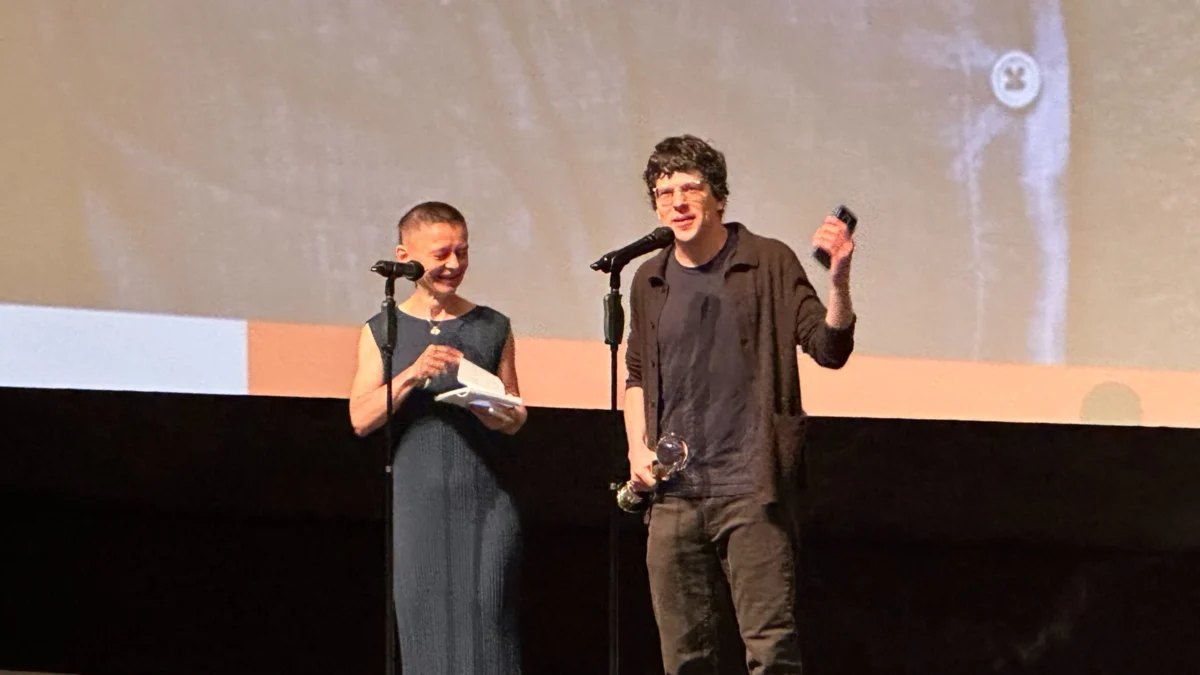
The revelation came as Eisenberg received the prestigious President’s Award at the 60th edition of KVIFF, held in the 80th year of the venerable Czech festival. Addressing a captivated audience in the Grand Hall of the Hotel Thermal, the festival’s bustling headquarters, Eisenberg shared, "Being here has particular meaning for me right now, because in exactly one week I am receiving my Polish citizenship. I pursued Polish citizenship because of my family’s heritage, but also because I want to spend more time in my life and my career working in Europe, specifically Central Europe." His comments resonated deeply, highlighting both a personal connection to his ancestry and a professional calculation regarding the future of independent cinema.
A Quest for Artistic Freedom: Hollywood vs. Europe
Eisenberg’s candid remarks shed light on a broader trend and an ongoing discourse within the global film industry. He articulated a clear distinction between the current filmmaking climate in America and Europe. "In America, many of the kind of films that I love so much — human scale, strange mid-budget films — have become increasingly difficult to make, but in Europe, those movies are thriving and celebrated," he stated. This observation speaks to the evolving financial and creative models that dictate film production on both continents.
Hollywood, in recent decades, has largely consolidated its resources around tentpole blockbusters, expansive franchise films, and high-concept genre productions, often driven by intellectual property with built-in fanbases. The economic imperative to generate massive returns has led to a cautious approach towards original, character-driven narratives that fall outside the mega-budget or micro-budget extremes. Mid-budget films, typically costing between $10 million and $60 million, once the bedrock of nuanced storytelling and star-driven dramas, have found themselves in an increasingly precarious position. These films often struggle to secure financing, marketing budgets, and theatrical distribution slots against the juggernauts dominating multiplexes. The rise of streaming services, while offering new avenues for content, has also shifted the perception of value and the economics of certain film types, sometimes pushing them into a less prominent direct-to-digital release model rather than a robust theatrical run.
Conversely, the European film landscape, particularly in Central Europe, frequently operates under a different paradigm. Many European countries, including Poland and the Czech Republic, boast robust public funding mechanisms, national film institutes, and cultural subsidies designed to foster artistic expression and preserve national cinematic heritage. These governmental and cultural institutions often prioritize artistic merit, diverse storytelling, and the development of unique voices over purely commercial viability. This support system, coupled with a strong tradition of auteur cinema and a vibrant festival circuit, creates a more fertile ground for the kinds of intimate, character-focused dramas and experimental narratives that Eisenberg cherishes. Filmmakers in these regions often benefit from co-production treaties, which allow for pooling resources across borders, further facilitating the creation of diverse projects. This environment cultivates an audience that actively seeks out and champions films that explore complex human experiences, often valuing thematic depth and artistic innovation over spectacle.
Karlovy Vary: A Beacon for Independent Cinema
Eisenberg’s announcement at KVIFF was particularly fitting, given the festival’s enduring legacy as a champion of independent and arthouse cinema. The Karlovy Vary International Film Festival, now in its 60th year, has long been a significant cultural event, renowned for showcasing films from Eastern and Central Europe, alongside acclaimed international productions. Its President’s Award is bestowed upon figures who have made profound contributions to world cinema, recognizing not just commercial success but artistic integrity and impact.
This year’s KVIFF has been a star-studded affair, reflecting its growing prominence on the international festival circuit. Alongside Eisenberg, cinematic legends such as Dustin Hoffman, honored with the Crystal Globe for Outstanding Artistic Contributions to World Cinema, and Maggie Gyllenhaal, also a recipient of the President’s Award, graced the festival. Harvey Keitel further added to the illustrious roster of guests walking the expanded red carpet in the picturesque Czech spa town. The festival’s ability to attract such caliber of talent underscores its vital role in the global film ecosystem, serving as a critical platform for films that might not receive the same spotlight in more commercial venues.
During his appearance, Eisenberg also introduced a screening of The Double, the 2013 Richard Ayoade-directed film in which he plays the lead role. In a surprisingly personal confession, he revealed that the KVIFF screening was the first time he had actually watched the film himself, explaining his traditional aversion to seeing his own face on screen. However, his burgeoning career as a director has instilled in him "the courage" to engage with his past work. He noted the "wonderfully strange" feeling of introducing The Double, a film made over a decade ago, acknowledging its significant debt to Central European cinema, thus further cementing his artistic alignment with the region.
Jesse Eisenberg’s Multifaceted Career: From Actor to Auteur

Eisenberg’s journey through Hollywood has been marked by a distinctive blend of sharp intellect, neurotic charm, and an unwavering commitment to complex characters. His career trajectory provides valuable context to his recent decision.
Born in New York, Eisenberg first gained critical attention for his role in the 2002 independent film Roger Dodger, earning him an award for most promising young actor at the San Diego Film Festival. His performance in Noah Baumbach’s poignant family drama The Squid and the Whale (2005) further solidified his reputation, garnering nominations for the Independent Spirit Award and the Critics’ Choice Award. While he tasted commercial success with the apocalyptic horror-comedy Zombieland (2009), it was his iconic portrayal of Facebook founder Mark Zuckerberg in David Fincher’s The Social Network (2010) that catapulted him to international stardom, earning him his first nominations for an Academy Award, a Golden Globe, and a BAFTA Award. This role cemented his image as an actor capable of embodying brilliant, yet often socially awkward, characters with remarkable depth.
In recent years, Eisenberg has increasingly diversified his artistic output, venturing beyond acting into screenwriting and directing, a move that parallels his desire for greater creative control and the ability to tell stories on his own terms. His directorial debut, When You Finish Saving the World, starring Julianne Moore and Finn Wolfhard, premiered at prestigious festivals like Sundance and Cannes, showcasing his unique voice as a filmmaker exploring intricate family dynamics.
He subsequently garnered significant critical acclaim for his second feature, A Real Pain (2024), which he also wrote, directed, and co-starred in alongside Kieran Culkin. The film, a poignant and often humorous exploration of two cousins retracing their Jewish heritage in Poland, received widespread accolades. Eisenberg was nominated for an Oscar and a Golden Globe for best screenplay, and his script won a BAFTA Award, the Waldo Salt Award at the Sundance Film Festival, an Independent Spirit Award, and numerous other prizes. His performance also earned him a Golden Globe nomination for best actor, while Kieran Culkin’s portrayal garnered an Academy Award for best supporting actor. The very subject matter of A Real Pain — a journey into ancestral heritage in Poland — foreshadowed his personal decision to pursue Polish citizenship, blurring the lines between his artistic pursuits and his personal identity.
His upcoming project, The Debut, further illustrates his ambitious creative vision. Starring Julianne Moore and Paul Giamatti, Eisenberg not only writes and directs but also composed the music and lyrics for a musical-within-the-movie. Set for a fall release by A24, The Debut promises to be another distinctive addition to his growing body of work as an auteur. KVIFF, in its pre-festival announcement honoring Eisenberg, aptly described him as "one of the most multifaceted figures in contemporary cinema," a testament to his versatile talents.
Ancestral Roots and the Practicalities of EU Citizenship
Eisenberg’s decision to pursue Polish citizenship is deeply rooted in his family’s heritage, a connection he openly acknowledged. While the original article does not delve into specific details of his lineage, it is widely known that many Jewish families from Eastern Europe, including Poland, emigrated during periods of persecution and conflict in the 20th century. For descendants, reclaiming citizenship in their ancestral lands can be a profound act of connection to history, identity, and family legacy. It can be a way to honor those who came before and to acknowledge a complex, often painful, past.
Beyond the personal and symbolic significance, Polish citizenship, as a member state of the European Union, offers considerable practical advantages for a filmmaker like Eisenberg. An EU passport grants the holder the right to live, work, and travel freely across the 27 member states. For a director seeking to work more extensively in Central Europe, this facilitates ease of movement, eliminates visa complexities, and simplifies legal and logistical aspects of film production. It opens doors to participating in European co-productions, accessing national and regional film funds, and collaborating with a broader pool of European talent and crews without bureaucratic hurdles. This freedom allows for a more seamless integration into the European film industry, aligning perfectly with his stated professional goals.
Broader Implications for the Global Film Industry
Jesse Eisenberg’s decision to embrace Polish citizenship and focus his creative endeavors on Central Europe could be viewed as more than just an individual career move; it may signal a burgeoning trend among artists seeking environments conducive to specific types of storytelling. As Hollywood continues its reliance on tentpole franchises and risk-averse strategies, the allure of international markets, particularly those with robust support for independent and art-house cinema, grows stronger for filmmakers who prioritize artistic integrity and diverse narratives.
His public articulation of the challenges in Hollywood and the opportunities in Europe might embolden other mid-career directors and actors to explore similar paths. It highlights the cultural and economic divergence between different global film markets and reinforces the vital role that film festivals like KVIFF play in sustaining and celebrating cinematic diversity. These festivals not only provide platforms for films but also foster communities where artistic visions can be shared and supported, often leading to international collaborations and cross-cultural exchanges.
Eisenberg’s move serves as a compelling case study in the ongoing evolution of the film industry. It underscores the perpetual tension between commerce and art, and the determination of some artists to navigate this landscape by seeking out creative havens where their particular brand of storytelling can flourish. His embrace of Polish citizenship represents a personal journey into his heritage, but simultaneously, it marks a significant professional commitment to a global cinematic future that is increasingly decentralized and diverse, promising a rich tapestry of "human scale" stories from the heart of Europe.