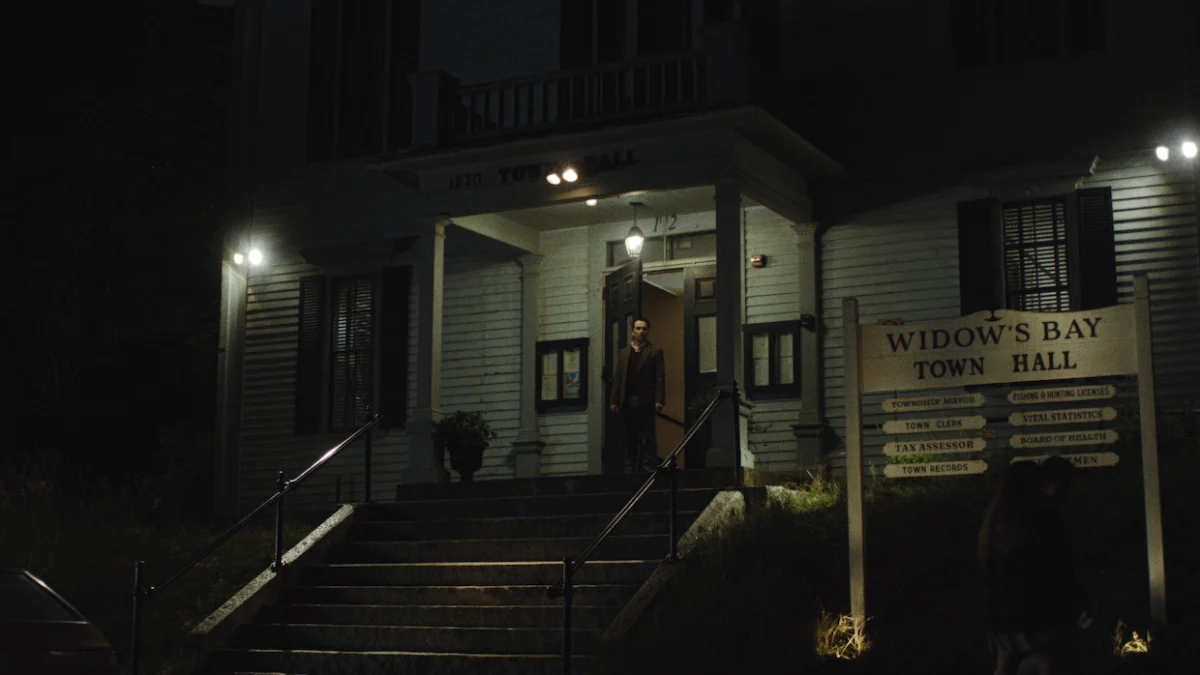
The creative synergy between sketch comedy and the horror genre has seen a remarkable resurgence in recent years, with a new wave of auteurs successfully transitioning from crafting laughs to eliciting screams. Apple TV+’s highly anticipated series, Widow’s Bay, stands as the latest and perhaps most nuanced entry in this intriguing trend, helmed by creator and showrunner Katie Dippold, whose comedic roots stretch from Mad TV to Parks and Recreation. This ten-episode series, starring Matthew Rhys and Stephen Root, exemplifies a sophisticated blend of genuine scares and character-driven humor, challenging traditional genre boundaries and prompting a reevaluation of how such productions are perceived, particularly within the competitive landscape of prestigious awards like the Emmys.
The Rise of Comedy Auteurs in Horror
The trajectory of comedians finding profound success in horror is not entirely new, with historical examples dating back decades. However, the last decade has seen this phenomenon reach unprecedented critical and commercial peaks, fundamentally reshaping audience expectations for the genre. Jordan Peele, formerly one half of the iconic sketch duo Key & Peele, catalyzed this movement in 2017 with his feature directorial debut, Get Out. The film was not merely a box office sensation, grossing over $255 million worldwide on a modest $4.5 million budget, but also a critical darling, earning Peele an Academy Award for Best Original Screenplay. Get Out masterfully wove biting social commentary into a psychological horror narrative, proving that a deep understanding of tension and release – hallmarks of good comedy – could be powerfully repurposed for dread. Peele solidified his position as a horror visionary with subsequent films, Us (2019) and Nope (2022), both of which continued his exploration of complex themes within genre frameworks, consistently achieving both critical acclaim and impressive box office returns.
Following Peele’s groundbreaking success, Zach Cregger, a founding member of the absurdist comedy troupe The Whitest Kids U’ Know, made a similarly impactful pivot. His 2022 directorial effort, Barbarian, emerged as a sleeper hit, surprising audiences and critics with its ingenious twists and genuinely unsettling atmosphere. Grossing over $45 million globally against a $4.5 million budget, Barbarian showcased Cregger’s ability to subvert expectations and build suspense with a keen comedic sensibility. Cregger’s second feature, Weapons, has already garnered significant attention, notably with Amy Madigan securing a Best Supporting Actress award for her "devious turn," further cementing the viability of comedy alumni in the horror space. These creators demonstrate a shared understanding of how to manipulate audience emotions, whether for a laugh or a scream, making their transition seem less like a departure and more like an evolution of their craft.
Katie Dippold, with Widow’s Bay, offers her unique perspective on this crossover. "I really do think there’s something to people who started in sketch comedy understanding how to build something, setting up the anticipation and the payoff," Dippold articulates. This insight highlights a fundamental truth: both comedy and horror thrive on the meticulous construction of tension and its subsequent release. A well-timed punchline and a perfectly executed jump scare rely on similar principles of pacing, misdirection, and emotional manipulation. The difference, as Dippold aptly notes, lies in the outcome: "What I find fun is that you don’t know if that build is going to lead to something that’s going to make you laugh or scare you." This ambiguity is precisely where Widow’s Bay finds its distinctive voice.
Katie Dippold’s Journey from Sitcoms to Supernatural Stories
Dippold’s professional journey provides a compelling case study for this genre fluidity. Her early career was firmly rooted in the world of sketch comedy and sitcoms, beginning with writing credits on the long-running sketch comedy series Mad TV. This experience honed her ability to craft concise, impactful comedic narratives and develop memorable characters within short formats. Her subsequent work on the critically acclaimed NBC sitcom Parks and Recreation further showcased her talent for character development, ensemble dynamics, and sustained comedic storytelling over multiple seasons. Parks and Recreation, known for its optimistic tone and quirky small-town charm, provided Dippold with invaluable experience in building a believable world populated by eccentric yet endearing individuals—a skill that proves surprisingly transferable to the setting of Widow’s Bay.
Dippold’s transition into the horror-comedy cinematic realm began with significant screenwriting credits on high-profile projects. In 2016, she co-wrote the controversial yet financially successful female-led Ghostbusters reboot. This film, while divisive among fans, demonstrated Dippold’s capability to infuse a beloved supernatural franchise with contemporary comedic sensibilities. Despite facing intense scrutiny and online backlash, the film earned over $229 million worldwide, proving the market for a comedic approach to paranormal activity. More recently, Dippold penned the screenplay for Disney’s 2023 Haunted Mansion film, a family-friendly horror-comedy that, while not a box office juggernaut, further solidified her reputation for blending spectral elements with humor. These experiences provided her with a crucial understanding of balancing audience expectations for scares with the necessity of comedic relief, setting the stage for her most ambitious project to date: Widow’s Bay.
The genesis of Widow’s Bay itself is a testament to Dippold’s long-term vision and persistent creative drive. She reveals that the core concept for the series has been percolating for nearly two decades, having initially conceived it as a Parks and Recreation spec script. This origin story underscores the deep roots of the show’s comedic foundation, drawing parallels to the quirky, community-focused dynamics of her previous work, but now infused with a sinister undercurrent. The evolution from a broad comedy spec script to a series that deftly balances humor with horror highlights not only Dippold’s growth as a storyteller but also the industry’s increasing openness to genre hybridization. This protracted development period, spanning 18 years, allowed the concept to mature, absorbing lessons from her film work and the broader shifts in television storytelling, ultimately culminating in the rich, multi-layered narrative of Widow’s Bay.
Widow’s Bay: A Deep Dive into its Unique Blend of Horror and Humor
Set against the picturesque yet perpetually ominous backdrop of a fictional New England island, Widow’s Bay introduces audiences to a community grappling with an undeniable supernatural infestation. At its heart is Mayor Tom Loftis, portrayed with endearing optimism by Emmy-winning actor Matthew Rhys. Loftis, a character reminiscent of a more charming and less corruptible Mayor Vaughn from Jaws, harbors an ambitious dream: to transform Widow’s Bay into a thriving vacation destination, a beacon of New England charm. His unwavering belief in the town’s potential, however, frequently clashes with the grim reality of its haunted existence and the fervent skepticism of local residents.
Among these residents is Wyck, the quintessential town crankpot, brought to life by the inimitable Stephen Root. Wyck serves as Mayor Loftis’s primary foil, a relentless Cassandra-like figure convinced the island is irrevocably cursed and perpetually on the brink of supernatural disaster. His grim pronouncements and dire warnings provide a constant, darkly comedic counterpoint to Loftis’s sunnier disposition. The humor in Widow’s Bay often springs from this dynamic—the clash between ordinary human aspirations and increasingly outlandish supernatural occurrences.
The island’s assortment of evils is genuinely unsettling, yet frequently presented through a comedic lens. Ominous fogs, thick and sentient, roll in from the sea, obscuring vision and foreboding doom. A genuinely terrifying killer clown stalks the unsuspecting, merging classic horror tropes with moments of absurd terror. Perhaps most memorably, an "amorous sea hag" emerges from the briny depths, her predatory advances on male victims leading to some of the series’ most outrageous physical gags. One particular scene involves the hag, notorious for smothering her victims by sitting on their faces, being comically propelled across Tom Loftis’s living room by a well-timed, if accidental, recline of an armchair. This is a prime example of the show’s commitment to finding humor in the most grotesque of situations.
Other supernatural elements include a genuinely haunted inn, where even the grizzled innkeeper refuses to stay overnight. Mayor Loftis, in a misguided attempt to prove its non-haunted status, volunteers for a night’s stay, only to be subjected to a series of terrifying and humiliating encounters. A mysterious spellbook, discovered by townsfolk, nearly turns a seemingly innocuous cocktail party into a mass drowning event, showcasing the swift and often chaotic escalation of the supernatural threats. What distinguishes Widow’s Bay is not just the presence of these horror elements, but the characters’ often relatable, albeit exaggerated, reactions to them. The humor arises from their desperate attempts to rationalize, mitigate, or simply survive scenarios that defy all logic, mirroring the coping mechanisms often seen in great situational comedies. It is a show where the real fun lies in observing how well-meaning, if somewhat naive, characters navigate an increasingly unhinged and supernaturally-charged reality.
Crafting the Aesthetic: Collaboration and Inspiration

The distinctive brooding visual tone of Widow’s Bay is a testament to Katie Dippold’s collaborative vision, particularly her partnership with Emmy-winning executive producer Hiro Murai. Murai, celebrated for his directorial work on critically acclaimed series such as FX’s Atlanta, Hulu’s The Bear, and HBO Max’s Station Eleven, brings a sophisticated and often surreal aesthetic sensibility to the project. His ability to seamlessly blend dark humor, atmospheric dread, and profound character studies made him an ideal collaborator for Dippold’s unique genre hybrid. Murai directed five of the season’s ten episodes, establishing a visual language that is both unsettling and visually captivating, mirroring the show’s tonal duality.
The inspiration for this unique blend of fear and fun stems from a vivid memory from Dippold’s teenage years. She recounts visiting a "lawless" haunted house in Long Branch, New Jersey, during the 1980s. "It was the ‘80s, and it was lawless. They could chase you around and grab you," she reminisces. This visceral experience of being genuinely scared while simultaneously "having the time of your life" became the core emotional touchstone for Widow’s Bay. It’s this precise sensation—the thrill of fear intertwined with the exhilaration of amusement—that Dippold has striven to capture in the series. This background context is crucial, as it explains the show’s deliberate approach to making its supernatural elements genuinely creepy while allowing the characters’ reactions to provide comedic relief.
Dippold’s collaborative philosophy extends beyond Murai, embracing the entire creative team. She emphasizes that the process of making television, unlike the often solitary nature of feature film writing, fosters an environment of shared vision. "With features, you just write the script and you’re lucky if the director wants you on set," she observes, highlighting the limitations of a singular authorial voice in film. In contrast, her role as showrunner on Widow’s Bay allowed her to actively seek and integrate input from various departments. "Not being able to have much say once the script is in and [now] being in a position where I have all the say naturally made me someone who wants that collaboration," she explains. This willingness to embrace diverse perspectives from brilliant actors, a tremendous production design team, and visionary directors who brought "other ideas that I would not have thought of" is key to the show’s multifaceted success. It underscores her belief that the strongest creative endeavors are born from a collective effort, allowing the narrative, visual style, and performances to evolve organically into something greater than any individual’s initial concept.
The Ensemble: Blending Dramatic Depth with Comedic Timing
The strategic casting choices for Widow’s Bay are integral to its successful navigation of the horror-comedy tightrope. While one might expect a show blending comedy and horror to lean heavily on established comedic performers, Dippold consciously opted for a core cast largely recognized for their work in television dramas. Matthew Rhys, an Emmy winner for his intense dramatic performance in The Americans, anchors the series as Mayor Tom Loftis. Alongside him, Kate O’Flynn, known for her dramatic roles, plays Tom’s mousy assistant Patricia; Kevin Carroll, with a background in weighty dramatic series, embodies the town sheriff Bechir Clemmons; and Dale Dickey, celebrated for her gritty, dramatic turns, portrays Rosemary, one of Tom’s no-nonsense employees.
This deliberate choice, Dippold explains, was essential for maintaining the show’s tonal balance. She initially considered populating her fictional town with comedic actors she had admired since her improv days at the Upright Citizens Brigade Theatre. However, she found that such casting "just took me out of it… Like, I don’t believe it’s a real place, and I don’t know that I would watch the show." As a horror fan, Dippold prioritized credibility: "I want to know that they’re taking it seriously." This philosophy dictates that the horror elements must be genuinely felt by the characters for the comedy to land effectively. Matthew Rhys, suggested by casting director Allison Jones, proved to be the perfect fit. Dippold praises his approach: "He always just plays the truth of the scene… He never goes for the joke. He’s so naturally funny, and he understands what’s funny about [the scene]."
Stephen Root, in the role of the town crankpot Wyck, stands as a fascinating bridge between the dramatic and comedic sensibilities of the cast. Root is a beloved figure in both comedy and drama, known for iconic roles in NewsRadio and Office Space, as well as his Emmy-nominated dramatic performance in Barry. His recent Emmy contention for voice work in the Netflix animated series Strip Law further highlights his incredible versatility. Root’s ability to imbue even the most outlandish characters with a grounded reality makes him an ideal foil, delivering dire warnings with a deadpan earnestness that serves both the horror and comedic aspects of the show.
Conversely, the supporting cast is intentionally populated with recognizable comedic talent, including Emmy winner Jeff Hiller, Tim Baltz, Toby Huss, Neil Casey, Connor Ratliff, and Chris Fleming. These actors provide vibrant, often absurd, comedic flourishes that enhance the show’s humor without undermining the dramatic integrity of the main narrative. Their presence adds layers of comedic texture, ensuring that while the primary characters react to the supernatural with a degree of grounded realism, the broader world of Widow’s Bay remains delightfully off-kilter.
Dippold’s casting philosophy echoes an insightful anecdote from the making of Sydney Pollack’s classic comedy Tootsie. As shared during a Q&A, Pollack was reportedly astounded by how funny the movie turned out, given the intensely dramatic mood on set. Dippold finds profound resonance in this observation. "Often when I talk about influences on the show, I talk about Stephen King and John Carpenter, Atlanta and Parks and Rec," she reveals, "but I am secretly also thinking about Tootsie—but I never say it, because I know it’s going to confuse the hell out of everyone." The parallel lies in Dustin Hoffman’s committed, serious performance as Michael Dorsey/Dorothy Michaels. Hoffman played the role with absolute conviction, never winking at the audience or going for a cheap laugh. It was his dedication to the dramatic reality of his character’s predicament that made the film so uproariously funny. Dippold believes her Widow’s Bay cast employs a similar strategy: "They don’t look at it like they’re in a comedy or a horror show; they’re just playing the scenes and they’re not thinking about the genres. And I think that helps a great deal." This commitment to character and truth, regardless of genre, is ultimately what allows Widow’s Bay to deliver both genuine chills and hearty laughs.
Emmy Contention: Navigating Genre Categories
The unique blend of horror and comedy in Widow’s Bay presents a fascinating challenge for awards bodies, particularly the Television Academy. Despite its genuinely unsettling supernatural elements and gruesome moments, the series will be submitted for Emmy consideration as a "comedy series." This strategic decision reflects Dippold’s primary comedic intent, even as it positions the show in a category that has historically been somewhat resistant to embracing genre-bending entries.
The Emmys have often struggled with how to categorize and recognize shows that defy strict genre definitions. While drama categories have shown increasing inclusivity, embracing genre shows like Game of Thrones, The Boys, The Last of Us, Lovecraft Country, The Mandalorian, and Stranger Things, the comedy categories have been slower to open their doors to the fantastical or terrifying. The reasoning often cited is a perceived difference in comedic approach or thematic weight, which traditional sitcoms and character-driven comedies are typically expected to uphold.
However, recent years have seen a crack in this traditional barrier, offering a glimmer of hope for Widow’s Bay. Netflix’s Wednesday and FX’s What We Do in the Shadows have both achieved Emmy recognition in comedy categories, despite their strong genre elements. Wednesday, a gothic mystery-comedy, successfully blended teen drama with supernatural investigation, resonating with a broad audience and garnering nominations. What We Do in the Shadows, a mockumentary about vampire roommates, has consistently earned critical acclaim and multiple Emmy nominations, proving that a specific, well-executed comedic tone can overcome genre classifications. These two examples, vastly different in their tonal approach but united by their genre-comedy blend, suggest a gradual evolution in the Academy’s receptiveness.
The film awards circuit, particularly the Golden Globes, offers a precedent for genre flexibility. Both Jordan Peele’s Get Out and the recently acclaimed body-horror film The Substance were notably submitted and nominated in the "Musical or Comedy" categories at the Golden Globes, a strategic move by distributors to avoid tougher competition in drama categories and highlight their comedic undertones. This highlights an industry-wide recognition that horror, especially when executed with a satirical or darkly humorous edge, can legitimately be classified as comedy.
For Widow’s Bay, its Emmy campaign will serve as a crucial test case. Can the comedy series Emmy be as inclusive and forward-thinking as its dramatic counterpart? The show’s creators argue that the jokes are as vital as the chills, intricately woven into the narrative fabric rather than existing as mere comic relief. The implication for voters is profound: successfully executing a jump scare, with its meticulous timing and psychological impact, requires a level of craftsmanship and understanding of audience response that is arguably on par with delivering a perfectly timed punchline. If Widow’s Bay can garner significant Emmy attention, it could signal a broader acceptance of genre fluidity within television comedy, encouraging more creators to explore the rich, fertile ground where laughter and fear unsettlingly, yet hilariously, converge. This would not only be a win for Widow’s Bay but for the evolving definition of what constitutes "comedy" in the golden age of television.