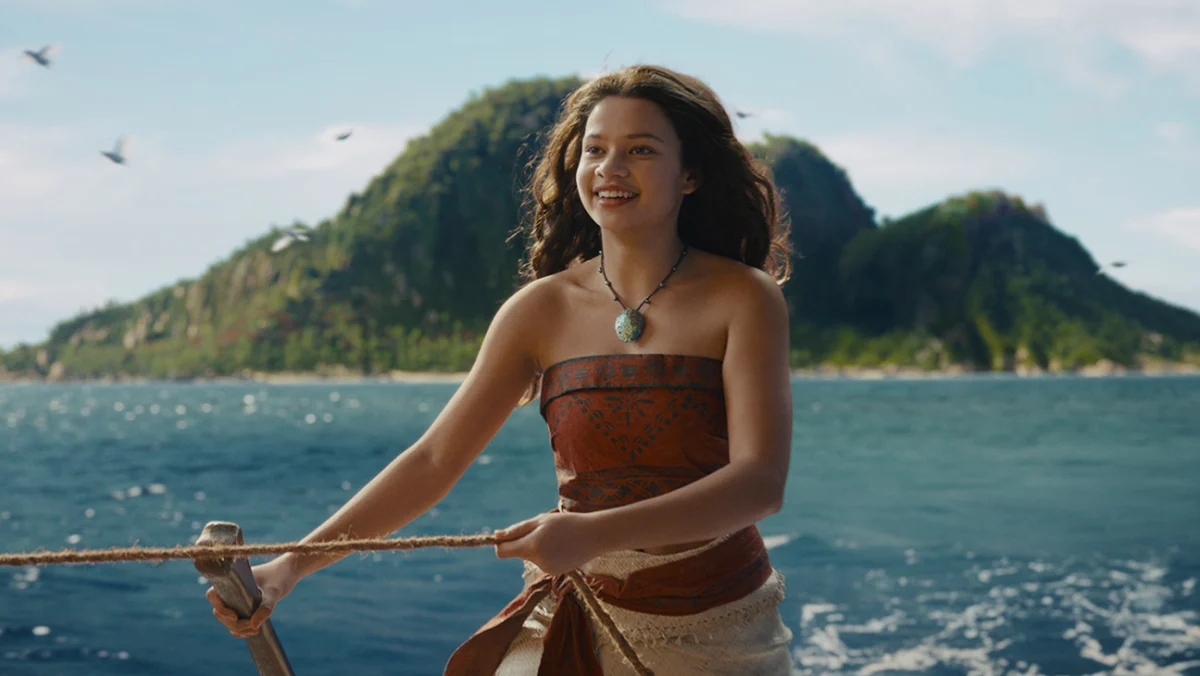
Disney’s highly anticipated live-action adaptation of Moana, featuring global superstar Dwayne Johnson reprising his role as the demigod Maui and introducing Catherine Laga’aia as the titular heroine, has encountered a challenging start at the domestic box office. The reimagining of the beloved 2016 animated feature, directed by Thomas Kail, garnered an estimated $18 million on its opening Friday, including early Thursday previews. This initial performance projects an opening weekend total around $45 million from approximately 3,900 North American screens. This figure falls significantly short of Disney’s targeted $60 million-plus benchmark, and even further from initial tracking estimates that suggested a potential opening weekend haul of $75 million. The film, which carries a substantial production budget of $250 million, received an A- CinemaScore from audiences, indicating positive viewer reception despite its lukewarm commercial debut. Its success will now heavily rely on sustained appeal to family audiences throughout the competitive summer movie season, especially as Universal’s R-rated The Odyssey, directed by Christopher Nolan, enters the fray next weekend.
A Deeper Look at the Box Office Performance
The soft opening for live-action Moana immediately invites comparisons and raises concerns within the industry, particularly given Disney’s recent track record with its live-action remakes. While an A- CinemaScore suggests strong word-of-mouth potential among those who see it, the initial turnout signals a disconnect between audience enthusiasm for the brand and willingness to purchase tickets for this particular iteration. For a film with a quarter-billion-dollar production cost, a $45 million opening is undeniably problematic, demanding exceptional longevity and robust international performance to approach profitability.
This debut is eerily reminiscent of the $42 million opening in March 2025 for Snow White, another high-profile Disney live-action remake starring Rachel Zegler and Gal Gadot. That film, with an even higher production budget of $270 million, was considered a significant box office disappointment, earning a B+ CinemaScore. The subdued reception of Snow White notably led to Disney temporarily halting development on its planned live-action Tangled weeks after its release. Tangled subsequently re-entered development in the fall of the same year, buoyed by the unexpected colossal success of Lilo & Stitch, which opened in May 2025 to a staggering $146 million in North America and ultimately surpassed $1 billion globally. This oscillating strategy underscores Disney’s reactive approach to its live-action slate, heavily influenced by immediate box office returns. Currently, Tangled is in production in Spain, with a live-action sequel to Lilo & Stitch also confirmed to be in development.
Disney’s Live-Action Remake Strategy Under Scrutiny
For over a decade, Disney has aggressively pursued a strategy of adapting its classic animated properties into live-action or photorealistic CGI films. This approach, initially conceived to leverage beloved intellectual property, tap into nostalgic appeal, and generate new revenue streams, has yielded mixed results. Early successes such as Tim Burton’s Alice in Wonderland (2010), Maleficent (2014), and Kenneth Branagh’s Cinderella (2015) paved the way for a more ambitious slate. Blockbusters like Beauty and the Beast (2017), Aladdin (2019), and The Lion King (2019) all achieved domestic openings exceeding $100 million and went on to gross over $1 billion worldwide, cementing the strategy as a seemingly infallible golden goose. These films generally benefited from strong critical reception, or at least a high level of audience enthusiasm that translated into ticket sales.
However, recent years have seen increasing critical and commercial scrutiny. While audience CinemaScores for these remakes often remain positive, critical consensus, as reflected by Rotten Tomatoes, has been more volatile. The live-action Moana currently holds a 34 percent critics rating on Rotten Tomatoes, a stark contrast to the higher scores enjoyed by earlier, more successful remakes. The Hollywood Reporter’s chief film critic David Rooney, however, offered a more nuanced view, noting that "this charming new iteration stands confidently on its own," suggesting that critical reception isn’t uniformly negative, but the aggregated score indicates a broader lack of enthusiasm among reviewers. This divergence between critical appraisal and audience satisfaction, while not uncommon, is amplified when a film carries such a significant budget and represents a tentpole release for a major studio. The challenge for Disney now is to determine if this trend is due to creative fatigue, market saturation, or specific issues with individual productions.
The Unique Challenges of the Moana Franchise Timeline
The original animated Moana, released less than a decade ago in 2016, was an undeniable cultural phenomenon and a commercial triumph. It opened to an impressive $82 million over a five-day Thanksgiving domestic opening, ultimately amassing a global cume of $643 million. The film introduced audiences to Auli’i Cravalho as the voice of Moana and Dwayne Johnson as the charismatic demigod Maui, whose partnership to save Moana’s island resonated deeply with viewers worldwide. Its vibrant animation, memorable songs, and empowering narrative made it an instant classic and a cornerstone of Disney’s modern animated canon.
The timing of the live-action Moana is particularly complex due to the recent, massive success of its animated sequel. Moana 2, originally conceived as a Disney+ series, was strategically shifted to a theatrical release in 2024. This animated sequel, again featuring Johnson and Cravalho reprising their voice roles, opened to an astonishing $225 million domestically over the five-day Thanksgiving frame and went on to surpass $1 billion globally. This phenomenal performance of Moana 2, just two years prior to the live-action version, created a "tricky timing situation" for the live-action film, which began production in mid-2024.
Industry analysts suggest that the close proximity of two major Moana theatrical releases, especially with the animated sequel being such a monumental hit, might have inadvertently diluted audience excitement or created confusion regarding the new live-action adaptation. While the Moana brand clearly boasts a massive and dedicated fanbase—Disney proudly highlights over 1.5 billion hours streamed on Disney+, more than 22 million toys sold, and exceeding 26 billion music streams—this widespread engagement does not automatically translate into theatrical ticket sales for every new iteration. The question arises whether audiences felt a strong enough imperative to see another Moana story so soon, particularly one that retells an already beloved narrative rather than continuing it. The decision to prioritize the animated sequel for theatrical release, a move widely seen as successful, might have inadvertently cannibalized potential interest in the live-action remake.
Broader Implications and Industry Reactions
The underperformance of the live-action Moana will undoubtedly prompt further introspection at Disney regarding the future of its live-action remake strategy. While the studio will likely emphasize the film’s A- CinemaScore as an indicator of positive audience experience and potential for strong legs throughout the summer, the high production budget necessitates a global gross well over $500 million, and ideally closer to $700-800 million, to be considered a clear success. This will require sustained performance, particularly in international markets where Disney remakes often find significant traction.
Industry analysts will be closely monitoring how Moana performs in the coming weeks. Is this an isolated incident, or part of a larger trend of diminishing returns for live-action remakes? The cautious approach taken with Tangled following Snow White‘s debut suggests that Disney is responsive to box office signals. The studio may become more selective in which animated classics receive the live-action treatment, potentially focusing on properties with a longer history or a clearer narrative path for reinterpretation. There might also be a greater emphasis on ensuring creative differentiation and a compelling reason for the remake’s existence beyond simply leveraging existing IP. The success of Lilo & Stitch, which offered a fresh take and resonated with audiences, could serve as a model for future projects.
Furthermore, the evolving landscape of streaming services, particularly Disney+’s vast library containing the original animated classics and new animated content, plays an increasingly complex role. While streaming can foster brand loyalty and audience engagement, it can also dilute the urgency for theatrical viewing, especially for films that closely mirror existing beloved properties. Disney’s challenge is to find a balance where its streaming content complements, rather than competes with, its theatrical releases.
The Competitive Landscape: Other Weekend Performers
Amidst Moana‘s debut, other films vied for audience attention. Warner Bros.’ Evil Dead Burn, the sixth installment in the venerable Evil Dead horror franchise that began with Sam Raimi’s 1981 original, secured the No. 4 spot. Directed by Sébastien Vanicek and starring Souheila Yacoub, Tandi Wright, and Hunter Doohan, the film took in $6.7 million, including Thursday previews. THR‘s review by David Rooney highlighted the film’s "orgiastic slaughter," and it earned a B CinemaScore, a solid rating for the horror genre. This performance follows Evil Dead Rise, which opened to $24.5 million domestically in April 2023, indicating a consistent, albeit niche, audience for the franchise.
Universal’s Minions & Monsters provided direct family competition for Moana, heading toward a second-place finish in its second weekend. The film collected an estimated $6.5 million on Friday, projecting a weekend total of $21 million. This brings its domestic run to $108 million, despite notching the lowest opening weekend for a film in Illumination’s Despicable Me franchise, which first launched in 2010. Its continued presence highlights the strong appeal of the Minions brand, even with a slightly softer start.
Disney’s own Toy Story 5 claimed third place, showcasing the enduring power of the Pixar franchise. Featuring the returns of beloved voice stars Tom Hanks and Tim Allen, the animated sequel picked up $5.6 million on Friday and is expected to reach around $18.6 million for the weekend. The film recently surpassed the impressive $800 million mark in its global run, demonstrating Pixar’s ability to maintain blockbuster status.
Rounding out the top five was Young Washington, an Angel Studios release, which looks to collect $2.1 million on its sophomore Friday frame. Starring William Franklyn-Miller as a 20-something George Washington, the film opened to $19 million domestically over the Fourth of July weekend, finding a dedicated audience within its specific niche.
The diverse array of films in the marketplace underscores the intense competition for audience dollars and attention. For Disney, the live-action Moana‘s journey has just begun, but its initial port of call suggests a voyage that will require deft navigation through challenging waters to reach its desired destination.