Christopher Nolan’s ambitious $250 million IMAX adaptation of Homer’s ancient epic poem, "The Odyssey," has emerged as a significant cinematic event, drawing widespread critical adulation and positioning itself as a strong contender for next year’s Academy Awards, particularly in the Best Picture category. The film, a monumental undertaking that translates the millennia-old tale of Odysseus’s arduous journey home into a visually stunning and thematically resonant modern spectacle, has been met with near-universal praise from major film critics, who laud its scale, ambition, and Nolan’s signature directorial prowess.
A Critical Deluge of Praise: Early Reviews Paint a Masterpiece
The initial wave of reviews, released following premiere screenings, paints a picture of a film that has not only met but exceeded the already sky-high expectations associated with Nolan’s filmography. Peter Bradshaw of The Guardian, a respected voice in film criticism, awarded "The Odyssey" a coveted five stars, describing it as a work of "thrilling ambition, boldness, seriousness, generosity and flair." He acknowledged that while some dialogue might lean towards the "broad-brush," these moments are delivered with a "muscular flourish," a testament to Nolan’s masterful command of cinematic language.
This sentiment was echoed by Clarisse Loughrey in The Independent, who declared the film to be "Nolan’s best work to date" and asserted that it "deserves to be the film that defines him." Robbie Collin of The Telegraph offered equally effusive praise, labeling "The Odyssey" as "a strange, fearsome and trailblazing machine of a movie – by some distance, the best of the year so far." The Times’ Kevin Maher went further, proclaiming the film "a masterpiece in every way," and highlighting a perceived "palpable yearning for primal storytelling and a need for art that can inform and instruct as well as entertain." Maher’s assessment suggests that Nolan has tapped into a profound cultural need, delivering a film that is both artistically significant and deeply engaging.
Manohla Dargis, the New York Times critic, observed Nolan’s profound connection to his craft, noting his "passion for cinema" evident "in every frame of his monumental adaptation." She characterized "The Odyssey" as "one of the most Nolan of Nolan spectacles in its thematic concerns, formal playfulness, kinetic thrills and unabashed showmanship," further emphasizing the director’s unique imprint on this epic narrative. Dargis’s commentary underscores the film’s potential to be a definitive statement in Nolan’s already illustrious career, a "transporting affirmation of the art and a work of pure cinema."

Nolan’s Immersive Vision: The IMAX Experience and Scale
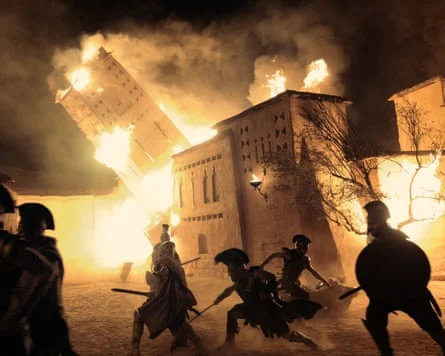
The film’s colossal $250 million budget is visibly translated onto the screen, with Nolan’s commitment to the IMAX format promising an unparalleled immersive experience. Reports suggest that the director has utilized the format to its fullest potential, capturing breathtaking vistas and intimate moments with equal grandeur. This approach to scale and sensory engagement is a hallmark of Nolan’s work, from the mind-bending narratives of "Inception" to the historical sweep of "Dunkirk." For "The Odyssey," this translates into an epic canvas that seeks to transport audiences directly into the heart of Odysseus’s perilous journey.
The sheer scope of the production is further evidenced by the "veritable banquet" of "loud, grandiose, movie-movie pleasures" described by Guy Lodge, chief critic at Variety. Lodge notes that the film is so "brashly, confidently lavish" that it can "afford to throw away a significant portion of its all-star cast on lily-gilding cameos." This abundance of spectacle and star power suggests a film designed to overwhelm the senses and provide a truly cinematic escape. Lodge’s assessment that audiences will leave feeling as though they have "been to hell and back, and exhilaratingly so" speaks to the film’s intended emotional and visceral impact.
Navigating the Currents of Adaptation: Critiques and Controversies
Despite the overwhelming positive reception, a few critical voices have raised points of contention, offering a more nuanced perspective on Nolan’s interpretation of Homer’s epic. David Rooney of The Hollywood Reporter, while acknowledging the film’s strengths, identified certain elements that faltered. He singled out scenes between Matt Damon’s Odysseus and Charlize Theron’s Calypso on a beach as "dull interludes" that "stop the narrative dead in its tracks," drawing a comparison to the contemplative pacing of Terrence Malick’s "The Tree of Life." Rooney also found the film "structurally clumsy" and questioned the casting of Tom Holland as Damon’s son, Telemachus. He further expressed reservations about the use of anachronistic language, citing instances like Penelope telling suitors she has "listened to you party" and Telemachus referring to his father as "dad."
These observations regarding anachronism and structural choices were met with a contrasting view from classicist Mary Beard. Writing in The Times, Beard championed Nolan’s decision to employ "brisk, pacy and contemporary" language, eschewing "dreadful cod-epic language." She lauded the film as a potentially "great introduction to Homer" for a modern audience. However, Beard did express a critique regarding the characterization of Odysseus, finding him "one-dimensional, single-minded, even [more] stolid" than Homer’s hero, lacking the "tricksiness" and humor attributed to the original character.
A more significant point of concern for both Beard and classicist Emily Hauser, writing in The Guardian, revolves around Nolan’s portrayal of female characters and the excision of certain narrative elements. Beard expressed disappointment at the omission of key female characters and a perceived reduction in the agency of others, lamenting, "This is an Odyssey without the sex." Hauser echoed this sentiment, suggesting that Nolan’s focus on a "modern-day hero" left insufficient room for women or nuance. Hauser specifically criticized Nolan for altering Penelope’s role, stating, "Nolan inexcusably turns Penelope into the executor of her enslaved woman, Melantho, and has Penelope actually push her into the slaughter." Hauser’s analysis suggests that the film’s thematic focus on male solidarity and redemption, while potent, may come at the cost of complex female characters and their storylines.

Contextualizing "The Odyssey": Homer’s Enduring Legacy and Nolan’s Vision
Homer’s "Odyssey," believed to have been composed in the 8th century BCE, is one of the foundational texts of Western literature. It narrates the ten-year journey of the Greek hero Odysseus, King of Ithaca, as he strives to return home after the Trojan War. His voyage is fraught with peril, encountering mythical creatures, divine intervention, and personal loss. The epic explores themes of homecoming, loyalty, perseverance, temptation, and the very nature of heroism.
Christopher Nolan’s adaptation, with its significant budget and IMAX presentation, signifies a deliberate attempt to reimagine this ancient narrative for a contemporary global audience. The choice to update the language and potentially the thematic emphasis reflects a directorial desire to make the epic accessible and relevant to modern sensibilities. However, as evidenced by the critical discourse, this modernization is not without its complexities and potential trade-offs in terms of fidelity to the source material and representation.
The film’s production itself has not been without its own contextual discussions. A related report highlighted the controversial use of occupied land as a film set, raising ethical questions about the production’s footprint and its relationship with indigenous populations. While not directly impacting the critical reception of the film’s artistic merits, such issues underscore the broader societal considerations that accompany large-scale filmmaking endeavors.
The Road Ahead: Oscar Prospects and Box Office Predictions
With a critical consensus largely pointing towards a monumental cinematic achievement, "The Odyssey" is undeniably a strong contender for the upcoming awards season. Its ambitious scope, technical mastery, and compelling narrative are precisely the elements that often resonate with Academy voters. The film’s performance at the box office will also be a crucial indicator of its broader cultural impact. Nolan’s films have a strong track record of commercial success, and "The Odyssey" is widely expected to draw massive audiences, eager to experience this epic retelling on the grandest scale possible. The intersection of critical acclaim and commercial viability often paves the way for Oscar recognition, making "The Odyssey" a name to watch in the Best Picture race.
The ongoing debate surrounding the film’s adaptation choices, particularly concerning its handling of female characters and narrative omissions, will likely continue to fuel discussion among cinephiles and scholars. Yet, the prevailing sentiment among critics suggests that Christopher Nolan has once again delivered a film that is both a technical marvel and a thought-provoking work of art, solidifying his position as one of contemporary cinema’s most impactful storytellers. The success of "The Odyssey" could redefine what is possible in epic filmmaking and spark renewed interest in the timeless tales of ancient Greece.