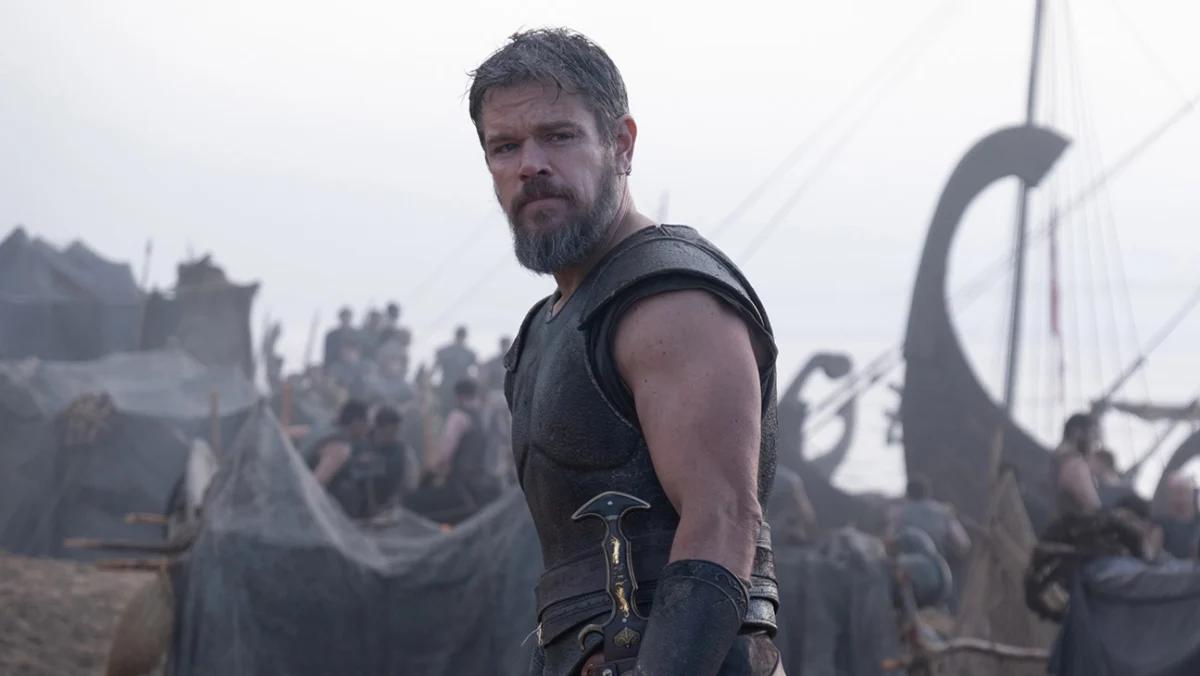
During a recent appearance on the popular Happy Sad Confused podcast with host Josh Horowitz, acclaimed actor Matt Damon made a candid confession regarding his impressively sculpted physique showcased in Christopher Nolan’s highly anticipated and critically successful epic, The Odyssey. While audiences were quick to laud Damon’s physical transformation for the demanding role of King Odysseus, the actor revealed that not all the muscular limbs seen on screen were his own, particularly in certain key sequences involving advanced cinematic techniques. This revelation offers a fascinating glimpse into the meticulous craftsmanship and collaborative nature inherent in blockbuster filmmaking, underscoring the vital contributions of often-uncredited professionals like stunt doubles.
The Revelation: A Bicep Betrayal (of Sorts)
The discussion began with Horowitz complimenting Damon on his remarkable physical condition in The Odyssey, specifically highlighting his biceps. Damon, acknowledging the "high praise," then elaborated on the intricate production methods employed by Christopher Nolan, known for his preference for practical effects over extensive CGI. "When we did the forced perspective stuff of the Laestrygonians," Damon explained, referring to the monstrous, man-eating giants from Homer’s original epic poem, "I don’t know if there’s been a thing about how we did it — there were these stunt men who were all seven feet." He continued, detailing the logistical challenges, "And then they got stuntmen who were under five feet, and so my double was a woman, a female stunt performer, who had the greatest arms I’ve ever seen."
This specific technique of using performers of varying heights to create the illusion of colossal scale required a unique solution for Damon’s character. For the shots where Odysseus appears dwarfed by the towering Laestrygonians, a smaller double was necessary to maintain the visual continuity of the forced perspective. The choice of a female stunt performer, specifically noted for her exceptional muscularity, highlights the specialized skill sets within the stunt community. Damon recounted meeting his double in the catering tent during filming, expressing his gratitude for her dedication. He concluded with characteristic humility, stating, "So there are those shots in the movie where you see these giants looming over me, and so it was almost 100 percent my arms in the movie, but you gotta give it up where it’s due." This admission not only showcases Damon’s integrity but also brings much-deserved attention to the often-invisible work of stunt professionals.
The Art of Cinematic Illusion: Forced Perspective in The Odyssey
Christopher Nolan’s The Odyssey is an ambitious adaptation of Homer’s ancient Greek poem, bringing to life the arduous decade-long journey of King Odysseus back to Ithaca after the Trojan War. This journey is fraught with mythical creatures, divine interventions, and epic battles, demanding innovative filmmaking techniques to translate such fantastical elements to the big screen. Forced perspective, the technique Damon referenced, is a venerable cinematic tool that manipulates human visual perception through the use of optical illusions to make objects appear larger, smaller, closer, or farther away than they actually are.
Historically, forced perspective has been a staple of filmmaking, particularly in the pre-CGI era. Classics like The Lord of the Rings trilogy famously employed sophisticated forced perspective setups, often involving elaborate sets built at different scales and precise camera positioning, to depict the size differences between characters like Gandalf and the Hobbits. In The Odyssey, Nolan’s use of this technique for the Laestrygonians speaks to his well-documented preference for practical effects. This approach often involves more complex on-set logistics, including the careful coordination of actors, stunt performers, and camera operators, but it frequently results in a more tangible and immersive visual experience for the audience. The Laestrygonians, described in Homer’s Odyssey as a tribe of giant, cannibalistic beings who destroy Odysseus’s fleet, presented a significant visual challenge that practical forced perspective, augmented by skilled stunt work, was uniquely suited to address. This method avoids the "uncanny valley" effect that can sometimes plague purely digital creations, grounding the fantastical elements in a sense of physical reality.
The Unsung Heroes: Stunt Performers and Body Doubles
Matt Damon’s revelation shines a spotlight on the crucial, yet frequently overlooked, role of stunt performers in the film industry. Stunt work is a highly specialized and dangerous profession, encompassing a vast array of skills from combat choreography and high falls to precision driving and fire stunts. Within this field, body doubles play a unique role, often stepping in for actors to perform specific physical actions or, as in this case, to maintain visual continuity for particular body parts or scale requirements.
The female stunt performer with "the greatest arms" exemplifies the diverse talent pool within the stunt community. Stunt doubles are meticulously chosen not only for their physical capabilities and safety expertise but also for their resemblance to the actor they are doubling, whether in general physique, hair color, or even specific limb definition. For a scene requiring a close-up of muscular arms within a forced perspective setup, the selection criteria would be incredibly precise. This dedication to finding the right physical match underscores the commitment to realism and visual integrity that permeates high-level film production. These individuals train rigorously, mastering various athletic disciplines and safety protocols, often enduring significant physical strain and risk, all while remaining largely anonymous to the general public. Their contributions are fundamental to bringing daring action sequences and complex visual illusions to life, ensuring the audience’s suspension of disbelief remains intact.
Matt Damon’s Career and Physical Transformations
Matt Damon has a long-standing history of commitment to his roles, often undergoing significant physical transformations. From his breakout role as a boxer in Good Will Hunting (1997) to the lean, agile spy in the Bourne franchise, and the emaciated soldier in Courage Under Fire (1996), Damon has consistently demonstrated a willingness to adapt his physique to the demands of a character. His dedication to fitness for The Odyssey was evidently substantial, as he implied that "almost 100 percent" of the muscular arms seen in the film were his own, with the exception of specific forced perspective shots.
This pattern of physical dedication is common among A-list actors, who often work with personal trainers and nutritionists for months to achieve the required look for a role. For The Odyssey, portraying a war-hardened king who endures years of perilous travel and combat would naturally necessitate a powerful and resilient physique. Damon’s confession, rather than diminishing his effort, actually highlights the extraordinary lengths both he and the production team went to achieve cinematic perfection, even enlisting specialized talent for niche requirements. It also serves as a reminder that even the most dedicated actors rely on a vast network of skilled professionals to bring their characters fully to life.
Christopher Nolan’s The Odyssey: A Modern Epic
Christopher Nolan’s The Odyssey has been heralded as a monumental achievement in modern cinema. Released on July 17, the film immediately captured global attention, collecting an astounding more than $264 million worldwide in its debut weekend alone, signaling a major box office victory. This financial success is a testament to Nolan’s reputation as a visionary filmmaker capable of delivering both critical acclaim and commercial triumph.
The film’s sprawling narrative, adapted from Homer’s foundational text of Western literature, traces King Odysseus’s epic journey home. It meticulously recreates mythical encounters with figures like the Cyclops, the Sirens, and, as revealed by Damon, the formidable Laestrygonians. Nolan’s distinctive directorial style, characterized by complex narratives, practical effects, and immersive soundscapes, lends itself perfectly to the grand scale of Homer’s poem. The movie features an ensemble cast that reads like a who’s who of Hollywood talent, including Anne Hathaway as Penelope, Tom Holland as Telemachus, and supporting roles filled by Zendaya, Robert Pattinson, Charlize Theron, Lupita Nyong’o, John Leguizamo, Elliot Page, Mia Goth, Corey Hawkins, Jon Bernthal, Samantha Morton, Travis Scott, and Benny Safdie. This star-studded lineup, combined with Nolan’s ambitious vision, contributed significantly to the film’s immense anticipation and subsequent success. The choice to cast such a diverse and high-profile group of actors further cemented The Odyssey‘s status as a must-see cinematic event, appealing to a broad demographic and ensuring its place as a significant cultural moment.
Broader Implications: Authenticity, Collaboration, and the Magic of Cinema
Matt Damon’s candid account extends beyond a mere anecdote; it offers a valuable insight into the intricate, collaborative machinery that drives large-scale film productions. In an era where visual effects are often perceived as entirely digital, Nolan’s reliance on practical methods, including ingenious applications of forced perspective and skilled stunt work, reinforces the enduring power of tangible filmmaking techniques. It also subtly challenges the audience’s perception of "authenticity" in film. While actors are the face of a character, the final on-screen portrayal is the culmination of countless contributions from a vast crew, including those whose work is designed to be seamless and invisible.
The revelation also serves as an important moment for the recognition of stunt performers. Despite their critical role in ensuring both the spectacle and safety of film production, stunt artists often remain in the shadows, rarely receiving the public accolades afforded to actors. Damon’s public acknowledgment of his female stunt double’s "greatest arms" not only gives credit where it is due but also highlights the specialized physical demands placed on these professionals. It is a reminder that the magic of cinema is not solely the product of a single star’s performance but a symphony of collaborative effort, precise execution, and often, ingenious illusion. This commitment to craft, from the leading actor’s physical preparation to the specialized skills of a stunt double, ensures that epic tales like The Odyssey continue to captivate and transport audiences, solidifying their place in cinematic history.