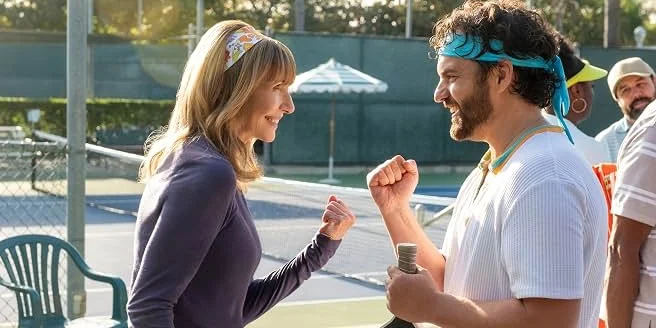
The upcoming sports comedy film follows the professional and personal tribulations of Dusty “The Hammer” Boyd, a former tennis prodigy whose career was derailed by a debilitating injury. Directed by Josh Greenbaum and featuring a high-profile ensemble cast, the production explores the generational and cultural friction between traditional tennis enthusiasts and the burgeoning community of pickleball players. The narrative centers on Dusty’s reluctant transition from the high-stakes world of professional tennis to the increasingly popular, though often derided, courts of pickleball in an effort to secure his father’s approval and save a local country club from institutional overhaul.
Narrative Overview and Character Dynamics
The story introduces Dusty Boyd, portrayed by Jake Johnson, as a man living in the shadow of a truncated athletic career. Once hailed as a world-class talent, Dusty’s trajectory was permanently altered during one of his early professional seasons when a severe wrist injury rendered him unable to compete at the elite level. This physical setback also fractured his relationship with his father and former coach, Chuck Boyd, played by Ed Harris. In the years following the injury, the dynamic between father and son has stagnated into a professional arrangement at a local country club managed by Chuck, where Dusty serves as the coach for the junior tennis program.
The central conflict arises when the country club faces a demographic shift. Chuck, a tennis purist, views the rising popularity of pickleball not merely as a trend but as an existential threat to the integrity of the club and the sport of tennis itself. As the demand for pickleball courts increases, the club’s administration proposes converting several existing tennis courts to accommodate the new sport. In a desperate bid to preserve the club’s traditional identity, Chuck facilitates a high-stakes ultimatum: a tournament that will determine the spatial future of the facility. The winning sport’s representative will secure the majority of the courts, effectively establishing dominance within the club’s ecosystem.
Dusty, seeking a path toward reconciliation with his father, volunteers to represent the tennis faction. However, the narrative takes a pivotal turn when Dusty suffers a secondary injury to his wrist, making traditional tennis impossible. To maintain his standing in the tournament and his father’s good graces, Dusty is forced to pivot to pickleball—a sport he previously viewed with disdain.
The Rise of Pickleball: A Cultural and Statistical Context
The thematic core of the film mirrors real-world athletic trends that have reshaped American recreation over the last decade. Pickleball, a paddle sport that combines elements of tennis, badminton, and ping-pong, has been identified by the Sports & Fitness Industry Association (SFIA) as the fastest-growing sport in the United States for several consecutive years. According to the 2023 APP Sports Index, more than 36.5 million people played pickleball at least once between 2022 and 2023.
This growth has led to significant logistical challenges for municipalities and private clubs nationwide. The film’s premise of "court wars" reflects a documented phenomenon where the conversion of tennis courts into pickleball courts has sparked localized disputes. Data suggests that while tennis participation remains stable, with approximately 23.6 million players in the U.S., the rapid acceleration of pickleball has created a demand for infrastructure that often outpaces available real estate. The film utilizes this "zero-sum game" environment to heighten the stakes of its comedic and dramatic arcs.
Production Background and Creative Team
The project is helmed by Josh Greenbaum, a director known for his ability to balance absurdist humor with genuine emotional resonance, as seen in his previous works such as Barb and Star Go to Vista Del Mar and the documentary The Short Game. The film is produced under the banner of Red Hour Films, the production company co-founded by Ben Stiller, who also appears in the film in a supporting capacity.
The casting of the film brings together a diverse array of comedic and dramatic talent. Jake Johnson, widely recognized for his role in New Girl, anchors the film with a performance that balances the character’s "offbeat humor" with a "somber undertone." Mary Steenburgen portrays Candace, a recently divorced woman who becomes Dusty’s pickleball partner and emotional anchor. The cast is rounded out by veteran actor Ed Harris, Chloe Fineman of Saturday Night Live, and Australian comedian Aaron Chen. Notably, the film includes a cameo by former world No. 1 tennis professional Andy Roddick, adding a layer of authenticity to the sports-centric narrative.
Chronology of Events and Plot Development
The film’s structure follows a classic underdog trajectory, segmented into three distinct phases: the fall, the adaptation, and the resolution.
- The Historical Context: The opening act establishes Dusty’s "washed-up" status and the cold, performance-based relationship he shares with Chuck. The audience is shown the pivotal moment of the wrist injury that ended Dusty’s professional aspirations.
- The Institutional Crisis: The introduction of the pickleball "epidemic" serves as the catalyst. Chuck’s refusal to modernize leads to the tournament challenge, setting the stage for Dusty’s initial attempt to save the club through tennis.
- The Pivot to Pickleball: Following his re-injury, Dusty enters the world of local pickleball clubs. This phase serves as the "fish-out-of-water" segment of the film, where Dusty is humbled by experienced female players who dominate the local scene.
- The Partnership with Candace: The introduction of Mary Steenburgen’s character shifts the tone from pure comedy to a character study. Through his training with Candace, Dusty learns the nuances of the "dink" (a soft shot in pickleball) and begins to value the social and restorative aspects of the sport over the singular pursuit of victory.
- The Tournament Finale: The film concludes with the high-stakes tournament, where Dusty must apply his newly acquired skills to defend the club’s future while navigating his complex feelings toward his father.
Analysis of Thematic Implications
The film serves as more than a standard sports comedy; it functions as a commentary on the evolution of leisure and the psychology of aging athletes. By pitting tennis against pickleball, the screenplay explores the tension between "elite" athleticism and "accessible" recreation. Tennis is presented as a sport of rigor, tradition, and often, exclusionary status. In contrast, pickleball is portrayed as a communal, egalitarian pursuit that prioritizes longevity and social connection.
The character of Dusty Boyd represents a generation of athletes grappling with the loss of their physical prime. His transition to pickleball is a metaphor for finding a second act in life. The film suggests that the "true meaning of sports" is often lost in the pursuit of professional accolades. Through the mentorship of Candace, Dusty realizes that his value is not tethered to his ranking or his ability to satisfy his father’s expectations, but rather to his capacity for growth and his enjoyment of the game.
Industry and Audience Reception
The film is positioned as a "warm, light, and heartwarming summer movie," aimed at a broad demographic. The inclusion of Andy Roddick and specific tennis-related humor suggests a targeted appeal to the sports community, while the presence of Ben Stiller and Chloe Fineman ensures a draw for mainstream comedy audiences.
From an industry perspective, the film enters a marketplace where sports-related content is seeing a resurgence. The success of projects like Ted Lasso and Challengers has demonstrated an appetite for narratives that blend athletic competition with deep character development. By focusing on pickleball—a sport currently experiencing a cultural "moment"—the film is well-positioned to capitalize on current trends.
Conclusion and Broader Impact
The film’s focus on the "dink"—a tactical, patient shot—serves as a recurring motif for Dusty’s personal development. It represents a move away from the "hammer" style of his youth toward a more measured and sustainable approach to life. As the country club faces its inevitable transformation, the film posits that adaptation is not a sign of defeat but a necessary step for survival in a changing world.
In summary, the production offers a factual look at the friction between established sporting traditions and new cultural movements. Through its blend of veteran dramatic actors and contemporary comedic voices, the film provides an analytical yet entertaining exploration of what happens when a "pro" is forced to become a "loser" to find himself. The project remains a significant entry in the 2024-2025 film slate, highlighting the ongoing evolution of the American sports comedy genre.