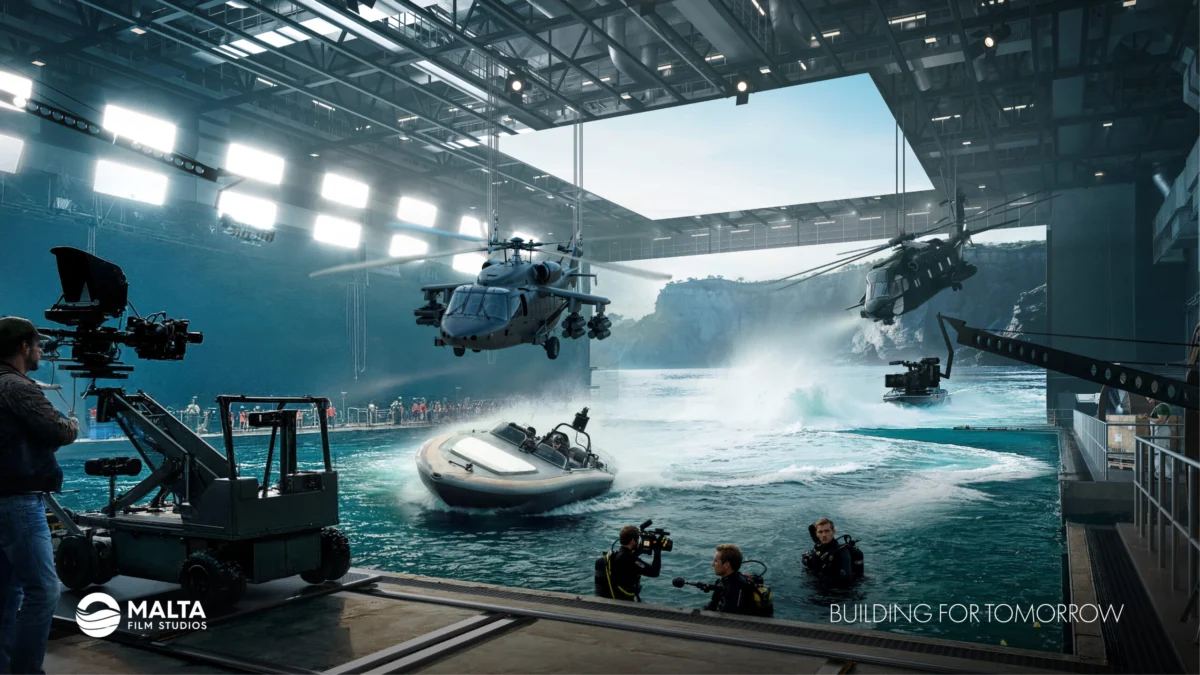
Malta has officially opened the bidding process for the development of its ambitious Land Sea Super Stage, a state-of-the-art facility poised to cement the Mediterranean island’s reputation as a premier destination for high-budget international cinema. Following a teaser announcement by Film Commissioner Johann Grech at the Mediterrane Film Festival earlier this summer, the Malta Film Commission has now invited private sector investors to finance, construct, and operate what is being billed as a world-first, integrated production environment.
The project, which carries an estimated private investment value exceeding €80 million, is designed to serve as the crown jewel of the Malta Film Studios. By integrating specialized water-filming capabilities with a cutting-edge soundstage, the government aims to bridge the gap between outdoor location shooting and high-end studio production, offering a seamless workflow for blockbuster franchises.
A Strategic Pivot for the Mediterranean Film Hub
The move to develop the Land Sea Super Stage comes at a time of intense global competition for film production investment. Countries worldwide have increasingly utilized tax incentives, infrastructure grants, and purpose-built studios to capture the lucrative output of Hollywood studios and streaming giants. For Malta, a country that has long relied on its natural beauty and existing water tanks to draw productions, this project represents a fundamental shift toward vertical integration.
The facility’s technical specifications are designed to cater to the extreme demands of modern tentpole films. The blueprints call for a soundstage structure engineered with immense load-bearing capacity—sufficient to suspend two Black Hawk helicopters simultaneously—a requirement intended to facilitate complex aerial stunts and intricate rigging setups that typically necessitate long lead times or off-site construction. By housing these capabilities on-site, the Malta Film Studios aims to reduce the "down time" for productions, a critical factor for studios balancing budgets that often exceed $200 million per project.
Chronology of the Development
The path to this public call for tenders has been marked by a series of deliberate steps by the Malta Film Commission to modernize the island’s cinematic infrastructure:
- Mid-2023: Initial feasibility studies were conducted to assess the requirements for expanding the Malta Film Studios’ capacity to handle more complex, year-round productions.
- June 2024: During the Mediterrane Film Festival, Johann Grech publicly introduced the concept of the "Land Sea Super Stage," signaling the commission’s intent to move beyond traditional outdoor filming toward an all-in-one production ecosystem.
- August 2024: Final architectural and operational blueprints were finalized, incorporating workshops, technical offices, and high-capacity warehouses to support the soundstage.
- September 2024: The official public call for tenders was launched on the Maltese government’s e-procurement platform, opening a three-month window for prospective developers to submit their proposals.
Economic and Industry Implications
The projected €80 million injection into the film infrastructure is expected to have a multiplier effect on the Maltese economy. Beyond the direct construction jobs, the long-term objective is to move Malta up the value chain. Currently, many major productions utilize Malta for specific scenes—often those involving water or maritime themes—before moving to larger studios in the United Kingdom, Hungary, or Georgia for interior work.
By providing a "one-stop-shop," the Land Sea Super Stage aims to convince producers to anchor their entire production on the island. This shift would provide a more consistent revenue stream for local crew members, specialized service providers, and the hospitality sector, which supports the thousands of cast and crew members who descend upon the island during major shoots.
Economists observing the regional film industry suggest that the move is a defensive and offensive measure. As competition from Eastern Europe and the Middle East intensifies, Malta’s ability to retain its "film-friendly" status depends on its capacity to offer world-class technical facilities that match the quality of its locations. The commitment to this project demonstrates a confidence that the global appetite for high-end, high-value production remains robust.

A History of High-Profile Success
The confidence behind the Land Sea Super Stage is rooted in a proven track record. Malta has served as a production hub for decades, hosting an array of iconic films that have tested the limits of its existing infrastructure. From the classic settings of Gladiator (2000) to the expansive scale of its recent sequel, the island has demonstrated a unique versatility.
Other notable productions that have utilized Malta include Napoleon, Captain Phillips, Troy, Munich, Assassin’s Creed, Murder on the Orient Express, and the upcoming Enola Holmes 3. The decision by the Jurassic World franchise to utilize the island further solidified its status as a destination capable of hosting top-tier intellectual property. These productions have not only provided direct economic benefits but have also cultivated a local workforce that is increasingly skilled in the complexities of international studio production.
Official Vision for the Future
For Johann Grech, the launch of the tender is the realization of a long-term goal to transform the island’s industrial identity. "Today’s launch marks the final piece of the jigsaw in creating a world-class film industry in Malta," Grech noted during the announcement. He emphasized that the project is not merely about physical construction, but about "completing Malta’s offer to the global film industry."
The inclusion of workshops and production offices in the design is a direct response to feedback from international producers who require a cohesive environment to manage the logistics of a large-scale film. By centralizing these functions, the Malta Film Commission intends to simplify the production process, making the island a more attractive prospect for studios looking to avoid the fragmented logistics that can often plague international shoots.
Analyzing the Tender Process
The call for tenders, which remains open for three months, is highly specific regarding the expectations for prospective investors. The government is not looking for a mere construction contractor but rather a partner capable of operating a sophisticated facility that meets international studio standards.
Key evaluation criteria for the bids will likely include:
- Financial Capability: Ensuring the developer has the capital depth to handle an €80 million project without relying on public funding.
- Operational Expertise: Proven experience in managing film production facilities or similar high-tech industrial spaces.
- Sustainability and Innovation: Given the modern focus on green production, bidders are expected to integrate energy-efficient technologies, particularly for the power-intensive climate control required for a soundstage of this magnitude.
- Integration with Existing Assets: The ability to seamlessly connect the new stage with the existing, historic water tanks at the Malta Film Studios is a technical requirement of the highest priority.
The Road Ahead
The next two years will be a critical period for the Maltese film industry. Once a developer is selected, the construction phase will be monitored closely to ensure that the facility meets the exact specifications required by the most demanding film studios in the world.
Should the Land Sea Super Stage be delivered on time and on budget, Malta will be uniquely positioned to capture a larger share of the global content production market. By offering a facility that combines the cinematic allure of the Mediterranean with the technical rigor of a state-of-the-art studio, the nation is signaling that it is no longer content with being a supporting player on the world stage. Instead, it is positioning itself to be a permanent, foundational home for the next generation of global cinema franchises.
As the tender period progresses, the international film community will be watching to see which developers step forward to take on this ambitious project, and whether the proposed facility can truly live up to the promise of being the first of its kind in the world. For now, the call has been made, and the next chapter of Malta’s cinematic history has officially begun.