Decades after its theatrical release, the 1995 film adaptation of Jane Austen’s Sense and Sensibility continues to be studied as a gold standard in literary translation from page to screen. Directed by Ang Lee and adapted by screenwriter and star Emma Thompson, the Columbia Pictures release grossed approximately $135 million worldwide against a production budget of roughly $16.5 million. Beyond its commercial success, the film secured seven Academy Award nominations, including Best Picture, Best Actress for Thompson, and Best Supporting Actress for Kate Winslet, ultimately winning Thompson the Oscar for Best Adapted Screenplay. This retrospective examines the structural, creative, and socio-historical elements that elevated a 19th-century domestic novel into a defining cinematic achievement of the 1990s.
Background and Literary Provenance
Jane Austen originally published Sense and Sensibility anonymously in 1811, more than two decades after she began drafting it in epistolary form around 1795. The narrative examines the precarious financial realities faced by women in Regency-era England, where common law dictates that ancestral estates must pass through the male lineage. When Henry Dashwood dies unexpectedly, his second wife and their three daughters—Elinor, Marianne, and Margaret—are disinherited by primogeniture, leaving them dependent on the goodwill of relatives and vulnerable to a marriage market driven strictly by wealth and social stratification.
In the mid-1990s, producer Lindsay Doran championed the project, spending years convincing studios that an Austen adaptation could appeal to modern audiences following the success of various television and film iterations. Doran ultimately enlisted Emma Thompson, who was already celebrated for her dramatic work in films such as Howards End and The Remains of the Day, to pen the screenplay. Thompson spent five years drafting the script, balancing Austen’s biting social satire with emotional resonance.
Chronology of Production and Casting Strategy
The assembly of the production team and cast reflects a deliberate strategy to blend seasoned British dramatic actors with rising international talent and a visionary director from outside the traditional British period-drama establishment.
Principal photography commenced in the spring of 1995, utilizing historic British estates and rural landscapes across Devonshire, Wiltshire, and Somerset to establish the stark visual contrast between the affluent Norland Park and the modest Barton Cottage.
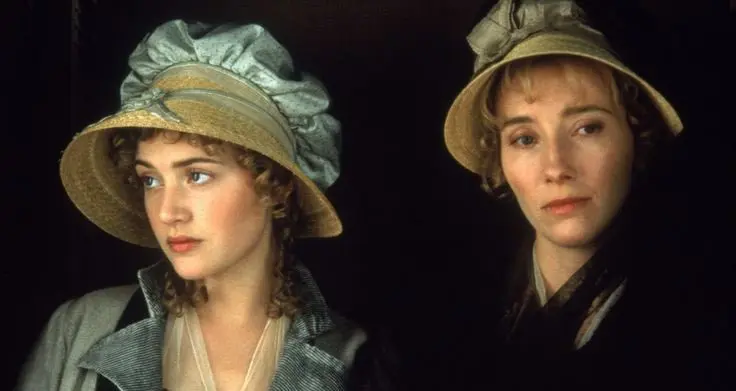
The casting process strategically subverted audience expectations. Ang Lee, whose previous credits included the internationally acclaimed family dramas Eat Drink Man Woman and The Wedding Banquet, was chosen for his profound understanding of domestic social hierarchies and repression. For the lead roles, the production secured Emma Thompson to portray the sensible, emotionally restrained Elinor Dashwood. Kate Winslet, building upon her breakout performance in Peter Jackson’s 1994 psychological drama Heavenly Creatures, was cast as the passionate, impressionable Marianne Dashwood.
Supporting roles featured Alan Rickman—widely recognized for villainous turns in action cinema—as the melancholic and steadfast Colonel Brandon. Hugh Grant was cast as Edward Ferrars prior to his global romantic-comedy stardom, while Greg Wise stepped into the role of the morally ambiguous John Willoughby. The ensemble was further rounded out by veteran British actors including Gemma Jones, James Fleet, Harriet Walter, Hugh Laurie, and Imelda Staunton.
Narrative Mechanics and Thematic Analysis
The thematic core of Sense and Sensibility relies on the dialectic between logical restraint (sense) and emotional impulse (sensibility), embodied by the two eldest Dashwood sisters. Thompson’s screenplay utilizes structural compression to establish the stakes within the opening twenty minutes, transitioning the family from sudden destitution to their humble countryside exile in Devonshire.
From an analytical perspective, the narrative serves as a critique of property law and economic security in 19th-century Britain. The financial ruin of the Dashwood women highlights the systemic vulnerability of women who lacked independent earning power or inheritance rights. The dramatic tension throughout the film does not merely stem from romantic courtship, but from the economic necessity of securing a stable match to avoid social obsolescence.
Lee’s directorial approach utilizes non-verbal communication, environmental framing, and spatial choreography to convey psychological states. Rather than relying solely on exposition, the camera frequently observes characters in domestic interiors, highlighting the claustrophobia of societal expectations. Technical choices—such as Michael Coulter’s naturalistic cinematography and Patrick Doyle’s classically inspired yet melancholic score—reinforce the historical authenticity while accentuating internal character transformations.
Industry Impact and Critical Reception
Upon its release in December 1995, Sense and Sensibility received widespread critical acclaim, earning a 97% approval rating on review aggregator Rotten Tomatoes and a score of 84 on Metacritic. Critics praised the film for successfully avoiding the overly reverent, stilted pacing that frequently characterizes literary period pieces.
The film’s commercial viability also helped instigate a broader cinematic revival of Jane Austen adaptations in the late 20th century, paving the way for subsequent film and television versions of Emma, Pride and Prejudice, and Mansfield Park. Industry analysts note that the project proved that literary adaptations could achieve both high artistic distinction and box-office profitability without sacrificing textual integrity.
Broader Implications and Legacy
The enduring relevance of the 1995 adaptation lies in its timeless exploration of grief, duty, economic disparity, and the universal human struggle to reconcile emotional impulses with rational responsibilities. By examining the mechanics of class and gender through a lens that remains accessible to contemporary audiences, the film transcends its period-piece classification.
Furthermore, the collaboration between an international auteur like Ang Lee and a British literary adaptation specialist like Emma Thompson established a new paradigm for cross-cultural filmmaking within Hollywood studios. Sense and Sensibility remains a benchmark for screenwriting and ensemble performance, continuing to inform how modern filmmakers approach the adaptation of canonical literature for the screen.