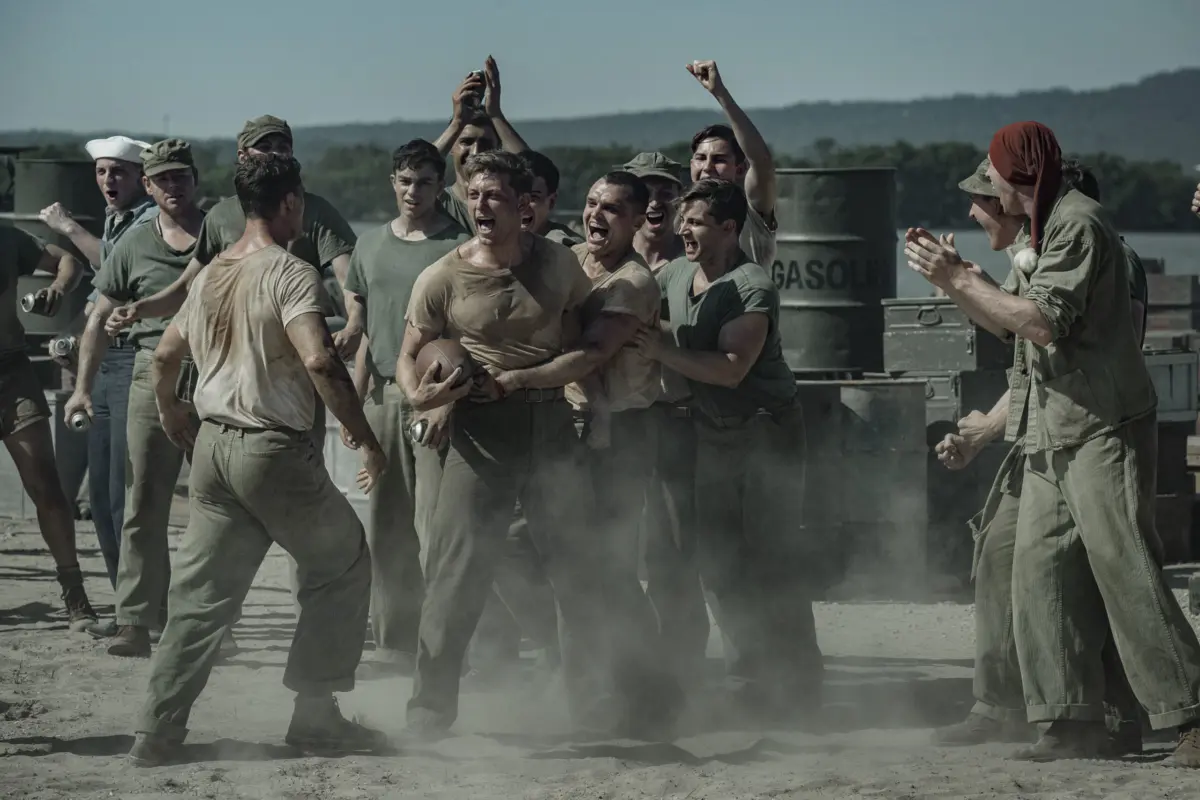
The Mosquito Bowl, directed by Peter Berg and produced for Netflix, serves as both a cinematic dramatization and a historical examination of the legendary football game played between the Fourth and Sixth Marine Divisions on Christmas Eve in 1944. Adapted from the non-fiction book by Buzz Bissinger, the film explores the intersection of professional-grade athleticism and the brutal reality of the Pacific theater during World War II. While the production leverages high-fidelity technical execution to depict the harrowing nature of combat, it also faces critical scrutiny regarding its narrative depth and the pacing of its character arcs.
Historical Context: The Pacific Theater and the Gridiron
The events depicted in the film are rooted in the reality of the Marine Corps’ operations in the Pacific. In late 1944, following the intense battles of the Guadalcanal campaign and the subsequent preparation for the invasion of Okinawa, many Marines were stationed on the island of Guadalcanal. Among the ranks were numerous former college football stars who had traded their cleats for combat boots following the Japanese attack on Pearl Harbor in December 1941.
The “Mosquito Bowl,” as it came to be known, was not merely a recreational game; it was a testament to the morale-building efforts of military leadership during a period of prolonged stasis. The match took place on a makeshift field carved out of the island’s jungle terrain. For the men involved, the game represented a temporary escape from the psychological toll of the war. However, the contrast between the organized, rule-bound nature of football and the chaotic, lethal environment of the battlefield remains the central tension of the narrative.
Chronology of the Production and Real-Life Events
The timeline of the film mirrors the rapid transition from collegiate sports to military mobilization. The narrative follows four primary figures: John McLaughry (played by Nicholas Galitzine), a Brown University alum; Tony Butkovich (Ray Nicholson), a standout from Purdue; and the University of Wisconsin duo David Schreiner and Bob Bauman (played by Tom Francis and Bill Skarsgard, respectively).
The sequence of events follows a predictable trajectory:
- December 1941: The catalyst of Pearl Harbor initiates the mass enlistment of the athletes.
- 1942–1944: The characters navigate the rigors of boot camp and initial deployments, witnessing the harsh reality of war.
- December 24, 1944: The Mosquito Bowl takes place on Guadalcanal, serving as the climax of the film’s athletic focus.
- Post-Game: The narrative shifts toward the final stages of the war, reflecting the heavy casualty rates experienced by these units in subsequent operations.
Technical Analysis and Combat Realism
From a production standpoint, Peter Berg, in collaboration with cinematographer Jacques Jouffret, sought to capture the visceral intensity of the Pacific theater. Filmed primarily in Australia, the combat sequences utilize a gritty, immersive visual style. The camera work often mirrors the perspective of the infantrymen, prioritizing close-up shots that emphasize the confusion and sensory overload of jungle warfare.
The production design aims for historical accuracy in terms of equipment, uniforms, and environmental conditions. By focusing on the interplay between the "offensive line" of the Marine Corps and the literal offensive lines of football, the film attempts to create a thematic parallel. Critics note that while the action sequences are technically proficient—highlighted by the use of pyrotechnics and expansive extras to convey the scale of the engagements—they occasionally overshadow the character development. The film’s pacing, which runs for 126 minutes, is heavily weighted toward these set pieces, often at the expense of exploring the internal motivations of the soldiers.
The Role of Athletics in Military Morale
The inclusion of professional and collegiate athletes in the military during World War II was a significant cultural phenomenon. The War Department encouraged sports as a means of maintaining physical fitness and competitive drive. In the context of the Mosquito Bowl, the game served as a rare moment of levity. Historical records confirm that the game was a brutal affair, played on a surface that was as much mud as it was grass, resulting in numerous injuries that, while minor compared to combat wounds, underscored the intensity with which the men approached the game.
Critical Reception and Narrative Limitations
The film’s screenplay, co-written by Berg and Mark L. Smith, has been subject to analysis regarding its reliance on war-genre tropes. The opening inclusion of Herbert Hoover’s quote—"Older men declare war. But it is youth that must fight and die"—establishes a somber tone that the film attempts to maintain. However, observers point out that the script struggles to bridge the gap between the camaraderie of the locker room and the tragedy of the frontline.
The decision to gloss over the darker aspects of the military mindset—such as the dehumanization of the enemy—has been noted by historians and critics alike. While the film acknowledges the fervor of recruits, it often pivots quickly toward a traditional heroic arc. This narrative choice prevents the film from engaging in a deeper critique of the institutional culture of the era, opting instead for a more streamlined, audience-friendly depiction of service.
Broader Implications of the War Drama Genre
The Mosquito Bowl joins a crowded field of World War II dramas that seek to humanize the "Greatest Generation." Its impact lies in its effort to document a specific, albeit localized, event that serves as a microcosm for the larger experience of the American infantryman.
For historians, the film highlights the importance of oral histories and personal narratives in preserving the memory of those who served. By focusing on the lives of individuals like John McLaughry and David Schreiner, the film ensures that their contributions—both on the field and in the service of their country—remain part of the cultural discourse. However, the film also serves as a case study in the challenges of adapting historical non-fiction to a visual medium. The balance between maintaining historical fidelity and crafting a compelling, character-driven story remains a difficult needle to thread.
Statistical Context and Legacy
Data regarding the units involved in the Mosquito Bowl reflects the high cost of the Pacific campaign. Many of the participants in the game were later killed in action during the Battle of Okinawa, one of the final and bloodiest battles of the war. This historical reality provides the film with its most poignant subtext: the fleeting nature of the lives of these young men. The contrast between the "triumph" of a football game and the "sorrow" of the subsequent battlefield deaths is the film’s most enduring, if underutilized, thematic element.
Conclusion
The Mosquito Bowl stands as a technically ambitious effort to capture the duality of youth in wartime. Through its meticulous recreation of both the gridiron and the battlefield, it provides a vivid, if narratively constrained, look at a unique moment in military history. While it may rely heavily on established genre conventions, its commitment to honoring the memory of those who fought in the Pacific remains its primary contribution to the historical record. As audiences continue to engage with stories from this period, films like this serve as a reminder of the complex, often contradictory experiences of the individuals who formed the backbone of the Allied effort. Whether the film succeeds in its storytelling or not, the underlying truth of the event remains a significant footnote in the history of the United States Marine Corps.