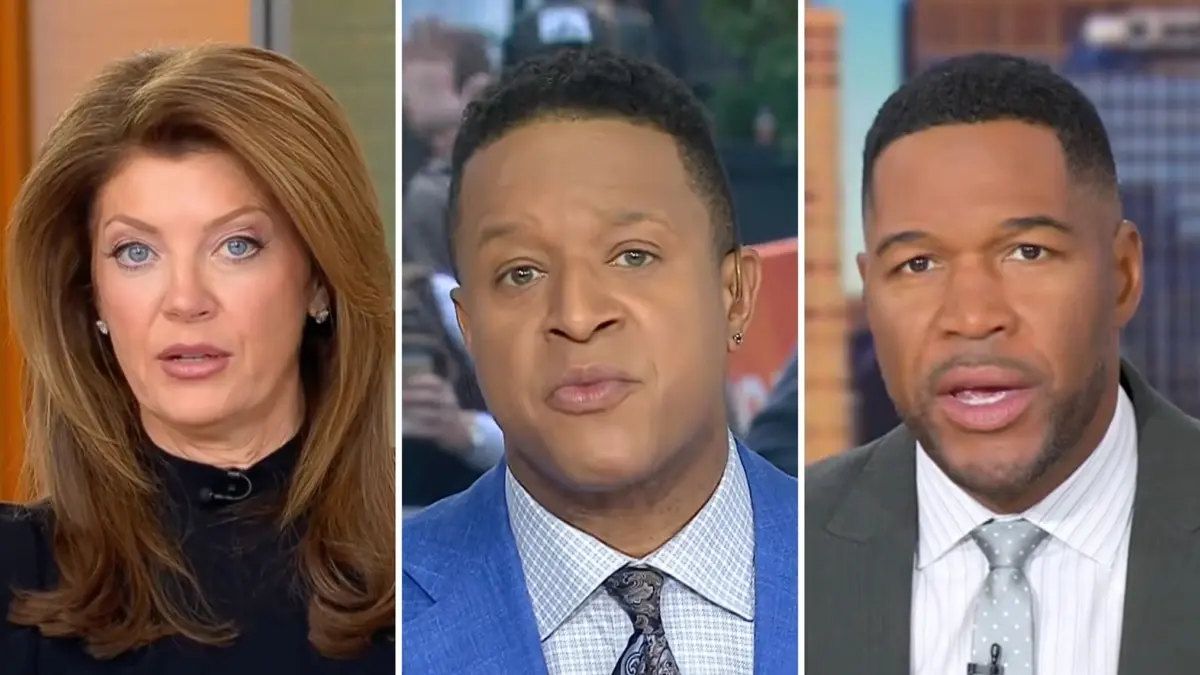
The landscape of American morning television underwent a significant shift during the first week of November 2026, as heightened public interest in midterm election coverage propelled viewership figures upward across the three major networks. According to the latest data provided by Nielsen regarding national live-plus-same-day metrics, NBC’s Today, ABC’s Good Morning America, and CBS Mornings all experienced tangible growth in total audience reach compared to the same period in the previous year. As the nation turned its attention to the polls and the subsequent political fallout, the fierce competition between these flagship programs intensified, highlighting the continued relevance of linear broadcast news in a fragmented media environment.
NBC News’ long-standing morning juggernaut, Today, anchored by Savannah Guthrie and Craig Melvin, maintained its position as the most-watched program in the category. For the week ending November 2, 2026, the broadcast garnered an average of 2.999 million total viewers. This represents a 7 percent increase compared to the same week in 2025. While the show enjoyed growth in total reach, it did face a minor contraction in the coveted 25-54 demographic, where it recorded 588,000 viewers, an 8 percent decline from the prior year. Nevertheless, the consistent performance of Today underscores its structural stability in a market that is increasingly susceptible to digital news consumption trends.
Close on its heels, ABC’s Good Morning America, led by the veteran team of Robin Roberts, George Stephanopoulos, and Michael Strahan, demonstrated robust health. The program pulled in 2.923 million total viewers, marking a 7 percent year-over-year improvement. More notably, GMA outperformed its NBC rival in demo growth, recording 471,000 viewers in the 25-54 age bracket—an 8 percent increase over the same week in 2025. The narrowing gap between Today and GMA suggests that the editorial focus on political analysis and election-night projections played a pivotal role in maintaining high engagement levels throughout the early hours of the morning.
The CBS Mornings Trajectory and Strategic Shifts
CBS Mornings, while maintaining its third-place position, showcased the most significant momentum in terms of percentage growth within the demographic category. The program, which has seen a strategic refresh with the return of Norah O’Donnell to the anchor desk alongside Gayle King and Nate Burleson, averaged 2.053 million total viewers for the week. This reflects a 6 percent rise from the previous year. Perhaps more importantly for network executives and advertisers, CBS Mornings saw a 10 percent increase in the 25-54 demographic, reaching 370,000 viewers.
This performance is particularly notable given the structural adjustments the network has made to its morning block over the past several months. The reintegration of O’Donnell into the fold is viewed by industry analysts as a move to stabilize the brand’s identity and leverage the established chemistry between the hosts. By focusing on deep-dive reporting and long-form interviews, CBS has carved out a distinct niche that appears to be resonating with a specific segment of the morning audience that seeks an alternative to the lighter, lifestyle-heavy segments often found on competing networks.
Chronology of the 2025-2026 Season Performance
To understand the current surge, one must view these figures against the backdrop of the broader 2025-2026 television season. Before the November election-cycle spike, the competitive hierarchy had already begun to solidify. Throughout the preceding months, Today remained the dominant force, concluding the season with an average of 2.948 million total viewers and 612,000 demo viewers. That period marked the most successful broadcast season for the NBC program in four years, cementing its status as a cornerstone of the network’s daily output.
During that same season-long timeframe, Good Morning America maintained its strong second-place standing with 2.831 million total viewers and 477,000 demo viewers. CBS Mornings, meanwhile, closed the season with 1.770 million total viewers and 278,000 demo viewers. When comparing the season-long averages to the specific performance metrics recorded during the week of November 2, it becomes clear that the election season acted as a catalyst, pushing all three networks to surpass their seasonal baselines.
The Role of Election Coverage in Ratings Volatility
The influx of viewers during the first week of November is a testament to the enduring power of high-stakes political news. In an era where social media often provides immediate updates, the "event television" nature of morning shows becomes a vital utility for the public. Viewers rely on these programs not just for the headlines, but for the synthesis of information provided by established anchors.
Industry experts note that the "Midterm Effect" is a well-documented phenomenon in television ratings. When the public perceives an immediate impact on their daily lives—such as changes in legislative control or policy shifts resulting from midterm elections—the propensity for appointment-based viewership increases. Networks that are able to pivot their production schedules to prioritize clear, objective reporting on these events often see a corresponding uptick in both total reach and sustained attention throughout the broadcast.
Industry Analysis: The Value of the 25-54 Demographic
While total viewership numbers are often the primary headline, the 25-54 age demographic remains the "gold standard" for network revenue. Advertisers prioritize this age group due to their higher discretionary spending power and established brand loyalty patterns. The fact that CBS Mornings saw a 10 percent increase in this segment during the November surge is a signal of the network’s growing competitiveness.
Conversely, the slight dip in the demo for Today despite its total viewer growth highlights the ongoing challenge of maintaining relevance among younger, tech-savvy audiences. The shift in viewership habits, where younger viewers may opt for short-form video updates or social media clips, creates a "fragmentation hurdle" for legacy morning programs. The networks are currently engaged in a balancing act: they must satisfy their long-term loyalist base—who often prefer traditional broadcast segments—while simultaneously innovating to capture the attention of a demographic that is increasingly comfortable with digital-first content.
Future Implications for Morning News Strategy
Looking ahead, the networks are likely to refine their strategies to maintain the momentum gained during the election period. For NBC, the objective will be to stabilize the demo numbers and leverage the brand equity of the Today brand to retain the audience that tuned in for the midterm coverage. For ABC, the strategy may involve doubling down on the personality-driven segments that have historically kept GMA competitive with Today, while ensuring that their political coverage remains robust.
CBS, meanwhile, finds itself in a period of calculated experimentation. With the return of Norah O’Donnell and a stabilized core of anchors, the network is focused on growing its footprint. The increased viewership during the first week of November provides a proof-of-concept that the current lineup and editorial direction are capable of drawing significant interest.
As the industry moves into the next quarter, the focus will likely shift from election-related programming to holiday-themed content and winter season narratives. However, the data from the week of November 2 has provided a clear roadmap for the networks: in an environment of constant noise, viewers remain willing to turn to traditional morning news platforms when they require authoritative, consistent, and well-produced coverage of events that define the national conversation. The race for the morning is far from over, and the data suggests that each of the three major players remains a formidable force in the American media landscape.