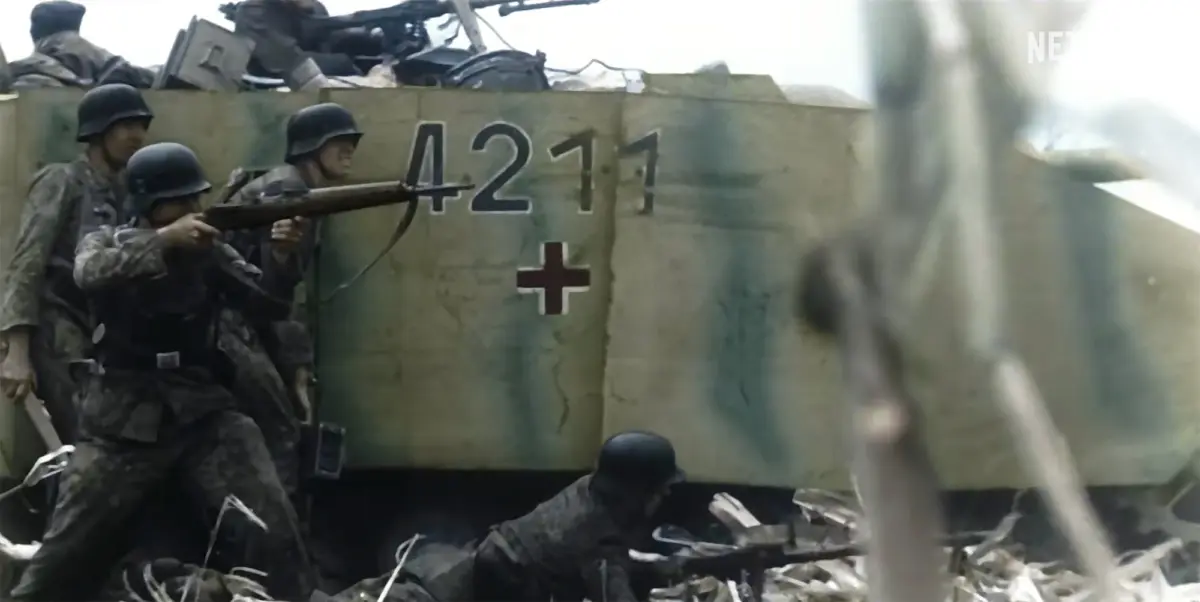
Netflix has officially released the full-length trailer for its upcoming historical documentary series, World War II: Behind Enemy Lines, scheduled for a global streaming release on December 2, 2026. Directed by acclaimed British historical non-fiction filmmaker Rob Coldstream and narrated by Oscar-nominated actor Josh Brolin, the multi-part series chronicles the high-stakes, perilous operations executed by the United States Army’s 101st Airborne Division deep within Nazi-occupied Europe. Spanning the critical timeline from the historic Allied landings on D-Day in June 1944 to the ultimate realization of Victory in Europe (V-E) Day in May 1945, the project serves as a thematic and creative successor to the 2023 Emmy Award-winning Netflix documentary series World War II: From The Frontlines.
The production relies heavily on state-of-the-art restoration techniques, presenting audiences with authentic wartime cinematography that has been meticulously cleaned, stabilized, and colorized. By breathing vibrant life into historical visual records—much of it previously unseen by the general public—the creative team aims to bridge the temporal gap between modern viewers and the generation that fought the conflict. The project follows in the footsteps of pioneering archival restorations like Peter Jackson’s acclaimed World War I documentary They Shall Not Grow Old, striving to present a visceral, unfiltered perspective of frontline combat and clandestine operations through the eyes of the individuals who lived through them.
Chronology of the 101st Airborne Division in the European Theater

The narrative arc of World War II: Behind Enemy Lines tracks the pivotal chronological milestones of the 101st Airborne Division, commonly known as the "Screaming Eagles," during the final year of the European war. The timeline begins in the pre-dawn hours of June 6, 1944, as paratroopers of the 101st dropped behind enemy lines in the Cotentin Peninsula as part of Operation Overlord. Their primary objective was to secure crucial exit causeways off Utah Beach and neutralize German artillery batteries that threatened the amphibious invasion force.
Following their pivotal contributions during the Normandy campaign, the division was redeployed to the Netherlands in September 1944 to participate in Operation Market Garden, a daring airborne and armored offensive designed to secure a series of strategic bridges across the Rhine river system. The timeline subsequently advances to the bitter winter months of late 1944 and early 1945, highlighting the division’s legendary defense of Bastogne during the Battle of the Bulge. Surrounded by overwhelming German forces in freezing conditions, the 101st held the strategic crossroads until relieved by General George Patton’s Third Army. The documentary’s chronological journey concludes in the spring of 1945 as the division pushes eastward into Germany, capturing Hitler’s alpine retreat at Berchtesgaden just weeks before the unconditional surrender of German armed forces.
Production Background and Creative Team
World War II: Behind Enemy Lines is produced by Caroline Marsden and manufactured by the London-based production company 72 Films. Executive producers David Glover and Mark Raphael bring extensive experience in high-end factual television to the project, ensuring rigorous historical accuracy alongside cinematic presentation. Director Rob Coldstream brings a prolific track record in historical documentary filmmaking to the table. His extensive portfolio includes critically well-received non-fiction projects such as John Lennon: Murder Without a Trial, North Korea: Inside the Mind of a Dictator, The Last Days of Anne Boleyn, and the predecessor series World War II: From The Frontlines.

The addition of Oscar-nominated actor Josh Brolin as narrator provides the project with a grave, authoritative voice that underscores the magnitude of the historical events depicted on screen. Brolin’s narration threads together rare firsthand personal accounts, military dispatches, and oral histories, creating an intimate narrative framework that contrasts with the macro-level strategic movements of Allied command.
Technological Advancements in Archival Restoration
The documentary’s reliance on colorized and enhanced archival footage reflects an ongoing methodological shift in contemporary historical filmmaking. For decades, standard-definition, monochrome newsreel footage served as the primary visual medium for educational content regarding the mid-20th-century conflict. However, technological advancements in digital scanning, frame interpolation, and artificial intelligence-assisted color grading have revolutionized the archiving sector.
By converting archival black-and-white recordings into vibrant color, filmmakers remove a psychological barrier that often distances modern audiences from historical events. Colorization allows viewers to perceive historical actors not as distant, mythic figures confined to history textbooks, but as contemporaries experiencing tangible, immediate realities. The process requires painstaking historical research to ensure that uniform colors, military hardware, terrain, and environmental conditions accurately reflect authentic wartime palettes, preserving historical integrity while enhancing visual engagement.

Implications and Broader Cultural Impact
The release of World War II: Behind Enemy Lines arrives at a time of sustained global interest in military history and commemorative non-fiction programming. As the generation of veterans who fought in the Second World War reaches its final chapter, cultural institutions, historians, and media platforms face an urgent mandate to preserve firsthand testimonies before they pass from living memory.
Industry analysts note that high-budget historical docuseries commissioned by global streaming platforms play a crucial role in maintaining public historical literacy, particularly among younger demographics who consume media primarily through digital subscription services. By combining cinematic aesthetics with rigorous historical documentation, projects like World War II: Behind Enemy Lines transcend traditional educational programming, functioning simultaneously as high-entertainment prestige television and vital digital preservation efforts.
Global audiences will be able to access the complete series when Netflix premieres World War II: Behind Enemy Lines worldwide on December 2, 2026. As the streaming giant continues to expand its catalog of premium historical non-fiction, the series stands poised to offer a definitive, visually arresting examination of one of military history’s most celebrated units.