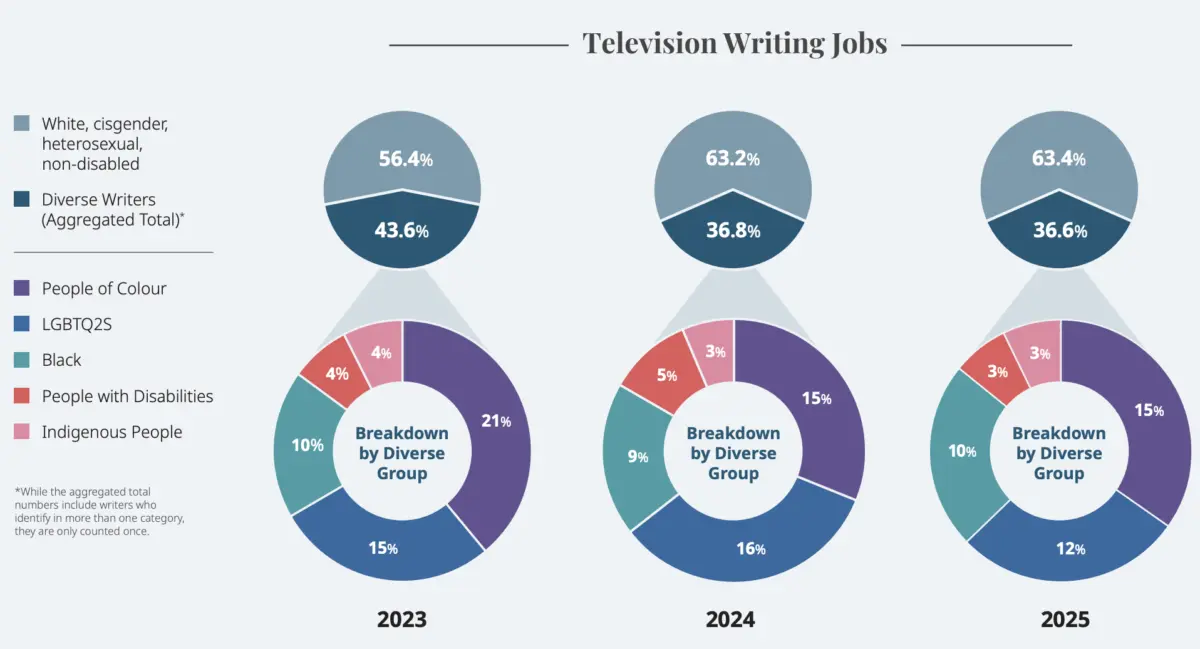
The Canadian film and television industry is currently navigating a precarious crossroads where the push for institutional diversity, equity, and inclusion (DEI) is colliding head-on with a profound and sustained industrial downturn. While the Writers Guild of Canada (WGC) has successfully shepherded a historic demographic shift within its ranks, the latest Equity, Diversity and Inclusion report, released this Tuesday, paints a sobering picture of a profession in distress. Even as the guild celebrates a membership that is now more representative of the Canadian mosaic than ever before, the broader economic landscape—marked by shrinking production volumes and a shift in power toward foreign-owned streaming giants—is effectively stalling the career advancement of the very writers the industry promised to elevate.
A Demographic Shift Amidst Professional Stagnation
The WGC’s 2026 report provides a granular look at the demographic evolution of Canada’s creative workforce. According to the data, the percentage of diverse members—defined as Black, Indigenous, LGBTQ2S+, people of color, and individuals with disabilities—has climbed steadily over the last seven years. In 2019, diverse members accounted for 33 percent of the guild. By 2024, that figure had risen to 42 percent, and as of 2025, it reached a milestone of 51 percent.
However, this increase in representation has not translated into proportional financial stability. The report highlights a glaring "prosperity gap" that persists regardless of the guild’s inclusive makeup. Data from 2025 indicates that the highest earners—those taking home more than CAN$200,000 annually—remain disproportionately drawn from white, cisgender, heterosexual, and non-disabled demographics. Conversely, the economic floor for marginalized groups remains dangerously low; half of all Black writers and writers with disabilities reported annual earnings of less than CAN$20,000.
This financial disparity suggests that while the "front door" to the industry has been opened wider, the pathways to high-level showrunning positions, stable long-term contracts, and lucrative residuals remain obstructed for those from historically underrepresented backgrounds.
A Chronology of Decline: The Contraction of Canadian Content
To understand the current crisis, one must look at the production trends that have defined the last decade. The WGC report examined 141 live-action and animation series produced between 2024 and 2025, comparing them against a longitudinal study of 448 series from 2019 to 2023. The findings reveal a consistent, year-over-year decline in the volume of domestic production.
The erosion of the industry did not happen overnight. The period from 2018 to 2025 represents a sustained "hollowing out" of the Canadian creative sector. By the end of 2025, the number of one-hour drama episodes produced in Canada had plummeted by 29 percent compared to 2018 levels. Adult-oriented half-hour series saw a similarly drastic contraction of 28 percent. Even more concerning for the long-term health of the industry was the precipitous drop in children’s programming, both in live-action and animation, which has historically served as a training ground for emerging writers and a cultural cornerstone for Canadian youth.
Victoria Shen, executive director of the WGC, characterized these findings as a systemic failure rather than a temporary market correction. "These are alarming numbers that affect not only diverse writers, but all Canadian screenwriters," Shen noted in the report. "This is the second year in a row in which we saw a decline in the number of episodes across every production format covered by the report. These numbers demonstrate an industry in decline."
The Streaming Paradox and Sovereignty Risks
The primary driver of this contraction is the seismic shift in audience consumption patterns. As Canadian viewers migrate toward global streaming platforms—often based in the United States—domestic broadcasters have seen their advertising revenues and market shares evaporate. Unlike local broadcasters, who are tethered to rigorous Canadian Content (CanCon) spending requirements and regulatory obligations, foreign-owned streamers operate under a different set of rules.

This regulatory asymmetry means that as streamers become the primary destination for Canadian audiences, they are not obligated to invest in the Canadian ecosystem at levels that would offset the loss of domestic production. The result is a "cultural trade deficit," where the Canadian creative sector effectively subsidizes the growth of foreign giants while losing the ability to tell its own stories.
This economic reality is unfolding against a volatile geopolitical backdrop. With U.S. trade policies becoming increasingly protectionist and political rhetoric from the south occasionally casting doubt on Canadian sovereignty, the loss of a robust domestic film and television industry is not merely an economic issue; it is a matter of national identity.
Expert Perspectives and Institutional Responses
Industry analysts observe that the "post-Trump" climate, characterized by a general rollback of DEI initiatives in the United States, has created a unique pressure point for Canadian institutions. While the Canadian industry has publicly committed to maintaining its equity goals, the "shrinking pie" of available work makes these commitments difficult to enforce.
"One of the key barriers to their advancement is the depressed state of the industry and the lack of opportunities for anyone," Shen argued. "This is compounded and made more acute by their diverse identities, which often makes them the first to be sidelined when production budgets are cut and risk-averse hiring practices take hold."
From an economic perspective, the lack of investment in Canadian screenwriting is viewed by many as a missed opportunity to develop an exportable cultural product. Historically, Canadian series have found significant success on the international stage—a phenomenon sometimes referred to as the "Canadian soft power dividend." However, without a foundational level of domestic production, the pipeline for creating these "hits" is effectively severed.
Implications for the Future of Canadian Storytelling
The WGC report serves as both a diagnostic tool and a call to action. The guild argues that the current crisis should be treated as a catalyst for a fundamental reimagining of the Canadian media landscape. Rather than merely defending the status quo, the guild is pushing for a reform strategy that focuses on:
- Regulatory Reform: Closing the loopholes that allow foreign streamers to bypass domestic investment requirements.
- Economic Realignment: Treating cultural production as a vital economic sector rather than a discretionary expense, focusing on the export potential of Canadian stories.
- Targeted Support: Ensuring that as the industry recovers, the demographic gains made in the last five years are protected through institutionalized mentorship and production quotas that specifically target high-level writer roles.
The "bellwether" effect mentioned by Shen—that the loss of jobs for writers spells the loss of Canadian screens to foreign creators—is a warning that the industry is approaching a point of no return. As the number of available episodes continues to slide, the talent pool of experienced, diverse writers risks migrating to international markets or leaving the profession entirely.
Conclusion: A Moment of Profound Change
As 2026 draws to a close, the Canadian screenwriting profession stands at a critical juncture. The progress in diversifying the WGC membership is a significant achievement, but it remains vulnerable to the harsh realities of a contracting market. The path forward, according to the guild, requires a coordinated effort between policymakers, broadcasters, and producers to ensure that the Canadian cultural ecosystem does not disappear under the weight of global streaming dominance.
The challenge is clear: if Canada fails to invest in the infrastructure that supports its own creators, it risks ceding its cultural sovereignty to foreign entities. The "reimagining" that Shen calls for is not just an aspiration for the industry; it is a necessity for the survival of a distinctly Canadian voice in the digital age. Whether the government and industry stakeholders can bridge the divide between equity goals and economic reality remains the most pressing question for the future of Canadian television.