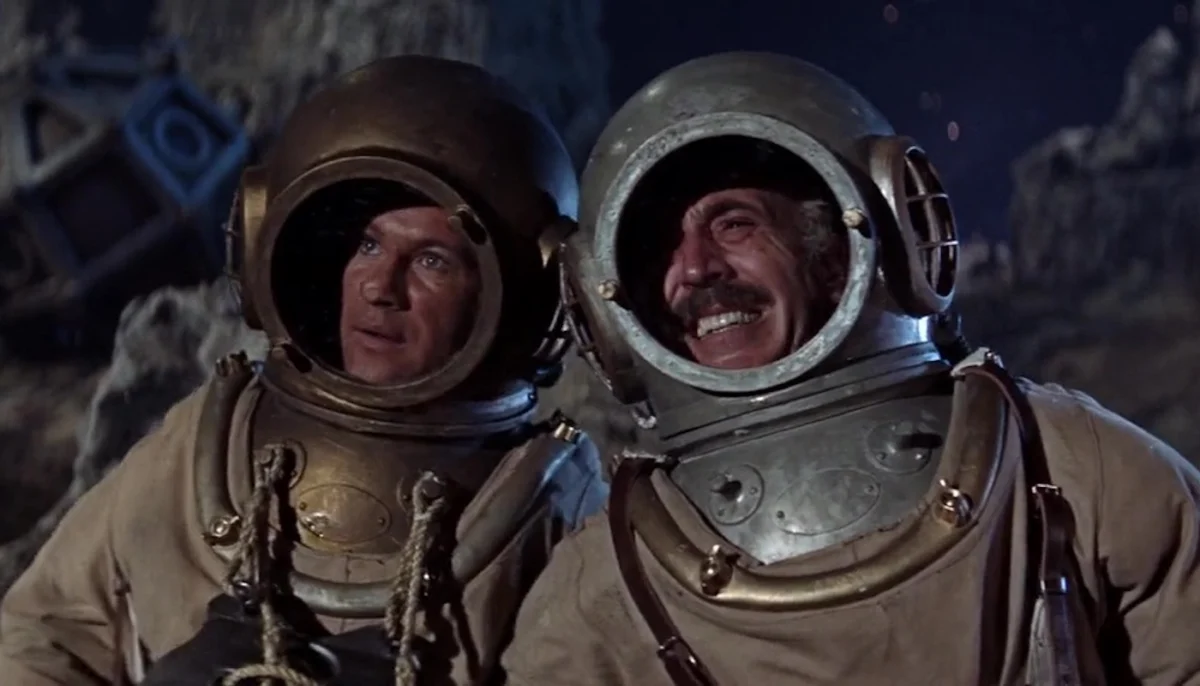
The year 1964 marked a pivotal moment in human history, a period brimming with the audacious ambition of reaching for the stars. It was within this context of burgeoning space exploration that Nathan Juran’s film First Men in the Moon premiered, offering audiences a glimpse, albeit fictional, of humanity’s lunar aspirations. Adapted from H.G. Wells’ seminal 1901 novel, the film, penned by Nigel Kneale and Jan Read, starred Edward Judd as the resourceful Arnold Bedford, Martha Hyer as his pragmatic girlfriend Kate, and Lionel Jeffries as the eccentric inventor Professor Cavor. While the movie itself is a product of its era, its narrative framework subtly reflects the complex geopolitical landscape of the Space Race, particularly the United States’ pursuit of international cooperation in space endeavors.
A Tale of Two Eras: The Film’s Narrative Structure
First Men in the Moon masterfully interweaves two distinct timelines. The film opens in 1964, portraying a multinational effort culminating in the landing of the spaceship United Nations 1 on the Moon. This futuristic (for the time) scenario, though visually characterized by a somewhat rudimentary lunar descent mechanism, sets a tone of global unity and achievement. However, this moment of triumph is quickly juxtaposed with a startling discovery: a tattered Union Jack and a handwritten note, dated 1899, claiming the Moon for Queen Victoria. This anachronistic find serves as the narrative catalyst, propelling the audience into the film’s primary setting – the original lunar expedition of 1899.
Echoes of the Space Race: Kennedy’s Vision for Lunar Cooperation
The 1964 framing device of First Men in the Moon offers a fascinating, albeit coincidental, parallel to real-world diplomatic overtures concerning space exploration. On September 20, 1963, U.S. President John F. Kennedy delivered a landmark speech to the United Nations General Assembly, advocating for a collaborative approach to lunar missions between the United States and the Soviet Union. Kennedy posed a critical question that resonated globally: "Why, therefore, should man’s first flight to the moon be a matter of national competition? Why should the United States and the Soviet Union, in preparing for such expeditions, become involved in immense duplications of research, construction, and expenditure?"
This proposal was a significant shift from Kennedy’s earlier framing of space exploration as a national imperative, notably in his May 25, 1961 address to Congress, which galvanized the American space program towards the Apollo missions. While the Soviet Union, under Premier Nikita Khrushchev, repeatedly declined proposals for joint lunar expeditions, the dialogue between the two superpowers was ongoing. Letters were exchanged between Kennedy and Khrushchev, and discussions occurred at various levels within their respective space agencies. The concept of cooperation was not entirely foreign, but the practicalities and political hurdles proved immense. Decades later, Sergei Khrushchev, Nikita Khrushchev’s son, would reveal that his father had privately considered accepting Kennedy’s proposal, acknowledging the potential benefits but also the challenges of declassifying Soviet space program details.
The assassination of President Kennedy in November 1963 and the subsequent removal of Premier Khrushchev from power in October 1964 marked the end of this specific era of dialogue. It wasn’t until 1972 that a significant step towards space cooperation was taken with the signing of the "Agreement Concerning Cooperation in the Exploration and Use of Outer Space for Peaceful Purposes" by President Richard Nixon and Premier Aleksei N. Kosygin. This paved the way for the Apollo-Soyuz Test Project in 1975, a joint mission where American astronauts and Soviet cosmonauts docked their spacecraft in orbit, a symbolic culmination of decades of competition and nascent cooperation. The sight of an American astronaut and a Soviet cosmonaut aboard the United Nations 1 lunar lander in the film’s opening, depicted as equals on a shared mission, offered a brief, optimistic glimpse of this cooperative future, a stark contrast to the prevailing nationalistic fervor of the actual Space Race.
From Victorian Novel to Silver Screen: The Literary and Cinematic Legacy
The core narrative of First Men in the Moon originates from H.G. Wells’ imaginative 1901 novel. Wells, already a celebrated author with classics like The Time Machine and The War of the Worlds to his name, penned a tale of scientific discovery and extraterrestrial encounters. The story centers on the charming but indebted Arnold Bedford and his eccentric neighbor, Professor Cavor, who invents "Cavorite," a material capable of negating gravity. Their subsequent journey to the Moon in Cavor’s spherical craft, replete with mad scientist hijinks and encounters with the subterranean, insectoid Selenites, captivated readers. The novel’s serialization in The Strand Magazine and Cosmopolitan in 1900-1901, accompanied by Claude Shepperson’s evocative illustrations, cemented its place in popular literature.
The novel has seen multiple adaptations, with the first cinematic version emerging in the United Kingdom in 1919. Unfortunately, this silent film is largely lost to history, with only a single still image and a brief synopsis surviving, as documented by the BFI’s "Most Wanted" project. This early adaptation captured the visual essence of the Selenites, described as "charmingly bug-eyed."
Forty-five years later, the 1964 film adaptation emerged, a testament to the enduring appeal of Wells’ vision. The production of this film was a collaborative effort driven by industry veterans. Stop-motion animation pioneer Ray Harryhausen, whose work on creatures and fantastical beings had already garnered acclaim in films like The Beast from 20,000 Fathoms (1953), joined forces with screenwriter Nigel Kneale, renowned for his creation of the Professor Quatermass character and his contributions to science fiction television and film.
Together, Harryhausen and Kneale convinced producer Charles Schneer and director Nathan Juran to bring First Men in the Moon to the screen. Schneer, who had a long-standing working relationship with Harryhausen and Juran, harbored initial doubts about audience reception to a Wells adaptation and the film’s more serious tone. However, the success of George Pal’s 1960 adaptation of Wells’ The Time Machine, which retained its Victorian setting and performed well at the box office, provided a crucial precedent. This encouraged the decision to proceed with First Men in the Moon, integrating the Space Age framing with the novel’s Victorian core.
Production Challenges and Creative Compromises
Despite the talent involved, the production of First Men in the Moon was not without its challenges, primarily stemming from time and budget constraints. Ray Harryhausen, in a 2005 interview, expressed some frustration with the final product, noting that technical difficulties, particularly with matching rear-projected backgrounds to the widescreen Panavision format, led to distortions. While these issues were not overtly apparent to the casual viewer, they evidently impacted Harryhausen’s satisfaction with the film.
Furthermore, the film’s visual realization of the Selenites suffered from these limitations. Instead of fully animating the alien civilization, a significant portion of the Selenite characters were portrayed by children in costumes. Harryhausen explained this compromise: "We had to do it this way, because if I had animated them all I still wouldn’t be finished today." While the child actors lent a certain cuteness to the aliens, this was not the intended aesthetic, detracting from the menacing or awe-inspiring presence that Harryhausen’s creature work typically conveyed.
The only substantial creature animation by Harryhausen in the film is the encounter with a giant centipede-like creature in the lunar caverns. This sequence, while showcasing Harryhausen’s signature artistry and creature design, is brief, leaving audiences wishing for more of his animated marvels. The creature’s swift demise, as the Selenites dispatch and strip it of its flesh, serves as a stark reminder of the film’s tonal shifts.
A Darker Turn: The Climax and Its Implications
The narrative culminates in a series of escalating conflicts between Arnold, Kate, and the Selenites, with Arnold’s penchant for violence hindering diplomatic efforts. Ultimately, Arnold and Kate manage to return to Earth, while Cavor chooses to remain on the Moon. The film’s closing scenes revisit the 1964 expedition of the United Nations 1. The astronauts discover that the Selenite civilization has vanished. They theorize that Cavor inadvertently carried a virus to the Moon, which decimated the alien population. This conclusion introduces a somber and tonally jarring element to a film that, for much of its runtime, embraced a more lighthearted, adventurous spirit.
The film’s conclusion carries an implicit commentary on the unintended consequences of human exploration. While the initial premise of reaching the Moon was driven by curiosity and ambition, the narrative suggests that such endeavors, particularly when undertaken without full understanding or control, can lead to catastrophic outcomes for indigenous life. This darker undertone, while perhaps not fully realized by the filmmakers, adds a layer of complexity to the film’s overall message.
A Film of Transition: Bridging Eras of Science Fiction
First Men in the Moon stands as an interesting, if imperfect, artifact of cinematic history. It occupies a unique space, attempting to bridge the gap between the fantastical, often whimsical, science fiction of the early to mid-20th century and the more scientifically grounded, serious explorations that began to emerge in the late 1950s and gained momentum through the 1960s. Films like Destination Moon (1950), The Day the Earth Stood Still (1951), and Forbidden Planet (1954) had already shifted the genre towards greater realism and thematic depth, a trend that would be further amplified by Stanley Kubrick’s 2001: A Space Odyssey (1968).
The film’s strengths lie in its charming performances, its imaginative embrace of H.G. Wells’ classic story, and its subtle nod to the era’s burgeoning internationalism in space. However, the visible production limitations and the uneven tonal shifts prevent it from reaching its full potential. It is a film that looks both backward to the era of pulp science fiction adventures and forward to the more mature, complex narratives that would come to define the genre. Ultimately, First Men in the Moon is a product of a specific moment – a time when humanity was on the cusp of achieving its lunar ambitions, yet the full reality and implications of that achievement were still largely unexplored, both on screen and in the cosmos.