Narrative Overview and Character Dynamics
The plot centers on Nick, portrayed by Jai Courtney, who is characterized as the affable and somewhat naive heir to a substantial rural estate. Nick’s life is anchored by his role on the family farm and his relationship with his fiancée, Kori, played by Emily Browning. However, the domestic stability Nick envisions is revealed to be an illusion when he discovers that Kori is engaged in an extramarital affair with her employer, Derek, played by Damon Herriman. This betrayal is compounded by the fact that Derek is married to Kori’s closest friend, Diana, portrayed by Claudia Doumit.
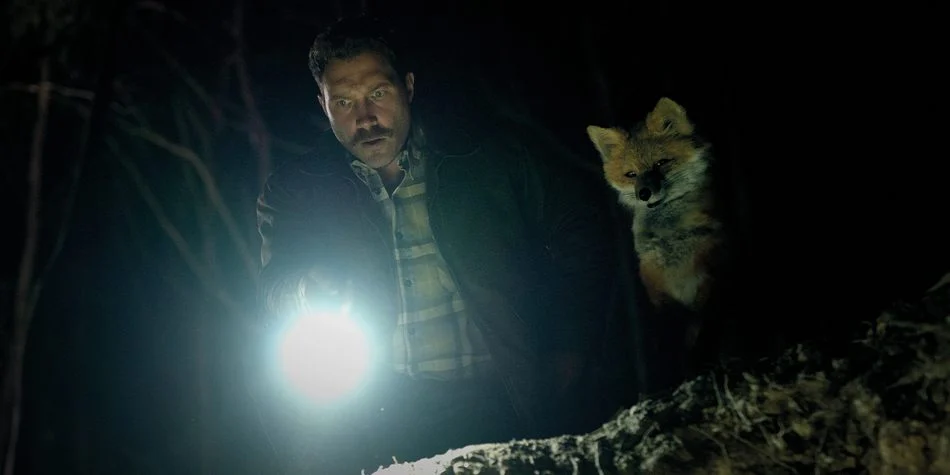
The narrative shifts from a standard domestic drama into the realm of the supernatural following Nick’s capture of a rogue fox that has been raiding his family’s livestock. In a departure from biological reality, the fox—voiced by Academy Award winner Olivia Colman—possesses the ability to speak and offers Nick a transactional bargain. If Nick spares her life, the fox promises to provide a solution to his crumbling relationship. The fox directs Nick to a mysterious "magic hole" located within the woods on his property, claiming the aperture possesses the power to transform Kori into a "perfect" version of herself.
Driven by a desperate desire to maintain his relationship and avoid the emotional labor of a traditional reconciliation, Nick follows the fox’s instructions. With the assistance of Diana, who is motivated by her own grievances regarding Derek’s infidelity, Nick orchestrates a scenario in which Kori is pushed into the hole. The subsequent day, Kori emerges in a state of primitive disarray—naked and covered in earth—but displaying a radical personality shift. The "new" Kori is initially characterized by extreme perkiness, an agreeable disposition, and heightened libido, fulfilling Nick’s superficial desires. However, as the narrative progresses, Kori’s behavior becomes increasingly erratic and non-human, leading to a series of escalating complications that involve Derek and further supernatural transformations.
Production Background and Creative Leadership
Dario Russo’s role in the production of The Fox is comprehensive, encompassing the primary creative pillars of writing, directing, editing, and composing the musical score. This level of creative autonomy is rare for a debut feature but aligns with Russo’s established reputation in the industry. Russo previously gained a cult following for his work on the television series Danger 5, which was noted for its kitsch aesthetic, absurdist humor, and meticulous production design.
The decision to utilize practical puppetry rather than computer-generated imagery (CGI) for the film’s animal characters is a deliberate stylistic choice. The puppets are designed with a specific aesthetic that avoids hyper-realism, opting instead for a slightly "off-sync" movement that contributes to the film’s surrealist atmosphere. This approach mirrors the "uncanny valley" effect, reinforcing the theme that the transformations occurring within the story are inherently unnatural.
The film’s 89-minute duration reflects a trend in independent filmmaking toward concise, high-impact storytelling. By maintaining a lean runtime, Russo ensures that the absurdist premise does not overstay its welcome, keeping the pacing tight as the story transitions from a rural comedy into a bizarre, third-act exploration of identity and consequence.
The Role of Voice Artistry and Narrative Framework
A significant portion of the film’s identity is derived from its narration and the vocal performances of its animal characters. Olivia Colman provides the voice of the titular Fox, delivering a performance that balances "chipper" delivery with an underlying sense of menace. The film opens with a philosophical monologue by Colman’s character, which categorizes various animals by their perceived moral failings—labeling cats as torturers, magpies as gossips, and frogs as sex pests—while ultimately concluding that humans are the most prone to avoiding responsibility for their actions.
Sam Neill contributes the voice of a gossipy magpie, serving as a secondary commentator on the unfolding events. The presence of Neill and Colman, both internationally recognized veterans, provides a tonal anchor for the film. Their delivery of "nasty" or cynical dialogue with upbeat inflections creates a "mean streak" that defines the film’s comedic voice. This stylistic choice emphasizes the "trickster" nature of the animals, a common motif in global folklore that Russo adapts for a modern, adult audience.
Performance Analysis and Character Subversion
The casting of Jai Courtney and Emily Browning represents a deliberate subversion of their established screen personas. Courtney, often cast in hyper-masculine or action-oriented roles (such as in Suicide Squad or the Terminator franchise), here plays against type as a "gentle giant." His performance relies heavily on physical comedy and reactive facial expressions, portraying a man who is consistently outmatched by the supernatural and emotional circumstances surrounding him.
Emily Browning’s performance is central to the film’s transition from drama to horror-comedy. In her role as the "transformed" Kori, Browning adopts a feral, unpredictable physicality. Critics and observers have noted her ability to maintain a "cheery smile" while delivering snarky retorts or engaging in animalistic behavior, effectively conveying the sense that while the character looks human, her internal essence has been replaced by something alien.
Damon Herriman’s portrayal of Derek provides much of the film’s tension in the second act. As the character who demands answers regarding Kori’s change, he serves as the catalyst for the story’s further descent into the surreal. His eventual interaction with the "magic hole" serves to broaden the film’s scope, moving the story beyond a singular relationship and into a broader commentary on the replaceability of individuals.
Broader Impact and Thematic Implications
The Fox enters the cinematic market at a time when "folk horror" and "adult fables" are seeing a resurgence in popularity. However, Russo’s work distinguishes itself by leaning more heavily into comedy than its contemporaries. The film’s refusal to provide a clear moral—a point explicitly addressed by the narrator in the final scenes—aligns it with postmodern storytelling, where the journey and the "weirdness" are prioritized over a traditional lesson.
From an industry perspective, the film highlights the strength of the Australian independent sector in producing high-concept genre films that can attract A-list talent. The involvement of actors like Colman and Neill suggests a strong script and a compelling creative vision, which often allows smaller-budget productions to achieve international distribution and festival recognition.
Thematic analysis of the film suggests a critique of the "quick-fix" mentality prevalent in modern society. Nick’s decision to use a supernatural shortcut to "fix" his partner rather than addressing the underlying issues of his relationship serves as a cautionary tale. The escalating "quirks" of the transformed Kori act as a literal representation of the unforeseen consequences that arise when one attempts to mold a partner into an idealized, subservient version of themselves.
Conclusion and Market Reception
As a debut feature, The Fox establishes Dario Russo as a filmmaker with a highly specific "wavelength." While the film’s sense of humor and surrealist leanings may not appeal to a broad, mainstream audience, its clear authorial voice and strong performances position it as a potential cult classic. The third-act twist, which reportedly recontextualizes much of the preceding narrative, offers significant "rewatch value," a trait highly prized in the independent film community.
The film’s technical execution—particularly its score and practical effects—demonstrates that a limited scale does not necessitate a lack of ambition. By focusing on a tight cast and a singular, bizarre premise, Russo has created a work that stands out in a crowded marketplace. The Fox serves as a reminder of the enduring power of the fable as a medium for exploring the darker, more absurd aspects of the human condition. Statistics regarding the film’s box office performance and streaming reach are expected to follow its festival run, providing further data on the commercial viability of such niche, high-concept Australian productions.