Narrative Overview and Character Architecture
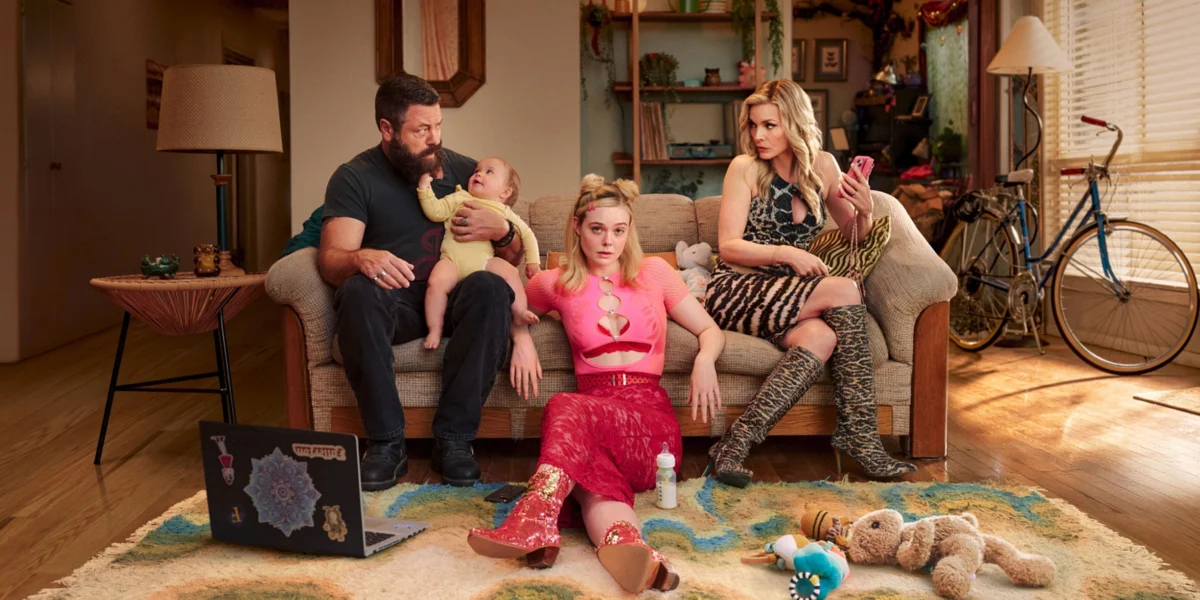
The series centers on Margo Millet, portrayed by Elle Fanning, a college student whose life is abruptly redirected following an unplanned pregnancy during her freshman year. Faced with the daunting reality of single motherhood and a lack of viable employment opportunities, Margo finds herself on the brink of financial ruin. The narrative premise hinges on a unique convergence of two seemingly disparate industries: the world of adult content creation and the theatrics of professional wrestling.
When Margo’s estranged father, Jinx (Nick Offerman), re-enters her life following a period in rehabilitation, he brings with him the wisdom of "kayfabe"—the professional wrestling practice of maintaining a stage persona as if it were real. Jinx, a former professional wrestler, suggests that Margo apply the principles of character development, audience engagement, and narrative "hooks" to an OnlyFans account. This advice proves transformative, as Margo utilizes her natural talent for writing to craft compelling personas that resonate with a digital audience.
The show meticulously balances the logistical challenges of Margo’s new career with the emotional toll it exacts on her family. Michelle Pfeiffer plays Shyanne, Margo’s mother and a long-time waitress at a Hooters-style establishment, who views her daughter’s career path with a mixture of horror and recognition. The supporting cast, which includes Nicole Kidman, Greg Kinnear, and Thaddea Graham, rounds out a community of characters who are each navigating their own versions of "performance" to survive.
Chronology of Production and Development
The journey of Margo’s Got Money Troubles from page to screen began in late 2023, when the television rights to Rufi Thorpe’s novel became the subject of a competitive bidding war among major streaming platforms. Apple TV+ ultimately secured the project, signaling their continued commitment to prestige literary adaptations and high-profile talent partnerships.
Development proceeded rapidly under the stewardship of David E. Kelley, whose track record for successful female-led dramas—including Big Little Lies and The Undoing—made him a natural fit for the material. Casting announcements in early 2024 generated significant industry buzz, particularly the pairing of Fanning and Pfeiffer as a mother-daughter duo. Principal photography took place across various locations in Southern California, capturing the gritty yet vibrant atmosphere of the story’s setting.
The production team emphasized authenticity in depicting both the wrestling and content creation industries. Consultants from the professional wrestling world were reportedly brought in to ensure that Jinx’s advice and back-story felt grounded in the reality of the independent circuit. Similarly, the depiction of the digital creator economy was handled with an impartial curiosity, avoiding the moralizing tropes often associated with mainstream media portrayals of sex work.
Supporting Data: The Economic Context of the Series
The thematic core of the series is rooted in real-world economic trends. According to industry data, the "gig economy" has expanded significantly over the last decade, with millions of Americans relying on non-traditional income streams to supplement or replace stagnant wages. OnlyFans, the platform central to Margo’s story, reported a 47% increase in creator earnings in 2023, reaching total payouts of over $5.3 billion.
The series reflects the growing trend of "financial survivalism" among Gen Z and millennial demographics. A 2023 study by the Pew Research Center indicated that nearly 30% of young adults have engaged in some form of online content creation for profit. By centering Margo’s struggle on the necessity of paying bills rather than a desire for fame, the show aligns itself with a broader cultural conversation regarding the erosion of the middle class and the disappearance of the traditional career ladder.
Furthermore, the integration of professional wrestling history provides a historical parallel to modern digital performance. The "territory days" of wrestling, which Jinx represents, were characterized by independent contractors traveling from town to town, often with little job security or long-term health benefits—a direct ancestor to the modern gig worker’s experience.
Performance Analysis and Industry Impact
Critical reception of the series has focused heavily on the powerhouse performances of its central trio. Elle Fanning’s portrayal of Margo is noted for its seamless transition between comedic timing and raw emotional vulnerability. Industry analysts suggest that this role could serve as a career-defining turn for Fanning, showcasing her ability to carry a complex, tonally diverse narrative.

Nick Offerman’s performance as Jinx is being hailed as a departure from his more stoic, comedic roles. By leaning into the physical and emotional wreckage of a retired athlete, Offerman provides the show with a "gut-punching" gravity. His chemistry with Fanning is described as the emotional anchor of the series, illustrating the "bittersweet" nature of a father-daughter reconciliation mediated by shared professional hardships.
However, it is Michelle Pfeiffer’s performance as Shyanne that has garnered some of the most intense praise. Critics have highlighted her ability to portray a character who is both "self-possessed" and deeply wounded. The mother-daughter dynamic explored through Pfeiffer and Fanning is viewed as one of the most authentic representations of the bond currently on television, capturing the nuances of friendship, resentment, and mutual survival.
Official Responses and Strategic Positioning
While Apple TV+ has not released specific viewership metrics—consistent with standard streaming industry practices—internal sources suggest the platform is positioning the series as a major contender for the upcoming awards season. The collaboration with David E. Kelley is part of a broader strategy to dominate the "prestige dramedy" category, appealing to both critics and a wide subscriber base.
In a statement regarding the show’s themes, the production team noted: "We wanted to tell a story that treats every form of entertainment—whether it’s in a wrestling ring, a restaurant, or on a smartphone screen—with the same level of dignity. These characters are storytellers who are using the tools available to them to navigate a world that doesn’t always make it easy for them to succeed."
The series has also sparked discussion among advocacy groups for digital creators. Several organizations have praised the show for its impartial look at OnlyFans, noting that it avoids the "harsh judgment" often found in television procedurals. By focusing on the "rippling effects" of Margo’s choices on her family, the show offers a three-dimensional view of a profession that is frequently reduced to a punchline or a scandal.
Broader Implications and Thematic Climax
Despite the high praise for its character work, some critics have pointed to the season’s climax as a point of contention. The narrative shift toward more traditional "melodrama" in the final episodes has been described as a departure from the "earnest grounding" that defines the earlier chapters. While this shift provides the actors with high-intensity material, some argue it "stretches believability" and slightly undermines the show’s established realism.
Nevertheless, the overarching impact of Margo’s Got Money Troubles remains significant. It stands as a smart, stylish examination of how fiction and performance are utilized as survival mechanisms. The show posits that everyone is playing a role—whether it is the "good mother," the "reformed father," or the "internet fantasy"—and that the true challenge lies in finding the authentic self beneath the persona.
As the television landscape continues to evolve, projects like this suggest a move toward more nuanced, empathetic portrayals of the modern economic struggle. By blending the "wacky" elements of pro wrestling with the "heartfelt" realities of family life, the series creates a unique space in the 2024 television calendar.
Awards Prospects and Final Assessment
The industry consensus points toward a strong showing for the series at the upcoming Emmy Awards. Predicted nominations include Outstanding Comedy Series, as well as individual acting nods for Fanning, Pfeiffer, and Offerman. The writing and directing, led by Kelley’s signature sharp dialogue and pacing, are also expected to be recognized.
With a final critical score of 8/10, Margo’s Got Money Troubles is being recognized as an absolute delight that wears its heart on its sleeve. It succeeds in being a compelling family drama while simultaneously serving as a cultural document of the 2020s, reflecting the resilience of those who must constantly reinvent themselves to survive. The series confirms that while internet fame and unconventional career paths come at a cost, the bonds of family and the power of a well-told story remain invaluable.