A Deep Dive into Subversion and Expanded Lore
At its core, Ready or Not 2: Here I Come maintains the gleeful spirit of subversion that permeated its predecessor, pushing boundaries not only in its increased blood-soaked violence but also in its narrative unpredictability. Directors Bettinelli-Olpin and Gillett masterfully weave a story that consistently defies audience expectations, opting to "zig" when one anticipates a "zag." This deliberate narrative misdirection, coupled with a surprising depth of character interiority amidst histrionic antics, sets the film apart. While it delivers the cathartic thrill of witnessing the wealthy receive their devilish comeuppance, it simultaneously champions the profound power of imaginative resistance, offering a nuanced commentary on societal structures.
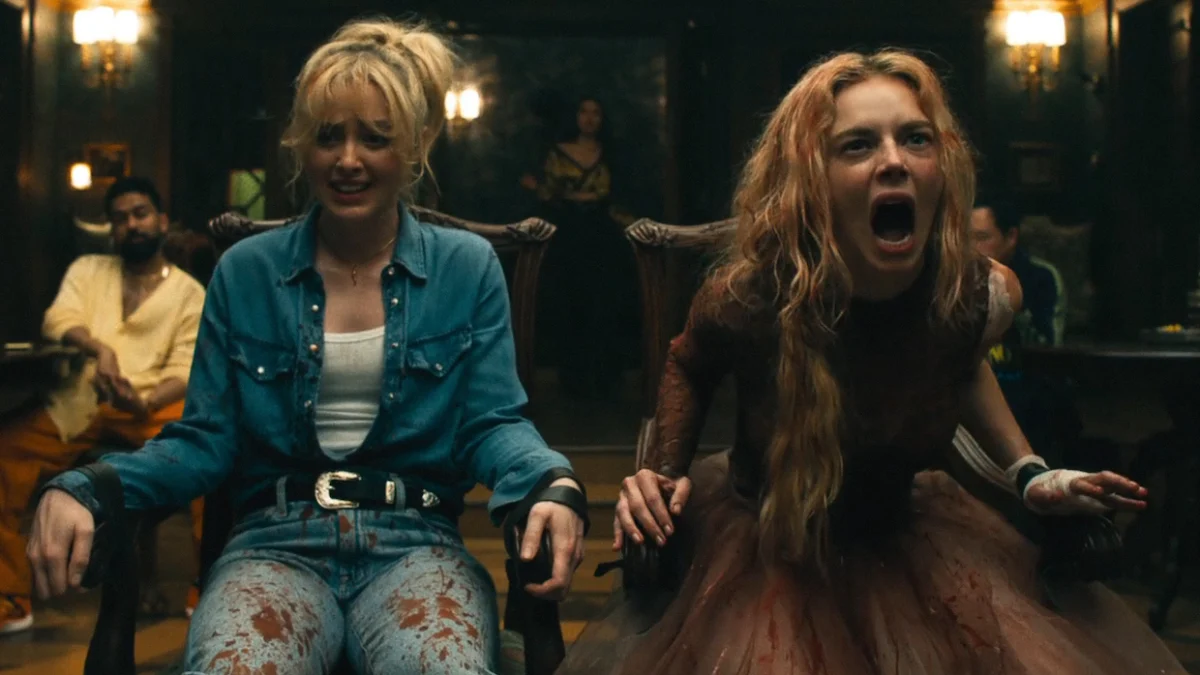
The narrative picks up precisely where the original film concluded – in the immediate aftermath of the Le Domas family estate’s explosive demise. Grace (Samara Weaving), covered in blood and grime, collapses on the mansion steps, the sole survivor of a supernatural game of hide-and-seek that annihilated her in-laws, including her new husband, in a spectacularly gruesome fashion. Her brief moment of respite is shattered upon waking to the unexpected presence of her estranged sister, Faith (Kathryn Newton). Before the sisters can even exchange their customary insults, they are brutally captured. This abduction swiftly reveals a far more expansive and sinister truth: the Le Domas family was merely one cog in a vast, capitalist Satanic cult. Other influential families, prominently led by the ruthless siblings Titus (Shawn Hatosy) and Ursula (Sarah Michelle Gellar), now vie for leadership, with the prerequisite being the elimination of Grace and Faith. The sisters’ desperate struggle for survival against these new, formidable adversaries must last until dawn, amplifying the tension and the macabre game to unprecedented levels.
Radio Silence’s Signature Blend of Horror and Humor
Matt Bettinelli-Olpin and Tyler Gillett, operating under their moniker Radio Silence, have carved out a unique niche in contemporary horror cinema, characterized by their adept blending of genre thrills, dark humor, and a keen eye for social commentary. Their filmography, which includes contributions to anthology films like V/H/S and Southbound, as well as the found-footage horror Devil’s Due, consistently explores the manifestation of the supernatural in everyday life. More recently, their successful revitalization of the Scream franchise demonstrated their ability to honor genre conventions while infusing them with fresh energy and self-aware meta-commentary.
Speaking on the day of Ready or Not 2: Here I Come‘s release, Bettinelli-Olpin and Gillett provided a spoiler-filled glimpse into their creative process, discussing the delicate balance between genre thrills and the film’s underlying themes of resistance and corporate greed. The decision to commence the sequel immediately after the iconic final shot of the original was a deliberate choice, as Gillett explained. "What people responded to from the first film was Grace’s scrappiness and how, down to the very end, she never gave up. She had every bit of fight in her at the end of Ready or Not that she had at the beginning," he noted. "We loved the notion of dragging someone through Hell and not giving them a break. Starting from the end was a fun way to suggest that the world of corruption and evil is much more expansive than just one family. The devil won’t wait for you." This immediate continuation not only capitalizes on the previous film’s memorable climax but also immediately establishes the expanded scope and heightened stakes of the sequel.
The filmmakers acknowledged their recurring exploration of the supernatural, a thread visible from their earlier works like Devil’s Due through to the Ready or Not series. Bettinelli-Olpin elaborated, "It’s interesting to explore these questions of spirituality through characters who themselves have their own crises of faith. When you look at those movies with a stronger supernatural element, there’s a darkness to them. Ready or Not 2: Here I Come does go a bit darker in terms of the exploration of the divine." However, Gillett was quick to clarify that their interest lies more in subverting supernatural horror tropes than strictly adhering to them. "I think if you’d asked us, though, if the supernatural horror sub-genre was something that we loved, we would say that we like watching those movies, but I don’t know if we have a particularly strong interest in making them. What you’re seeing in our work is very much a skewering and subversion of that subgenre," he stated. This "skewering" is often achieved through humor derived from the collision of relatable human characters with high-stakes, fantastical scenarios, giving their films a grounded yet absurd quality. Bettinelli-Olpin humorously added, "We try to treat our stories with a very grounded approach. I say that knowing that in both Ready or Not films, the fucking devil shows up at the end. It’s not subtle." This self-awareness is key to their unique tone.
Expanding the Universe: From Mansion Mayhem to Global Cabal
The first Ready or Not, released in August 2019, proved to be a critical and commercial sleeper hit. Produced on a modest budget of $6 million, it grossed over $57 million worldwide and garnered an 88% approval rating on Rotten Tomatoes, praised for its unique premise, dark humor, and Samara Weaving’s breakout performance. The film introduced audiences to the eccentric Le Domas family, whose tradition of playing a deadly game of hide-and-seek with new spouses culminates in a genuinely shocking supernatural twist. The success of the original paved the way for the sequel, greenlit by Searchlight Pictures (a division of Disney) who recognized the franchise potential in Radio Silence’s innovative storytelling.
Ready or Not 2: Here I Come builds directly upon this foundation, taking the "mansion burner" ending as its starting gun. The original film’s premise, wherein the Le Domas family’s wealth was tied to a demonic pact, is now revealed to be part of a much larger, insidious network. The introduction of other powerful families, such as those led by Titus and Ursula, signifies a significant expansion of the lore. No longer are the antagonists merely "cosplaying evil" with silly robes and goblets, as Bettinelli-Olpin described the Le Domas clan in the first film. The sequel’s antagonists are presented as more organized, more dangerous, and more fully aware of the true nature of their satanic rituals. This shift is subtly reflected in the production design and practical effects, including a notable increase in the "candle budget," which the directors jokingly highlighted. "In the first film we had a total of fifteen candles and three candelabras," Bettinelli-Olpin recalled, with Gillett adding that they "we’d move them into each shot to give them the appearance of candelabras in these long hallways." For the sequel, the abundance of candles and more elaborate set pieces underscore the heightened stakes and the deeper entrenchment of these new, more formidable cults.
Crafting the Chaos: Directorial Ingenuity and Unforgettable Moments
A significant aspect of Radio Silence’s filmmaking approach is their commitment to subverting audience expectations, even in moments that appear to lean into conventional genre tropes. Bettinelli-Olpin recalled a key example from the first film: "I think back to the first film when we saw the image of Samara with the shotgun, looking regal and badass. But when that scene actually comes up in the movie, the gun doesn’t work, and it’s not as ‘cool’ as the image showed." This deliberate undermining of the "hero shot" is a testament to their desire to keep audiences on their toes. The sequel continues this tradition, presenting numerous instances where a clear "A to B" narrative path is abruptly altered.

One of the film’s most talked-about sequences involves a series of "laundry machine kills," which the directors highlighted for their unique impact. "The laundry machine kills come to mind, namely because the sisters have to deal with that in real time," Bettinelli-Olpin explained. "It’s like, ‘Oh shit, we’re killing a guy. He’s in real pain.’" Gillett further elaborated, "You feel uncomfortable because of how drawn out it is and how it doesn’t feel like a horror movie death." These moments are designed to be jarring and uncomfortable precisely because they strip away the stylized nature of typical horror violence, forcing viewers to confront the brutal reality of the characters’ actions.
The film also features a standout comedic moment that perfectly encapsulates Radio Silence’s blend of the modern and archaic: a cameo by legendary filmmaker David Cronenberg, who is seen texting in a group chat. His line, "Approve the ceasefire," and its immediate, tangible effect on a global conflict, was described by Bettinelli-Olpin as "one of the jokes that we’re most proud of, how well that has landed." The humor stems from the juxtaposition of immense, almost god-like power being wielded through mundane, modern technology. "After Cronenberg says that line, it’s literally about three seconds before we see the notification that the ceasefire has happened," Bettinelli-Olpin noted, with Gillett adding, "But critically, the moment before it says there’s ‘no end in sight’ for the war, and then all of a sudden it gets resolved." This moment, early in the film, serves to cleverly set the tone, signaling to the audience that they are in for a ride that will constantly play with expectations.
Character Arcs Amidst the Carnage
Despite the escalating violence and fantastical elements, Ready or Not 2: Here I Come remains deeply anchored by its character work. Samara Weaving’s Grace continues to defy typical horror protagonist tropes. "We’re so used to seeing these characters become superheroes, filled with bloodlust. But Grace is not that," Bettinelli-Olpin asserted. "She can protect herself and protect her sister when she needs to, but she’s still very human and she doesn’t want to just go around murdering people." This commitment to Grace’s humanity, her inherent kindness, and her reluctance to embrace brutality makes her a far more relatable and compelling survivor. Her journey is not one of transformation into a hardened killer, but rather a testament to enduring humanity in the face of unspeakable evil.
The film also meticulously traces the descent of new antagonist Titus, portrayed by Shawn Hatosy. A recurring motif of him being slapped—by his father, his sister Ursula, and ultimately by Faith—serves as a crucial narrative device, gradually cracking his psyche. Bettinelli-Olpin observed, "Even though Titus is a capital-V villain in this movie, you want to know why he is the way he is. There’s something about those slaps, especially from his dad, where you do feel empathy for him, and you watch that get peeled away throughout the movie." This slow erosion of his composure culminates in a moment where he slaps his sister, signifying his complete break from sanity. Gillett drew parallels between Titus’s arc and that of Alex, Grace’s husband from the first film. "It’s funny how Alex and Titus mirror each other because Alex is falling into his family’s brutality begrudgingly, versus Titus who wants to be that fucking guy." This nuanced portrayal adds layers to the antagonists, preventing them from becoming one-dimensional villains.
The Philosophy of Resistance and Hope
Beyond the visceral thrills and dark humor, Ready or Not 2: Here I Come grapples with profound thematic questions, particularly concerning the nature of power, corruption, and individual agency. The film posits a critical dilemma: when confronted with an overwhelmingly corrupt system, must one either join it or be destroyed by it? Through Grace’s journey, the film articulates a hopeful "third path" – one rooted in imaginative resistance.
"We make fun, silly movies, but we really hope that the thematic stuff we deal with at the heart of our films is real and not goofy," Bettinelli-Olpin stated, emphasizing their commitment to conveying a worldview through entertainment. He highlighted Grace’s ultimate choice: "To have Grace take that moment and say, ‘I don’t believe that. I think there’s another way.’ We’re not presented with that option anymore." This rejection of a cynical binary is central to the film’s message. Gillett passionately added, "In both versions of those scenarios, the bad guys win. I’m fucking sick of living in a world where the bad guys win. We don’t want to express that in our work; we want the good guys to get the shot at victory. It should be complicated, it should come at a cost, it should be bittersweet, but it’s fucking great when the bad guys get what’s coming to them."
The directors also discussed the perils of cynicism, arguing that it ultimately allows the "bad guys" to win. Their approach seeks a path to victory that is not cynical, refusing to adopt the worldview of the oppressor. This philosophical underpinning, though delivered within a highly entertaining package, is a core tenet of their artistic mission. Gillett acknowledged that their tone sometimes leads to their work being "written off because it’s entertaining and silly and fun," causing some to believe "there’s nothing to see here." However, he stressed the deliberate effort to embed meaningful themes within an accessible framework. "I would say that some of the hardest work that we do is actually working to hide all of that nutritive shit inside of something that is hopefully digestible and approachable," he explained, concluding that they believe art should make you "feel first instead of think first."
Implications for the Horror Genre and Beyond
Ready or Not 2: Here I Come solidifies Radio Silence’s position as significant voices in contemporary horror. Their ability to deliver high-octane entertainment while simultaneously offering sharp social commentary and philosophical depth sets a benchmark for genre filmmaking. The expansion of the "Ready or Not" universe opens doors for potential future installments, exploring other facets of the capitalist Satanic cults and the broader implications of their power. The film’s success is not just a win for Searchlight Pictures but also a testament to the audience’s appetite for horror that dares to be both terrifying and thought-provoking, gory and genuinely funny.
The critical reception, while still developing post-release, is anticipated to echo the praise of its predecessor, with particular attention paid to its narrative boldness, the performances of its ensemble cast, and its resonant thematic core. In an era often marked by cynicism and despair, Ready or Not 2: Here I Come offers a cathartic, albeit bloody, vision of hope and the enduring power of resistance, proving that even in the darkest corners of a satanic capitalist conspiracy, a "third way" can indeed be found. The film is poised to continue the legacy of its predecessor, cementing its place as a unique and impactful entry in the modern horror landscape.