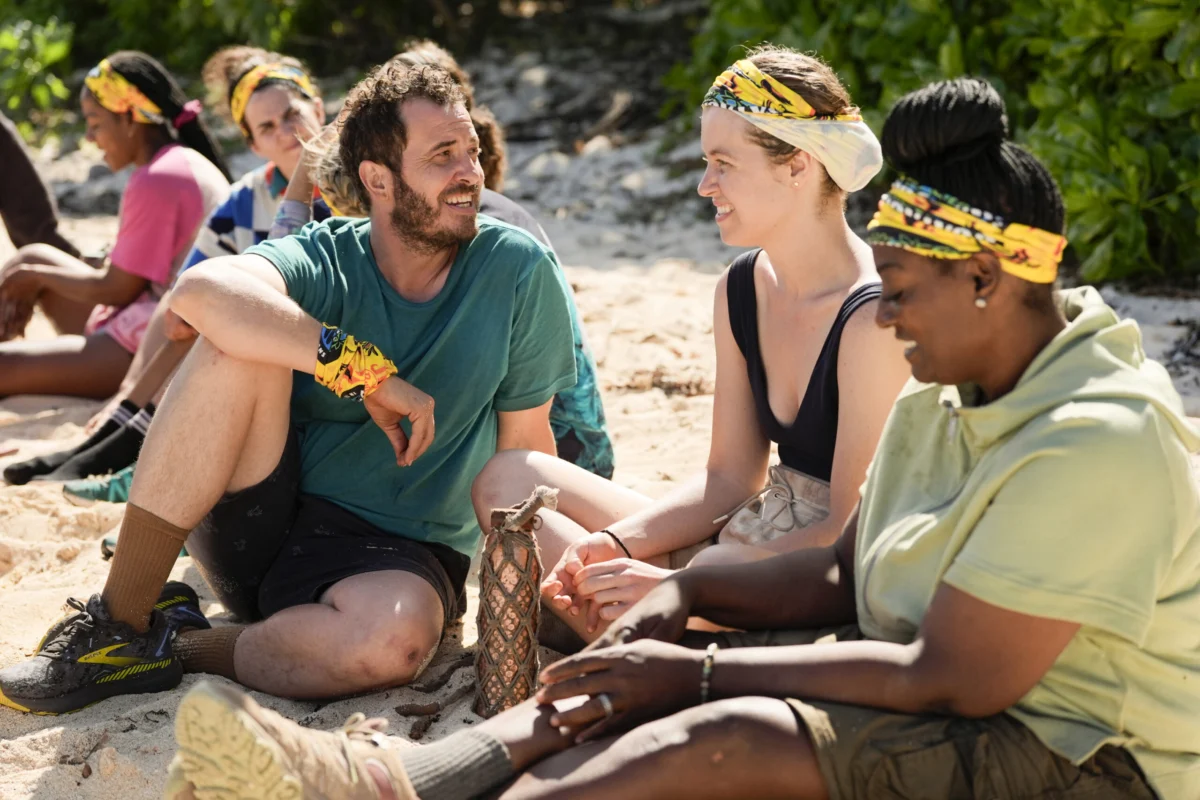
The landmark fiftieth season of the long-running reality competition series Survivor reached a historic turning point during its sixth episode, titled The Blood Moon. In a broadcast that aired on April 1 on CBS, the production executed the most significant elimination event in the franchise’s history, removing three veteran players in a single evening. The triple elimination, a first for the series, occurred during a high-stakes transition period just before the formation of the jury, fundamentally altering the strategic trajectory of the season. The episode resulted in the departures of Genevieve Mushaluk, Kamilla Karthigesu, and the legendary Colby Donaldson, leaving the remaining contestants and the viewing audience to grapple with a new precedent for the game’s structural volatility.
Structural Breakdown of the Blood Moon Twist
The episode’s central mechanic, dubbed the Blood Moon, was introduced by host and executive producer Jeff Probst as a response to fan requests for significant gameplay disruptions. This twist effectively bypassed the traditional tribal structure for one night, fragmenting the merged tribe of 15 eligible players into three distinct groups of five. This division was determined at random, creating new micro-alliances and forcing players to navigate immediate threats without the safety net of their broader voting blocs.
Safety was granted to two individuals prior to the group division. Ozzy Lusth, a four-time returning player known for his physical dominance, discovered a lifesaving advantage that secured his safety on Exile Island. Per the rules of the advantage, Lusth was permitted to select one companion to join him in safety; he chose Rizo Velovic. While being isolated on Exile Island typically presents a disadvantage regarding social positioning and information gathering, the move proved strategically sound given the unprecedented risk of a triple elimination.
The remaining 15 contestants were split into the following three cohorts:
- Group One: Tiffany Ervin, Jonathan Young, Kamilla Karthigesu, Chrissy Hofbeck, and Stephenie LaGrossa Kendrick.
- Group Two: Christian Hubicki, Rick Devens, Genevieve Mushaluk, Joe Hunter, and Aubry Bracco.
- Group Three: Cirie Fields, Colby Donaldson, Benjamin “Coach” Wade, Dee Valladares, and Emily Flippen.
Each group competed for individual immunity, with the winning player from each cohort securing safety for the night. Additionally, the groups competed for a recurring franchise reward—a feast provided by Applebee’s—which added a layer of physical incentive to the high-pressure environment.
Group One: The Betrayal of the New Era Alliance
The first segment of the triple elimination focused on Group One, where the power dynamics shifted toward the "Old Era" players. Stephenie LaGrossa Kendrick, a veteran of the show’s early seasons, secured both individual immunity and the Applebee’s reward for her group. This victory placed her in a position of total safety, allowing her to coordinate the vote alongside fellow veteran Chrissy Hofbeck.
The strategic tension centered on Jonathan Young, who found himself as the swing vote between two distinct factions. On one side were Tiffany Ervin and Kamilla Karthigesu, who shared a history with Young from the Kalo tribe earlier in the season. On the other were the "Old Guard" veterans, Hofbeck and Kendrick. Despite his existing alliance with Dee Valladares—who was closely aligned with Ervin and Karthigesu—Young chose to defect. By siding with the veterans, Young facilitated the elimination of Kamilla Karthigesu.
This decision was noted by analysts as a high-risk maneuver. By betraying the "New Era" alliance, Young prioritized short-term survival and veteran loyalty over long-term trust with Valladares. Upon her exit, Karthigesu urged her remaining allies to hold Young accountable for the betrayal, highlighting the fractured state of the tribe’s social architecture.
Group Two: The Failure of the Shot in the Dark
In the second cohort, the elimination of Genevieve Mushaluk illustrated the difficulty of breaking through established social blocks during a surprise twist. Christian Hubicki, a fan favorite known for his analytical gameplay, secured individual immunity, leaving Mushaluk, Rick Devens, Joe Hunter, and Aubry Bracco vulnerable.
Mushaluk, a Canadian lawyer, recognized her precarious position immediately. She was isolated from the core trio of Hubicki, Devens, and Bracco. In an attempt to dismantle the opposition, Mushaluk engaged in intensive negotiations with Hubicki, proposing a plan to flip the vote against Devens. While Hubicki expressed professional respect for Mushaluk’s persuasive abilities, he ultimately viewed her "talented" gameplay as a threat that needed to be neutralized.
Seeing no path forward through social maneuvering, Mushaluk opted to play her "Shot in the Dark" advantage during the tribal council. Introduced in the show’s "New Era" (Season 41 onwards), the Shot in the Dark gives a player a one-in-six chance at safety in exchange for their vote. The gamble failed, and Mushaluk was eliminated in a unanimous decision. This outcome reinforced a statistical trend in the series where the Shot in the Dark rarely provides the intended salvation, particularly when a player is targeted by a unified majority.
Group Three: The End of a Twenty-Five Year Legacy
The final and most emotionally resonant elimination of the evening involved Group Three, consisting of some of the most recognizable figures in Survivor history. Dee Valladares won individual immunity, leaving legends Colby Donaldson, Cirie Fields, and Coach Wade, along with Emily Flippen, at risk.
The tribal council served as a retrospective of the show’s evolution. Colby Donaldson, who first appeared in 2001 during Survivor: The Australian Outback, faced the reality that his physical and social game had been hampered by an injured foot and a previous loss of his voting rights. Despite a last-ditch effort to offer protection to Valladares in exchange for safety, the group moved toward a unanimous vote against him.
The elimination of Donaldson was treated with significant reverence by both the contestants and the production. Host Jeff Probst, who has moderated every season of Donaldson’s appearances, provided a rare personal acknowledgment during the torch-snuffing ceremony. Donaldson’s exit message, "Find the joy," was a poignant conclusion to a reality television career spanning a quarter-century. The elimination of a "Mount Rushmore" level player like Donaldson, alongside the exit of Coach Wade’s influence in the vote, signaled a definitive passing of the torch to the season’s younger strategic powerhouses.
Historical Context and Statistical Implications
The introduction of the "Blood Moon" triple elimination represents a significant escalation in the show’s "monster" era, characterized by rapid-fire twists and reduced predictability. Historically, Survivor has utilized "double eliminations" in various forms—such as splitting a tribe into two groups—but a triple elimination in a single episode is a logistical and strategic anomaly.
Data from previous seasons suggests that such twists disproportionately affect players who rely on large-scale social shielding. When a tribe of 15 is reduced to groups of five, the "mathematical safety" of a large alliance evaporates. In Group One and Group Two, the eliminations were driven by a desire to remove perceived strategic threats (Karthigesu and Mushaluk), whereas Group Three’s vote was a pragmatic removal of a weakened veteran (Donaldson).
Furthermore, the "Blood Moon" twist serves as a cautionary tale for future contestants regarding the value of advantages like the one found by Ozzy Lusth. The ability to bypass a high-risk event entirely is becoming increasingly valuable as the production experiments with "mass casualty" events.
Broad Impact and the Path to the Finale
Jeff Probst’s repeated assertions that the Blood Moon "changes the show forever" suggest that this format may become a recurring element of the series’ endgame structure. By removing three players just before the jury begins to form, the production has effectively "thinned the herd" in a way that prevents the stagnation often seen in the mid-merge phase of the game.
The fallout from Episode 6 is expected to dominate the social discourse in the coming days. Jonathan Young now faces the consequences of a public betrayal, while the "Old Era" alliance of Stephenie Kendrick and Chrissy Hofbeck has gained significant momentum. Meanwhile, the loss of Genevieve Mushaluk and Colby Donaldson removes two distinct styles of gameplay—the modern, aggressive strategist and the classic, legacy-based hero—from the board.
As Survivor 50 moves into its next phase, the remaining contestants must adapt to a reality where the rules of the game can be fundamentally rewritten at a moment’s notice. The Blood Moon has not only reduced the player count but has also raised the psychological stakes, proving that in the show’s golden anniversary season, no legacy is safe and no alliance is permanent.
The series continues next Wednesday on CBS, where the remaining players will begin the process of seating the jury and determining who will ultimately claim the title of Sole Survivor in this historic season. Exit interviews with Colby Donaldson, Kamilla Karthigesu, and Genevieve Mushaluk are expected to provide further insight into the unseen dynamics of the Blood Moon tribal councils.