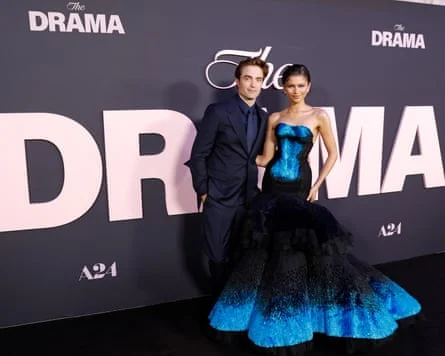
The cinematic landscape is currently captivated by the enigmatic allure of "The Drama," a dark romantic comedy from writer-director Kristoffer Borgli, distributed by A24. This highly anticipated film, starring Zendaya and Robert Pattinson, has ignited a fervent wave of speculation and discussion across online forums and critical circles since its initial trailer debuted. A24, known for its daring and often provocative cinematic choices, masterfully positioned "The Drama" as a seemingly lighthearted exploration of pre-marital anxieties, centered on a picture-perfect couple whose impending wedding is thrown into turmoil by a shocking revelation. The meta-narrative surrounding the film’s promotion, including a staged wedding announcement in the Boston Globe and Zendaya’s meticulously curated "something old, something new, something borrowed, something blue" press tour wardrobe, only amplified the public’s intrigue, hinting at deeper, more unsettling themes lurking beneath the surface.
Borgli, a Norwegian filmmaker with a penchant for the surreal and the psychologically unsettling, delves into the concept of "premarital jitters" not as fleeting nerves, but as a profound and potentially catastrophic psychological unraveling. The film is lauded for its lustrous cinematography, virtuosic performances, and crisp editing, yet its true impact stems from its deliberately combustible and provocative premise. This central conceit, however, was somewhat preemptively revealed by a pre-embargo TMZ headline referencing a recent American tragedy, an unfortunate spoiler that casts a long shadow over the narrative’s unfolding. Indeed, any substantive discussion of "The Drama" inevitably circles back to its pivotal "twist," a disclosure that functions less as a dramatic turn and more as a deeply unsettling divulgence, the justification for which remains a subject of intense debate. This analysis will proceed with spoiler warnings, assuming prior viewing and inviting a deeper engagement with the film’s complex thematic terrain.
The Premise: A Seemingly Idyllic Beginning
The film opens with Charlie, portrayed by Robert Pattinson, and Emma, brought to life by Zendaya, bathed in the warm, golden light of a Boston café. Their initial encounter is crafted as a quintessential meet-cute, a moment of serendipitous connection. Emma is engrossed in a novel, while Charlie, a strategist by nature, contemplates his approach. His research into her Goodreads page and his subsequent feigned familiarity highlight an underlying artifice in their nascent relationship. When Charlie finally musters the courage to speak, he finds Emma is unable to hear him, one ear blocked by music, the other rendered deaf. This initial communication barrier becomes a poignant metaphor, as Emma, recognizing his predicament, offers a chance to "start over," a phrase that will echo ominously throughout their journey. Charlie, it is revealed, is already working on his wedding speech, a narrative device that frames the film with a series of sun-drenched flashbacks chronicling their early days: their first date, their first kiss, and their first night together, all presented as idyllic milestones in their blossoming romance.
The Unraveling: A Game of Revelations
The couple embodies the epitome of young, successful love. They are attractive, professionally accomplished, and reside in a chic apartment, seemingly possessing all the hallmarks of a perfect life. However, this idyllic facade begins to crumble during a seemingly innocuous evening with their two closest friends and members of the bridal party, Mike (Mamoudou Athie) and Rachel (Alana Haim). The atmosphere shifts when Rachel suggests a game of "What’s the worst thing you’ve ever done?" Mike confesses a minor lapse in chivalry, and Rachel recounts an act of childhood cruelty. Charlie admits to some light cyberbullying. The tension escalates when a tipsy Emma reveals a deeply disturbing secret from her teenage years. In a period of profound depression and loneliness in rural Louisiana, she meticulously planned a mass shooting, even bringing her father’s rifle to school. Her deafness, she explains, is a consequence of accidentally blowing out her eardrum while practicing shots in the woods. She asserts that she was in a dark place and ultimately did not carry out her plan.
The Fallout: Navigating the Unspeakable
Emma’s confession lands with devastating impact. Mike is visibly horrified, while Rachel, whose cousin was a victim of gun violence, reacts with righteous indignation, effectively ostracizing Emma and deeming her irredeemable. Charlie, reeling from the revelation, grapples with the stark reality of his fiancée’s past. Pattinson delivers a performance lauded as some of his finest work, portraying Charlie’s bewildered attempts to rationalize, fantasize, and downplay Emma’s admission. This serves as a proxy for Borgli’s central thought experiment: what if the person you love most harbors violent ideations? How does one reconcile love with such a revelation? Can trust be rebuilt, and how much knowledge of one’s partner’s darkest thoughts is truly bearable? The film mines this agonizing scenario for bleakly comedic moments, such as a poorly timed engagement photoshoot, and compelling dramatic scenes, particularly Charlie’s descent into transgression as he seeks solace with his colleague Misha (Hailey Benton Gates), whose portrayal blends empathetic concern with hard-earned cynicism. However, this focus on Charlie’s journey leaves Zendaya’s Emma in a state of anguished stasis, awaiting her fiancé’s processing of her past. The film’s controversial, and arguably unfortunate, emphasis lies on Charlie’s navigation of Emma’s past self rather than Emma’s own path forward.

Borgli’s Provocation: A Deeper Examination of American Trauma
Kristoffer Borgli is no stranger to controversy. His previous film, "Dream Scenario" (2023), explored the complexities of cancel culture. In "The Drama," his engagement with American gun culture and the pervasive trauma of school shootings is a deliberate attempt to court opprobrium and spark dialogue. The choice to place the "thought crime"—it is crucial to reiterate that Emma never committed the act—in the hands of a Black woman is another calculated transgression. Statistics from the Rockefeller Institute of Government indicate that white men constitute a significant majority of mass shooters in the U.S., with a staggering 95% being male. By shifting the specter of violence away from the trope of toxic masculinity and onto Zendaya’s character, Borgli challenges conventional narratives and reframes the conversation around gun violence as a broader exploration of human capacity for change. Critics, such as Chris Murphy in Vanity Fair, have argued this approach is "ahistorical to a distracting degree."
Borgli’s foresight regarding potential media outrage is evident in the preemptive condemnation from those directly impacted by gun violence. A TMZ headline, "Zendaya’s ‘The Drama’ Condemned by Parent of Columbine Victim," highlighted the strong reactions. Tom Mauser, father of Daniel Mauser, a victim of the 1999 Columbine High School massacre, expressed his disgust with the film’s premise and Zendaya’s seemingly lighthearted appearance on Jimmy Kimmel Live!. Notably, Mauser did not extend his criticism to Borgli, Pattinson, or producer Ari Aster. Mia Tretta, a survivor of the 2019 school shooting at her alma mater, told USA Today, "A character planning a school shooting isn’t something that should be joked about." Jackie Corin, a Parkland school shooting survivor and co-founder of March for Our Lives, offered a more nuanced perspective to The Hollywood Reporter, stating, "What might read as satire or tonal contrast to one audience can feel very jarring to another." She further expressed hope that Zendaya and Pattinson would use their platforms to discuss gun violence responsibly, questioning whether the film itself "rises to the level of care that her platform brings to it."
Flashbacks: A Disputed Depiction of Youth
The film’s attempts to contextualize Emma’s past, through glimpses of her teenage self (portrayed by Jordyn Curet), are perhaps more contentious than the central twist itself. These scenes, steeped in the iconography of American gun culture, depict a sullen adolescent Emma adorned with dark makeup, handling her father’s rifle, and recording what are described as "sociopathic videos." The inclusion of numerous gangsta rap posters in her room has been criticized as a tired and potentially racist trope, suggesting a causal link between rap music and real-world violence. Borgli appears to suggest that the pervasive imagery of guns, rather than actual violence, can profoundly influence young minds. Charlie’s fantasies, such as imagining Emma wielding an AR-15 or posing for wedding photos with his teenage fiancée, further blur the lines between Emma’s past, her warped memory, and Charlie’s paranoid projections. The film intentionally avoids clear delineations, creating a disorienting effect that, while perhaps intended to explore the nature of "truth," ultimately feels confusing. The character of teenage Emma is presented with sparse biographical detail: a Black student in a predominantly white Southern school, a military brat with seemingly absent parents, an only child with a computer but no apparent friends. Her eventual abandonment of her plan, triggered by another supermarket shooting, leading her to gun safety activism, strikes some critics as a cynical resolution. Temporal context places her potential actions in the early 2010s, around the time of the Sandy Hook massacre, a period that cemented school shootings as a grim fixture of American life due to legislative inaction on gun control. The disparity between Curet’s portrayal of teenage Emma and Zendaya’s luminous performance as the adult bride makes it difficult to reconcile the character’s past with her present, a disconnect that some argue undermines the film’s thematic ambitions.
The Wedding: A Crucible of Pressure and Truth
Despite its thematic and narrative challenges, "The Drama" remains a compelling and engrossing watch, largely due to Arseni Khachaturan’s evocative cinematography and the inherent pressure cooker of its compressed timeline. With the wedding looming, the narrative intensifies as secrets and resentments surface. The wedding scene itself serves as the film’s centerpiece, forcing Charlie and Emma onto a more equal footing amidst the chaos. They are both harried, emotionally unraveling, and seemingly terrified of Rachel’s volatile presence. The film probes the unsettling question of guilt: is it worse to plan a shooting and not carry it out, or to betray one’s partner? Emma’s father delivers a perfunctory and uninspired speech, fitting for a film more concerned with ideas than realistic character portrayals. Rachel’s drunken, venomous roast of Emma’s social isolation, however, is a moment of raw, uncomfortable vulnerability. The film’s climax, with its explosive secrets and simmering rage, satirizes the precise choreography of a high-society wedding, showcasing Borgli’s directorial strengths in a manner that the more speculative flashbacks do not.
The Final Scene: A Glimmer of Hope or a Foreboding Future?
For those who have yet to experience "The Drama" but are amenable to spoilers, the final scene offers a poignant, albeit ambiguous, conclusion. Emma and Charlie, bruised and battered by their wedding day, reconvene at their favorite diner. The damage inflicted is undeniable, yet they tentatively revisit their initial playful exchange: "Can we start over?" Emma asks. This denouement suggests that the revelation of one’s deepest flaws, the illumination of one’s darkest corners, might, paradoxically, forge a stronger bond than an act of forgiveness. It also hints at a future fraught with challenges for the couple, a lingering storm on the horizon of their relationship. The film leaves audiences to ponder the true nature of love, forgiveness, and the enduring impact of past traumas on present relationships.