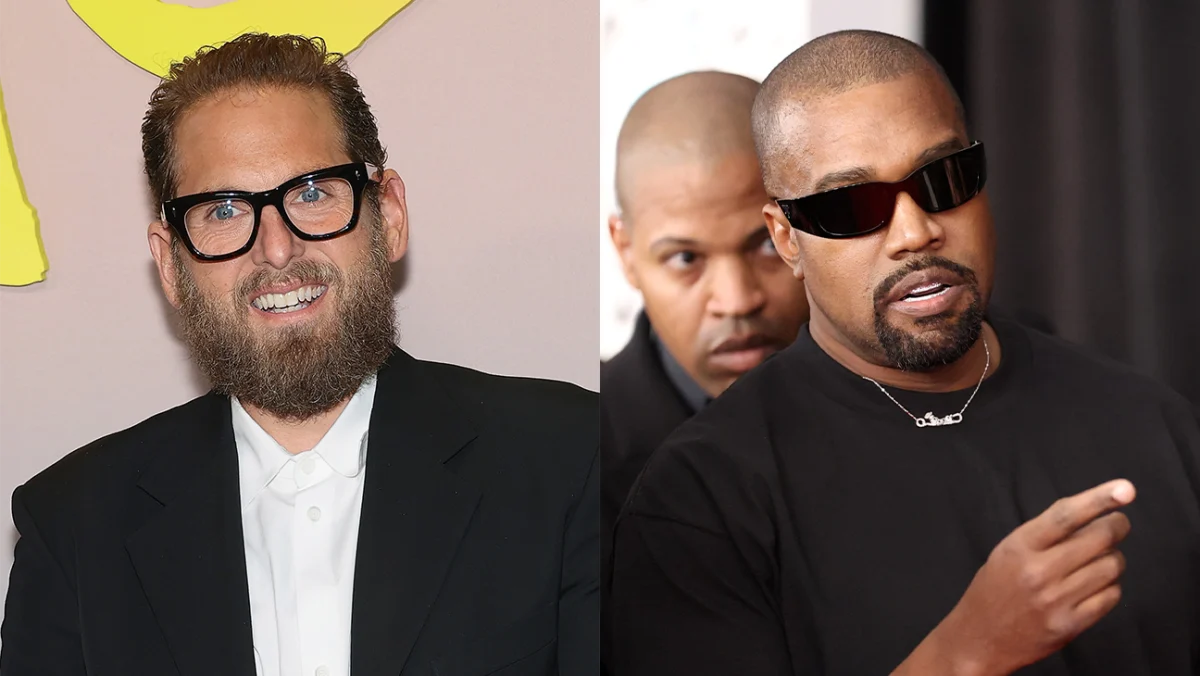
Actor and filmmaker Jonah Hill has woven a poignant and provocative joke involving Kanye "Ye" West into his upcoming film, Outcome, a creative decision directly stemming from a controversial 2023 Instagram post by the rapper. In that post, West, known for his erratic public behavior and antisemitic remarks, claimed that Hill’s performance in the 2012 film 21 Jump Street made him "like Jewish people again." Hill, who is Jewish, recently delved into the complex motivations behind this cinematic commentary during appearances on Apple Music’s The Zane Lowe Show and SiriusXM’s Julia Cunningham, shedding light on his nuanced feelings towards the embattled artist and the broader implications of West’s public conduct.
The Genesis of a Controversial Joke
The joke in Outcome unfolds when Hill’s character’s assistant states, "We did the research and it turns out hating Jews doesn’t hurt your career, it helps it," a line immediately followed by a cut to a photograph of Kanye West. This pointed inclusion is not merely a gratuitous jab but a carefully considered artistic response from Hill, designed to address West’s previous statements and the perplexing cultural landscape that has allowed the rapper’s career to persist, and even thrive in some respects, despite widespread condemnation.
Hill articulated his perspective on The Zane Lowe Show, describing West’s 2023 Instagram post as a "bizarre public thing" that felt like an attempt at reconciliation. "I felt that he did this bizarre public thing to kind of make up, like, ‘It’s all good ‘cause I love Jonah,’" Hill recounted. Despite the gravity of West’s past actions, Hill expressed a complex mix of continued admiration for the artist’s genius and a profound hope for his healing. "It just sat with me in a way that it’s, like, all good. I love him still, and I hope whatever happens, he can heal or whatever, and everyone can heal from all that stuff… I hope he can heal and make it right with the people he needs to make it right [with] in the Jewish community. Me and him got no beef." This statement underscores Hill’s personal struggle to reconcile the artist he admires with the individual whose actions have caused immense pain.
He further clarified his intent, stating, "The reason why I put that in there was not just to take a shot at Kanye. I love the Kanye that I’ve met over the years. I love the artist. I think there is no artist I probably love more across any genre ever. I think he is probably the greatest artist ever to live. And he thinks that." Hill added with a laugh, acknowledging West’s own self-perception. "He’s a genius, and the stuff with the hate stuff sucks. What are you going to say? It sucks, no matter who you are, to hear that. Now, do I know what’s going on? No. Am I going to punch someone while they’re down? No, of course not." This nuanced stance highlights the pervasive dilemma faced by many fans and colleagues of West: how to separate, or whether it’s even possible to separate, the groundbreaking artistry from the deeply troubling rhetoric.
A Comedian’s Commentary on "Culture’s F***ing Weirdness"
Hill, identifying as a comedian, framed the joke as a direct, albeit comedic, retort to West’s Instagram post. "I just put that in there like, yo, you’re going to put the 21 Jump Street poster up there and say you don’t hate Jews anymore? That’s pretty wild. I’m gonna put a picture of you saying that hating Jews helps your career. Obviously, that’s a joke on my part. It doesn’t help your career, but it’s me just having fun. I’m a comedian." This perspective positions the joke not as an attack, but as a satirical observation on the absurdity of the situation and a reflection of Hill’s own coping mechanism through humor.
Expanding on this during his interview with SiriusXM’s Julia Cunningham, Hill explained that the joke also serves as a broader commentary on the perplexing nature of contemporary culture. He noted that "culture’s f***ing weird and it always has been and it always will be. And one of the funny things about it is like you can go on a Jew-hating tour and then sell out [SoFi Stadium]." This statement directly references the seemingly paradoxical phenomenon of West’s continued commercial success despite his controversial public persona.
Kanye West’s Chronology of Controversy and Resilience
To fully appreciate the context of Hill’s joke, it is crucial to revisit the timeline of Kanye West’s antisemitic remarks and the subsequent fallout—or lack thereof, in some commercial aspects. West’s descent into overt antisemitism began to escalate in late 2022.
October 2022: West posted a series of antisemitic statements on social media, most notably a tweet declaring he would go "death con 3 On JEWISH PEOPLE." This immediately drew widespread condemnation from Jewish organizations, celebrities, and public figures.
December 2022: In a highly controversial interview with conspiracy theorist Alex Jones, West openly praised Adolf Hitler, denied the Holocaust, and made numerous other antisemitic claims. He also reportedly released a song titled "Heil Hitler." These remarks led to significant professional repercussions. Adidas, Balenciaga, Gap, and other major brands swiftly terminated their lucrative partnerships with West, resulting in a reported loss of billions of dollars and a significant hit to his personal net worth. Talent agency CAA also dropped him, and his music was briefly removed from some streaming platforms.
March 2023: Amidst the ongoing backlash, West posted the Instagram message referring to Jonah Hill’s performance in 21 Jump Street and claiming it made him "like Jewish people again." This post was widely seen as a bizarre and inadequate attempt to mitigate the damage from his previous hateful rhetoric.
December 2023: West posted an apology written in Hebrew on Instagram, stating, "I sincerely apologize to the Jewish community for any unintended outburst caused by my words or actions. It was not my intention to hurt or disrespect, and I deeply regret any pain I may have caused." While some viewed this as a step towards reconciliation, others criticized it as performative and insufficient, noting its timing ahead of new music releases and its lack of direct engagement with the specific content of his previous hateful remarks.
February 2024: West released his new album, Vultures 1, a collaboration with Ty Dolla Sign. Despite the controversies, the album achieved commercial success, debuting at number one on the Billboard 200 chart.
February 2024: During Super Bowl LVIII, West ran a low-budget commercial for his Yeezy brand, filmed on his phone, directing viewers to his website. Reports indicated that at various points, his Yeezy website had featured swastika-emblazoned t-shirts, further fueling outrage and concern.
Earlier 2024: West took out an advertisement in the Wall Street Journal where he again apologized for his antisemitic statements, though he has largely avoided further public discussion of the controversy since.
The Paradox of Public Persona and Commercial Viability
Hill’s joke, particularly the line about hating Jews potentially helping one’s career, gains particular resonance when viewed against West’s recent commercial resurgence. Despite the extensive boycotts and condemnations, West has continued to draw massive crowds and generate significant revenue.
Concert Success: West recently sold out two nights at SoFi Stadium in Inglewood, California, for concerts supporting his Vultures album. These events demonstrated a persistent, dedicated fanbase willing to overlook or compartmentalize his controversial actions. SoFi Stadium, with a capacity of over 70,000, represents a significant commercial achievement, underscoring the enduring appeal of his music.
Festival Headlining: Further illustrating this paradox, West is set to headline the U.K. Wireless Festival. This decision has not been without controversy, as several major companies, including Pepsi, pulled their sponsorships in protest of his booking. However, the festival’s managing director publicly defended the decision, urging people to "offer some forgiveness and hope to him." This stance highlights the ongoing debate within the entertainment industry about rehabilitation, accountability, and the separation of art from the artist. The commercial imperative often clashes with moral considerations, leading to difficult decisions for event organizers and brands.
Broader Implications: Celebrity, Accountability, and Antisemitism
Jonah Hill’s joke in Outcome transcends mere satire; it serves as a critical commentary on several pressing societal issues. Firstly, it forces a confrontation with the uncomfortable truth that public figures, even those who espouse hate, can maintain significant platforms and commercial viability. This raises questions about the effectiveness of "cancel culture" and the true cost of moral transgressions in the age of digital media.
Secondly, Hill’s position as a Jewish actor responding to antisemitic rhetoric adds a deeply personal and authentic layer to the commentary. His ability to fuse humor with a genuine call for healing, while simultaneously condemning the hateful acts, reflects a complex emotional landscape shared by many in the Jewish community and beyond. It highlights the burden placed on marginalized groups to respond to and process public hate speech.
Thirdly, the joke underscores the alarming rise of antisemitism globally. In recent years, there has been a documented increase in antisemitic incidents, often amplified by social media and, at times, legitimized by public figures. West’s comments, particularly his praise for Hitler and denial of the Holocaust, are not isolated incidents but contribute to a broader climate where such hateful ideologies can find a foothold. Hill’s artistic response can be seen as a way to challenge this normalization and provoke critical thought about the impact of celebrity influence on public discourse.
Conclusion: Art as a Mirror to a Conflicted Culture
Jonah Hill’s decision to include the Kanye West joke in Outcome is more than just a comedic device; it is a profound artistic statement. It encapsulates the ongoing tension between artistic genius and moral responsibility, the complex dynamics of public forgiveness, and the perplexing resilience of controversial figures in a hyper-connected world. By using his platform as a filmmaker, Hill not only offers a personal reaction to West’s "wild" remarks but also holds a mirror up to a culture that grapples with how to respond when beloved artists stray into the realm of hate. The ensuing dialogue, both within the film and in public discourse, will undoubtedly contribute to a larger conversation about celebrity accountability, the fight against antisemitism, and the often-bizarre ways in which society processes and reacts to its most polarizing figures. Hill’s humor, in this instance, serves as a sharp, incisive tool for critical reflection on these vital contemporary issues.