The four-year grassroots campaign to save Hollywood’s most recognizable cinematic landmark has reached an abrupt and quiet conclusion. Benjamin Steinberg, the 26-year-old actor and filmmaker who became the face of the "Save the Cinerama Dome" movement, announced this week that he is ceasing all advocacy efforts. The decision follows a confrontation with law enforcement and the threat of legal action from the property’s owners, Decurion Corporation. What began as a social media account fueled by nostalgia has, over the last several years, evolved into a high-stakes standoff between a lone activist and a multi-generational real estate dynasty, highlighting the precarious intersection of historic preservation and private property rights in modern Los Angeles.
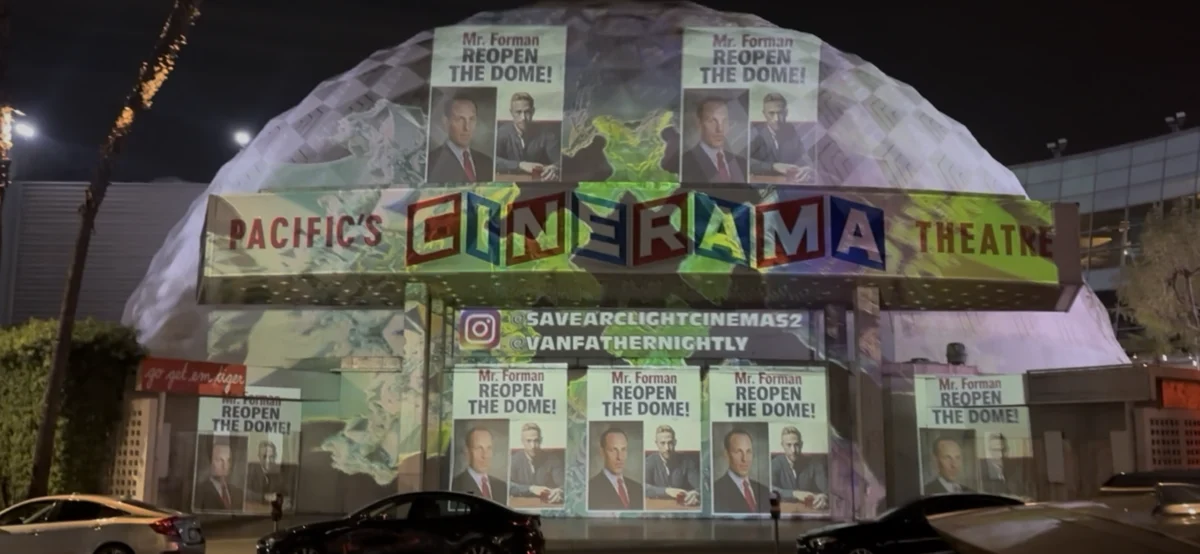
The catalyst for the campaign’s end occurred on the night of April 3, during a sophisticated protest staged by Steinberg. Seeking to escalate his message after years of petitions and rallies, Steinberg hired a professional lighting engineer to projection-map a series of vivid messages onto the concrete exterior of the iconic geodesic dome. The illumination, visible to thousands of commuters on Sunset Boulevard, specifically targeted Chris Forman, the CEO of Decurion Corp. and the scion of the family that has owned the property for over six decades. The projection read: "Mr. Forman REOPEN THE DOME!"
The demonstration was intended to last several nights, but it was cut short during its second evening. Officers from the Los Angeles Police Department (LAPD) arrived at the scene, informing Steinberg and his associates that the Forman family considered the projection a form of harassment and demanded its immediate cessation. While the protesters were operating from a public sidewalk across the street and were not issued citations or arrested, the specter of a protracted legal battle with a wealthy corporation proved a sufficient deterrent. Steinberg, citing the inability to fund a defense against potential litigation, officially shuttered his campaign shortly thereafter, stating that while he believes his actions fall under First Amendment protections, he cannot afford the risk of "messing around" with such a powerful entity.
A History of Innovation and the Forman Legacy
To understand the intensity of the "Save the Dome" movement, one must look to the history of the structure itself. Opened in 1963, the Cinerama Dome was a marvel of mid-century engineering. Designed by the renowned architectural firm Welton Becket and Associates, the theater was the first and only geodesic dome ever built for cinema. It was constructed in just 16 weeks, utilizing 316 individual reinforced concrete panels to create a massive, pillar-less interior. The theater was specifically designed to showcase Cinerama, a widescreen process that utilized three synchronized 35mm projectors to create a 146-degree field of vision on a deeply curved screen.
The venue premiered on November 7, 1963, with the star-studded comedy It’s a Mad, Mad, Mad, Mad World. For decades, it served as a premier location for Hollywood red carpets and experimental film formats. The property was developed by William Forman, a pioneer in the Southern California drive-in theater industry and the founder of the Pacific Theatres chain. Under William’s leadership, the Dome became a cornerstone of the Hollywood landscape.
In the early 2000s, the property underwent a significant expansion under the direction of William’s son, Chris Forman. This development saw the construction of the ArcLight Hollywood, a state-of-the-art multiplex that integrated the Dome into a larger lifestyle and entertainment complex. The ArcLight brand, known for its reserved seating, high-end concessions, and strict "no talking/no texting" policies, became a beloved institution among cinephiles and industry professionals alike. However, the arrival of the COVID-19 pandemic in March 2020 forced the closure of all ArcLight and Pacific locations. In April 2021, Decurion announced that it would not be reopening any of its theaters, effectively vacating the lease on the ArcLight Hollywood and leaving the future of the Cinerama Dome in limbo.
Financial Data and the Real Estate Pivot
While many theaters across the country successfully navigated the post-pandemic recovery through federal grants or acquisition by larger chains like AMC or Regal, the Cinerama Dome remained dark. This prolonged vacancy led Steinberg and other activists to investigate the underlying financial motivations of the ownership. Through an analysis of Los Angeles County public records, Steinberg discovered that Decurion had successfully filed for property tax reassessments on the site.
The data reveals a strategic shift in how the property is being managed. By reassessing the property to reflect a lower valuation—based on its current status as a non-operational venue—the owners have significantly reduced their tax liability. For an activist like Steinberg, this serves as evidence that Decurion has no immediate intention of returning the site to its intended use as a commercial theater. Furthermore, industry insiders have suggested that Decurion’s business model has shifted away from the volatile world of theatrical exhibition toward more stable commercial and industrial property development.

In 2022, rumors circulated that the Dome might reopen under a new operator. The Hollywood Reporter found that several major exhibitors had expressed serious interest in purchasing or leasing the Dome and the adjoining ArcLight complex. However, these inquiries were reportedly rebuffed by the Forman family, who have maintained a policy of silence regarding their long-term plans for the site. This lack of communication has fueled speculation that the family may be "land-banking" the property—holding onto a high-value asset in a prime location while waiting for market conditions that favor a massive redevelopment project rather than a theater.
The Grim Precedent of the Hollywood Pacific Theatre
One of the primary drivers of the community’s anxiety is the historical precedent set by another Decurion-owned property: the Hollywood Pacific Theatre. Located just blocks away on Hollywood Boulevard, the Pacific Theatre was originally built by the Warner brothers in 1928. Like the Dome, it was once a flagship venue, later converted to the Cinerama format in the 1950s.
However, after sustaining structural damage during the 1994 Northridge earthquake, the theater was closed to the public. In the three decades since, it has remained dormant, becoming a site of significant urban decay. Preservationists point to the Hollywood Pacific as a cautionary tale; it is a historic landmark that has been allowed to rot in plain sight, despite its prime location. Steinberg and his supporters fear that without public pressure or city intervention, the Cinerama Dome is destined for a similar fate—a slow decline marked by accumulating graffiti, broken tiles, and eventual structural instability.
Broader Implications for the Theatrical Landscape
The struggle over the Cinerama Dome is emblematic of a larger crisis facing the movie theater industry. The rise of streaming services, combined with the lingering effects of the pandemic and the 2023 Hollywood labor strikes, has made the operation of large-scale single-screen venues increasingly difficult. While boutique theaters like the New Beverly Cinema or the Vidiots-reopened Eagle Theatre have found success through curation and community engagement, the massive overhead required to maintain a facility like the Cinerama Dome requires significant capital.
The loss of the Dome would represent more than just the closure of a business; it would mark the erasure of a specific type of cultural experience. The theater is one of the few remaining venues in the world capable of projecting 70mm film on a curved screen, a format that directors like Christopher Nolan and Quentin Tarantino have championed as the pinnacle of the cinematic medium.
The Role of Civic Leadership and Future Outlook
As Steinberg exits the fray, the question remains: what can the City of Los Angeles do to protect its cultural heritage? The Cinerama Dome was designated a Los Angeles Historic-Cultural Monument in 1998, which provides some protection against demolition. However, the city has few mechanisms to compel a private owner to keep a business operational or to prevent "demolition by neglect."
Steinberg has called upon city officials, including members of the Los Angeles City Council, to apply more pressure on Decurion. He suggests that the city should offer incentives for reopening or, conversely, implement stricter penalties for owners who allow historic landmarks to remain vacant and deteriorating for extended periods.
For now, the Cinerama Dome stands as a silent sentinel on Sunset Boulevard. Its white concrete skin is increasingly marred by the elements, and the marquee that once heralded the world’s greatest films remains empty. While Benjamin Steinberg’s "movement" may have ended under the threat of legal reprisal, the conversation he sparked regarding the responsibility of private owners to the public good continues. The fate of the Dome remains a pivotal test case for whether Hollywood can preserve its history in an era where real estate value often outweighs cultural significance. Without a change in strategy from Decurion or a bold intervention from the city, the "Mad, Mad, Mad, Mad World" that the Dome once celebrated may be replaced by a far more mundane reality of corporate silence and urban decay.