If oppressive regimes inadvertently give rise to striking artistic works of resistance, then "Hen" might just be a parting gift from Viktor Orbán’s far-right administration. This compelling, original film, told from the perspective of a hen, was born from the ashes of Hungarian filmmaker György Pálfi’s inability to create in his homeland. Orbán’s 16-year tenure, marked by allegations of cronyism, effectively stifled opportunities for independent filmmaking in Budapest. This lack of funding and creative freedom drove Pálfi, a director acclaimed for his wildly original works ranging from the near-wordless 2002 debut "Hukkle" to the visually striking and grotesque "Taxidermia" (2006), into a form of exile. Seeking a universal narrative that could transcend cultural and linguistic barriers, Pálfi and his co-writer and partner, Zsófia Ruttkay, settled on an ambitious project: a biopic of a factory-farmed chicken.
The narrative follows a hen who escapes her grim, industrial birthplace in Greece. Through her naturally comic, beady-eyed perspective, the audience witnesses the unfolding of a modern-day Greek tragedy, where a down-on-his-luck restaurateur becomes entangled in the brutal world of people-smuggling.
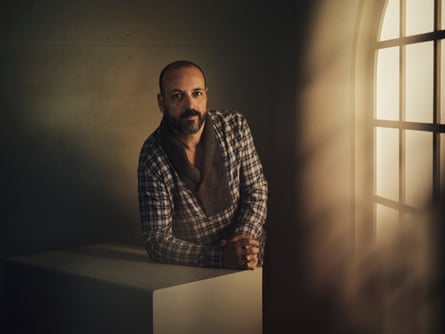
In an interview conducted the day after Orbán’s party was voted out, Pálfi, like many Hungarians, expressed palpable relief and optimism. "Orbán wasn’t a real prime minister," he stated, his voice reflecting a sentiment shared by many who felt marginalized. "He just supported those who voted for him, not all Hungarians. That was for 16 years – and it got worse and worse, every year, every hour." He acknowledged the new prime minister’s "beautiful speech" but tempered expectations, noting the significant parliamentary majority. "He has 70% of the parliament, which means total power again. We just hope he will control himself and give the power back. He’s promising real democratic stuff, so let’s see."
The absence of financial support for independent film in Hungary necessitated Pálfi’s relocation. He initially moved to Mexico, gradually developing the concept of a powerless chicken as his protagonist, through whose adventures a human story would be interwoven. An opportunity to secure funding and film in Greece emerged, leading to the incorporation of the people-smuggling theme. "When we find this very small chicken meets with a huge social problem, then it can be a good movie," Pálfi explained, emphasizing the film’s core thematic juxtaposition. To immerse himself in the local context, Pálfi and his family relocated to Greece for a year to "learn about the people."

The Genesis of a Fowl Protagonist
The film’s inception can be traced back to Pálfi’s experiences under what he describes as an increasingly restrictive political climate in Hungary. The alleged patronage system within the national film fund, under the influence of the Orbán government, reportedly favored projects aligned with the regime’s ideology, leaving independent filmmakers like Pálfi struggling for resources. This environment created an urgent need for Pálfi to find a project that could be realized outside of the Hungarian system, demanding a narrative that was both universally resonant and logistically feasible in an unfamiliar setting.
"We were looking for a story that could be told without a deep understanding of the specific nuances of a culture, something that could resonate on a primal level," Pálfi elaborated in a separate interview. "The idea of an animal perspective offered that universality. A chicken, of all creatures, is often seen as simple, insignificant. Yet, within its limited world, it experiences life and death, fear and comfort, love and loss. We realized that by placing this seemingly ordinary creature at the center of extraordinary events, we could explore profound human themes."
The decision to set the film in Greece was driven by a confluence of factors, including the availability of production support and the country’s own complex socio-economic landscape, which provided fertile ground for exploring themes of desperation and clandestine activity. The financial challenges were significant, forcing a highly efficient and resourceful production approach.
A Hen’s Journey: From Factory Farm to Human Drama
"Hen" opens with a deliberate, almost documentary-style portrayal of the protagonist’s birth and subsequent escape from the harrowing conditions of factory farming. This initial phase is crucial in establishing empathy for the avian protagonist and setting the stage for the film’s unique perspective. "If you can go with the chicken after the first 15 or 20 minutes," Pálfi observed, "then somehow you become the chicken, and people become a higher level, like the gods of ancient Greek mythology. It’s very interesting. That was the most important thing – to change the perspective."
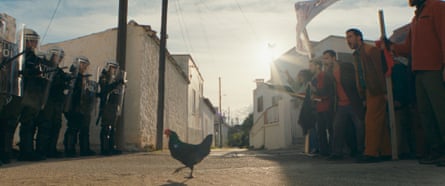
The narrative takes a significant turn when the hen, having narrowly escaped a predatory fox, is rescued by Giorgos, an aging restaurateur whose seaside establishment is clearly in economic decline. Giorgos lives with his young granddaughter and his daughter, whose ne’er-do-well boyfriend introduces a modest smuggling operation, dealing in contraband cigarettes and alcohol. While the hen experiences a charming romantic interlude with the household cockerel, Giorgos finds himself increasingly drawn into a more perilous venture: facilitating the clandestine transport of people into Europe.
The Eight Leading Ladies: A Feathered Ensemble
The logistical and artistic challenge of portraying a single hen character was met with an ingenious solution: the casting of eight identical black hens, each named Eszti, Szandi, Feri, Enci, Eti, Enikő, Nóra, and Anett. These avian actresses underwent intensive training for two months prior to filming, aimed at making them "human friendly." An animal trainer meticulously managed their behavior on set. Pálfi admitted to initial difficulties in distinguishing between them, but the crew soon discovered that each hen possessed unique strengths. One excelled at running, another at pecking, and a third could remain remarkably still when required. This allowed the filmmakers to select the most suitable "leading lady" for each scene’s demands, showcasing a remarkable level of canine performance art.
The production faced a rigorous shooting schedule, demanding 50 days of script to be filmed in just 35 days. This compressed timeline necessitated a novel hierarchy on set, where the hens’ needs took precedence. "It was hard for the actors to realize they were last in line," Pálfi recounted, highlighting the unusual dynamic. When faced with a difficult scene or an uncooperative hen, Pálfi often called for his favorite, Feri. "She wasn’t so professional at jumping, she wasn’t so professional at running, but she knew everything. She was a jolly joke. And if one hen couldn’t do a scene because maybe she was tired or her stomach was full, we would say, ‘Bring Feri’ – and Feri would do it.”
A Shift in Filmmaking Style: Embracing Convention
Pálfi’s reputation is built on his inventive and experimental filmmaking. However, directing a cast of chickens necessitated a more orthodox approach. Traditional arthouse techniques, such as prolonged single takes, proved impractical. Consequently, Pálfi embraced "classical Hollywood storytelling and shot-by-shot movie language." He described this as a deliberate and successful decision: "And that was a good decision because the chicken could do it." When asked if the chickens made him conventional, he grinned, noting, "It’s also a good experiment to make a normal movie."
While the film adopts a more conventional narrative structure, Pálfi maintained his distinctive visual style. Unlike typical Hollywood films that focus on the human face, "Hen" is shot from a chicken’s eye level, employing a low camera angle to immerse the audience in the protagonist’s world. To maintain the authenticity of the avian performance, no CGI was used on the chickens themselves. However, special effects were employed to remove the animal trainer from the frame, particularly in a tense scene where the hen is pursued by a fox. This thrilling sequence was achieved by filming the fox on a leash, with the leash subsequently removed through post-production wizardry.
"Hen" as a Mirror to Human Behavior
"Hen" functions as an innocent eyewitness, offering a fresh perspective on the foibles and complexities of human behavior. The hen’s seemingly objective gaze can, at times, appear to cast a moral judgment on the actions of the human characters. However, Pálfi clarifies, "This is just happening in the audience’s mind. The chicken needs to be a chicken. Sometimes we play with what a chicken can think, but we try very carefully to use a chicken as a chicken."
The film unflinchingly exposes the brutality inherent in the lives of both powerless chickens and marginalized human populations. The stark depictions of factory farming and the quiet desperation of the hen, whose eggs are repeatedly taken, may inspire audiences to reconsider their dietary choices, potentially leading to vegetarianism or a rejection of factory-farmed poultry. Yet, Pálfi states this was not the primary intention. "Chickens are chickens. And they bite each other, and so they are not a perfect society. But humans should be able to change their way of living to be a bit better."
A New Chapter for Hungarian Cinema?
Pálfi and his family have since returned to Budapest, buoyed by the recent political changes in Hungary. He harbors ambitions to complete a trilogy of animal-centric films, with a monkey in an Indian city slated as the next project, followed by a Hungarian outlaw story, which he playfully describes as an "eastern," not a western. Remarkably, Pálfi expressed a desire to create a mainstream film, albeit one that retains artistic integrity. He cited directors like Stanley Kubrick and Ridley Scott (particularly "Blade Runner") as benchmarks for this elusive balance: "the mainstream and the outer movie, which is the best kind of movie ever."
He hopes for the opportunity to once again produce films within Hungary. For the present, "Hen" stands as a powerful testament to the resilience of creativity in the face of political and economic adversity. The film’s protagonist offers a poignant commentary on contemporary society, particularly concerning moral agency and its consequences. "When we considered the difference between animals and humans, we concluded that humans have the possibility to make moral decisions," Pálfi mused. "But when someone makes this moral decision, according to the Greek tragedies, it’s too late. Although Giorgos gave his life to a mafia, he can take it back – but he will get his punishment."
The character of Giorgos, the fictional Greek restaurateur, serves as a broader allegory for individuals who align themselves with what Pálfi terms "brutal populist regimes," extending this observation to include Americans and Hungarians alike. "We gave away our rights to a mafia," Pálfi concluded, posing a critical question that resonates far beyond the cinematic narrative: "Now the big question is, ‘Can we get them back?’" The film, born out of artistic necessity and political displacement, thus transcends its avian protagonist to offer a profound reflection on freedom, complicity, and the enduring struggle for self-determination in a complex world.