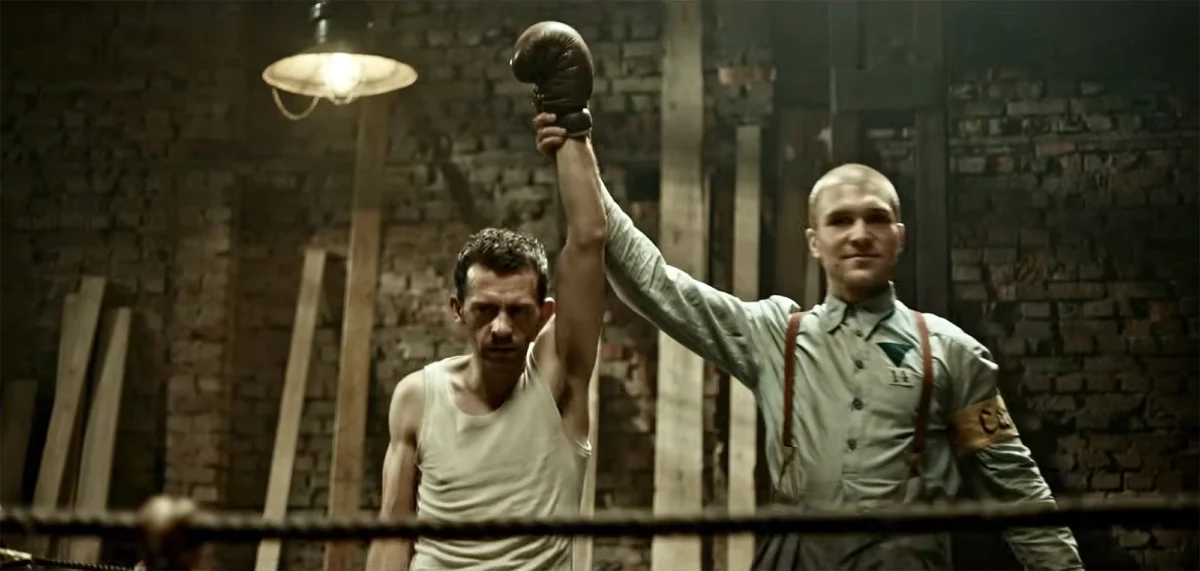
Well Go USA has officially announced the upcoming Video on Demand (VOD) release of The Champion, a poignant and visceral Polish drama that chronicles the harrowing true story of a professional boxer who fought for survival within the confines of the Auschwitz-Birkenau concentration camp. Directed by Maciej Barczewski and starring Piotr Głowacki, the film—originally titled Mistrz and known internationally as The Champion of Auschwitz—is scheduled to become available for digital audiences in the United States on May 26, 2026. This release marks a significant moment for domestic viewers to access a narrative that garnered critical acclaim during its initial festival run and subsequent European theatrical release, now presented with an English-language dub to broaden its accessibility in the North American market.
The Champion delves into the life of Tadeusz "Teddy" Pietrzykowski, a pre-war Polish boxing champion whose resilience and athletic prowess became a beacon of hope for his fellow inmates during one of the darkest chapters of human history. Arriving at Auschwitz in June 1940 as part of the very first transport of political prisoners, Pietrzykowski’s journey is not merely one of physical endurance but of a quiet, calculated defiance against the dehumanizing machinery of the Nazi regime.
The Historical Foundation of Tadeusz Pietrzykowski
To understand the weight of The Champion, one must look at the historical record of Tadeusz Pietrzykowski, a figure whose life story borders on the cinematic even before the cameras began rolling. Born in 1917, Pietrzykowski was a rising star in the Polish boxing circuit throughout the 1930s, training under the legendary Feliks Stamm, the father of the Polish school of boxing. When Germany invaded Poland in September 1939, Pietrzykowski attempted to join the Polish Army in France but was captured by the Gestapo near the Hungarian border.
On June 14, 1940, he was deported to Auschwitz, where he was assigned prisoner number 77. The film meticulously recreates the atmosphere of the early days of the camp, a period before the industrial-scale extermination facilities were fully operational, yet when the cruelty and mortality rates were already staggering. Pietrzykowski’s first fight in the camp occurred in 1941 against Walter Dünning, a German kapo and former middleweight champion. Despite being severely malnourished and outweighed, Pietrzykowski’s victory earned him not only his life but also extra rations of food and medicine, which he frequently shared with his fellow prisoners, including the resistance movement within the camp.
Historical records suggest that Pietrzykowski fought between 40 and 60 matches at Auschwitz, losing only once. His victories served as a psychological blow to the Nazi officers’ ideology of racial superiority, proving that the supposedly "inferior" prisoners could best their captors in a fair contest of strength and skill.

Production Insights and Performance
The Champion marks the feature directorial debut of Maciej Barczewski, who also penned the screenplay. Barczewski, a filmmaker with a background in legal academia and a deep interest in Polish history, sought to create a film that balanced the brutality of the Holocaust with the uplifting spirit of human resistance. The production, handled by Krzysztof Szpetmański and Leszek Starzyński, emphasizes authenticity in its production design, utilizing desaturated palettes and claustrophobic framing to evoke the grim reality of the barracks and the makeshift boxing rings.
Piotr Głowacki’s portrayal of Tadeusz Pietrzykowski has been cited as a career-defining performance. To prepare for the role, Głowacki underwent a grueling physical transformation, losing significant weight to mirror the emaciated state of a concentration camp prisoner while simultaneously training in vintage boxing techniques. His performance is characterized by a stoic intensity, conveying the internal conflict of a man forced to perform for the entertainment of his oppressors in order to secure the survival of himself and others.
The supporting cast includes Jan Szydłowski, Marcin Czarnik, and Rafał Zawierucha, the latter of whom gained international recognition for his role as Roman Polanski in Quentin Tarantino’s Once Upon a Time in Hollywood. The ensemble works to portray the complex social hierarchy within the camp, from the predatory nature of certain kapos to the desperate camaraderie among the prisoners.
Chronology of Release and Distribution
The Champion has followed a long and winding road to its 2026 VOD release in the United States. The film’s journey began with its world premiere at the 2020 Gdynia Polish Film Festival, one of Poland’s most prestigious cinematic events. Despite the challenges posed by the global pandemic at the time, the film resonated with domestic audiences and critics, leading to a theatrical release in Poland in late 2021.
Following its success in Central Europe, the film toured various international film festivals, including those in Newport Beach and Chicago, where it introduced the story of "Teddy" to a Western audience. The decision by Well Go USA to acquire the distribution rights and release the film on VOD reflects a growing trend in the industry where high-quality foreign-language historical dramas find a second life on digital platforms.
The May 26, 2026, release date is strategically timed to coincide with the early summer season, providing a somber and intellectual alternative to the typical blockbuster fare. While the trailer features an English dub—a move often made to increase the film’s "watchability" for casual viewers—purists and cinephiles generally advocate for the original Polish audio with subtitles to preserve the emotional authenticity and linguistic nuances of the performances.

Historical Context: Sports as Survival and Resistance
The Champion touches upon a lesser-known aspect of the Holocaust: the existence of organized sports within concentration camps. While it may seem paradoxical that games and matches occurred in places of mass death, the SS often organized such events for gambling and entertainment. However, for the prisoners, participation in these events was a double-edged sword.
As depicted in Barczewski’s film, boxing was a "work assignment" that could provide a temporary reprieve from the backbreaking labor of the camp. For Pietrzykowski, the ring was a sanctuary where he could assert his identity. His matches became a focal point for the Polish underground resistance within Auschwitz, which included figures like Witold Pilecki. The victories in the ring were used as morale boosters, circulating through the camp as proof that the Nazi "supermen" could be beaten.
This historical context adds a layer of depth to the film’s narrative. It moves beyond the tropes of the "underdog sports story" and enters the realm of existential survival. The stakes of Pietrzykowski’s fights were never just a title or a trophy; they were bread, soup, and the collective hope of thousands of condemned men.
Critical Analysis and Broader Implications
The Champion arrives in a cinematic landscape that has seen a resurgence of interest in Holocaust narratives that focus on specific, often overlooked individuals. Unlike broad historical surveys, films like The Champion and its contemporaries seek to humanize the victims by focusing on their pre-war lives and the specific skills they used to navigate the camp system.
The film’s focus on Polish nationalism and resistance is also a significant thematic element. As a Polish production, it emphasizes the specific plight of Polish political prisoners, a group that formed the initial population of Auschwitz before it became the primary site of the Shoah. This perspective provides a nuanced look at the camp’s evolution and the various groups targeted by the Nazi regime.
From a technical standpoint, the film has been praised for its refusal to sentimentalize the violence. The boxing matches are not choreographed as heroic spectacles but as desperate, ugly brawls for life. This realism ensures that the film remains grounded in the gravity of its setting, avoiding the pitfalls of "Holocaust-sploitation."

Well Go USA’s Distribution Strategy
Well Go USA’s involvement indicates a commitment to bringing diverse international stories to the American market. Known primarily for distributing martial arts and action cinema from Asia, the company’s expansion into European historical drama suggests a diversifying portfolio. By opting for a VOD release, they are leveraging the shift in consumer habits, where specialized or "prestige" foreign films often find larger audiences through streaming and digital rental than they would in a limited theatrical run.
The inclusion of an English dub in the marketing materials suggests an attempt to reach the "home theater" demographic that might otherwise be deterred by subtitles. However, the film’s core strength remains its visual storytelling and the historical weight of its subject matter, which transcends language barriers.
Conclusion and Legacy
The Champion serves as a cinematic monument to Tadeusz Pietrzykowski and the millions of others who faced the horrors of the Holocaust. By bringing this story to VOD on May 26, 2026, Well Go USA ensures that the legacy of "The Champion of Auschwitz" continues to inspire and educate. The film stands as a testament to the fact that even in the absence of freedom, the human spirit can find ways to resist, whether through a clenched fist in a boxing ring or a shared piece of bread in a dark barrack.
As audiences prepare for the film’s digital debut, the story of Teddy Pietrzykowski remains a vital reminder of the power of individual courage against systemic evil. His life did not end in the camps; he survived Auschwitz, Gross-Rosen, and Bergen-Belsen, eventually returning to Poland to become a physical education teacher, continuing to inspire youth until his death in 1991. The Champion captures the most harrowing years of that journey, offering a film that is as much a historical document as it is a work of art.