The European arthouse cinema has long harbored a reputation for depicting family reunions as arenas of profound discord, ranging from the subtle undercurrents of resentment in Louis Malle’s "Milou in May" to the explosive catharsis of familial scores being settled in Thomas Vinterberg’s "Festen." Within this landscape, Spanish director Carla Simón emerges as a distinctive voice, one that, while acknowledging the inherent complexities and occasional fissures within family dynamics, consistently leaves audiences with a renewed appreciation for the profound, and often beautiful, connections that bind relatives. Her films, characterized by a rare ability to transform seemingly mundane gatherings into vibrant, sprawling canvases of human virtue and vice, challenge the prevailing cinematic narrative of familial strife.
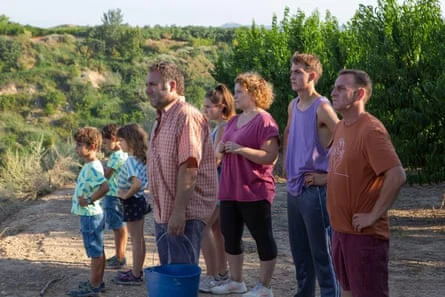
Simón, at 39, has rapidly ascended as a significant talent, adept at capturing the intricate tapestry of human interaction during moments like birthday celebrations, casual garden parties, or the quintessential summer barbecue. Her directorial approach imbues these intimate settings with a thrilling depth, exploring the spectrum of human behavior with remarkable nuance. From the boisterous, chaotic energy of a water fight in her Berlinale Golden Bear-winning drama "Alcarràs," a poignant exploration of a Catalan farming family facing eviction, to the raw, unvarnished intimacy of a boisterous, expletive-laden singalong at a dinner table in her latest film, "Romería," Simón orchestrates these familial encounters with an almost anthropological level of detail. This meticulous attention mirrors the precision other filmmakers might reserve for elaborate action sequences or finely choreographed dance numbers, underscoring her unique artistic vision.
A cornerstone of Simón’s distinctive filmmaking technique involves a deliberate departure from conventional acting preparation. She often instructs her actors to read the script only once before filming commences, a method designed to foster genuine improvisation and spontaneous reactions as they navigate the narrative. This approach extends beyond the confines of the soundstage; Simón frequently immerses her casts in real-life social situations, organizing outings for walks, shopping trips, and informal gatherings. Any ensuing disagreements or unexpected moments are not only tolerated but actively embraced, serving as valuable raw material for the authentic portrayal of relationships. However, the director points to an even more fundamental, and perhaps counterintuitive, element of her success: her willingness to defy the notorious adage attributed to W.C. Fields, which advises against working with children and animals.
"I never get bored of working with kids," Simón has stated, articulating a profound appreciation for the unpredictable nature of young performers. "When you are only working with adult actors, shooting becomes more like executing an idea that you have in your mind, and I think that is not interesting. With children, you always have this feeling that things are going to happen in front of the camera by chance. It keeps things alive." This embrace of the unscripted and the elemental imbues her films with a vibrant, almost organic quality, a palpable sense of life unfolding before the viewer’s eyes.
The Autobiographical Roots of a Cinematic Vision
Simón’s profound fascination with the unvarnished portrayal of family life is deeply rooted in her own biography, a life marked by profound loss and the subsequent search for identity. Born in Barcelona in 1986, her formative years were shadowed by the tragic deaths of both her parents from AIDS. Her father passed away when she was three, and her mother when she was just six. The revelation, delivered by her adoptive mother at age 12, that her biological parents had contracted the immunodeficiency virus through drug use, cast a long shadow, prompting a complex journey of understanding and acceptance.
This deeply personal history has served as the wellspring for her initial cinematic endeavors, with her first three films drawing heavily from her own experiences. "Summer 1993," released in 2017, sensitively chronicles the story of a six-year-old girl grappling with the aftermath of her mother’s death, relocating to the Catalan countryside to live with her aunt and uncle. The film delicately navigates themes of grief, adaptation, and the formation of new familial bonds.
Her 2022 offering, "Alcarràs," a critical and commercial triumph that garnered the prestigious Golden Bear at the Berlin International Film Festival, delves into the specific socio-economic realities of her adoptive family’s community. Set against the backdrop of the peach-growing region of Catalonia, the film poignantly depicts the struggles of a multi-generational family facing the imminent loss of their ancestral land due to a solar farm development. This narrative, while fictionalized, is deeply interwoven with the lived experiences of the community and Simón’s own connection to it.

Her most recent work, "Romería," a title that translates to "pilgrimage" in Spanish, ventures even deeper into the complex territory of her biological heritage. The film centers on eighteen-year-old Marina, who embarks on a journey to her relatives in Vigo, a city in the northwestern region of Galicia. Ostensibly seeking her biological father’s death certificate to facilitate her film studies in Barcelona, Marina’s quest unravels a tapestry of long-held secrets and unspoken truths. The initial familial reception is a mixture of warmth and subtle tension, epitomized by her stern grandmother’s pointed question, "Why are you only coming to see us now?" and the unsettling observation, "You don’t look like your mother." The revelation that her father died five years later than she had been led to believe opens a chasm of silence, prompting a deeper exploration of the obscured periods of her parents’ lives.
The Art of Unearthing Truths and Navigating Legacy
"Romería" is broadly inspired by Simón’s own journeys to reconnect with her extended family across Spain, including trips to Madrid, Barcelona, and Galicia. "I wanted to do this journey out of curiosity, not out of resentment or anger," she has explained, emphasizing her desire to explore her roots without the burden of perceived abandonment. "Many films or stories about looking for your roots come out of feeling abandoned – I didn’t want that, because I have had the family thing through my adoptive parents. But this feeling of being uncomfortable because you are with these people who are supposed to be your family but you don’t feel it, that’s similar to what I’ve had." This nuanced perspective highlights the inherent complexities of forging connections with biological relatives when one has already experienced the formation of a loving adoptive family.
Within the narrative of "Romería," a pivotal element is the discovery of a collection of letters penned by Simón’s late mother. These epistles serve as a powerful conduit to her parents’ past, illuminating their initial encounter, their burgeoning love, and their entanglement with drugs. Simón confirms that these letters are indeed real, remnants of her mother’s correspondence with friends and family during her time in Vigo. "She wrote to her friends and family while she lived in Vigo. Her Catalan is full of mistakes, because teaching Catalan was banned under the Franco regime. But they are the most important thing that I have from my mother, because suddenly I can hear her talking." The imperfect Catalan, a testament to the repressive linguistic policies of the Franco era, imbues the letters with an even greater poignancy, offering a direct, unfiltered voice from the past.
Spanish cinema boasts a rich tradition of featuring compelling child performances, with Ana Torrent’s indelible portrayal of a young girl captivated by the Frankenstein myth in Víctor Erice’s 1973 masterpiece, "The Spirit of the Beehive," widely regarded as one of the most significant performances by a child actor in cinematic history. Simón herself acknowledges the profound influence of this film, describing it as "a very, very important film for me." While Erice’s film served as a veiled allegory for a nation grappling with the oppressive legacy of Franco’s dictatorship, "Romería" shifts its focus to the secondary traumas that emerged in the wake of his fall, during Spain’s tumultuous period of transition to democracy, known as la Transición española.
Echoes of History: La Movida and the AIDS Epidemic
The era of la Transición witnessed the vibrant emergence of la movida, a countercultural movement that blossomed in Madrid and spread throughout Spain. This explosion of artistic and social freedom celebrated lifestyles that had been suppressed under the military regime. "All these kids who were raised under Franco and religious oppression, suddenly freedom arrived and they embraced it," Simón observes. "They didn’t think much about the future or the consequences of what they were experimenting with. And then the drugs came in." This period of liberation, while intoxicating, also ushered in unintended consequences, particularly the devastating AIDS epidemic.
Globally, the AIDS epidemic was often framed as a crisis affecting marginalized communities. However, in Spain, its trajectory was inextricably linked to a widespread heroin epidemic that gripped the nation. Regions like the Basque Country, where the terrorist group ETA was implicated in drug trafficking, and Galicia, with its porous coastline serving as a crucial entry point for narcotics, were particularly hard-hit. Simón reflects on this historical context with a sense of empathy, stating, "When we talk about this generation in Spain, people sometimes use words like shame and blame, but I feel that’s really unfair: people like my parents just had bad luck." This perspective challenges the often judgmental narratives surrounding the AIDS crisis and drug addiction, advocating for a more compassionate understanding of individual circumstances within a broader societal context.
A Stylistic Evolution and a Glimpse into the Future
Approximately halfway through "Romería," the film undergoes a noticeable stylistic transformation. Simón transitions from the observational, almost documentary-like "Eurorealism" that characterized her earlier works towards a more overtly magical-realist sensibility. This shift is heralded by the appearance of a mysterious cat, reminiscent of characters found in the enchanting films of Hayao Miyazaki, and culminates in an unforgettable musical interlude. The scene features a spirited dance number set to the energetic anthem "Bailaré Sobre Tu Tumba" ("I’ll Dance on Your Grave") by Vigo punk rock legends Siniestro Total, a bold and defiant statement that encapsulates the film’s exploration of resilience and confronting mortality.
Simón views her first three films as a thematic triptych, each exploring different facets of her familial identity, both adopted and biological. However, the recent experience of motherhood has profoundly reshaped her perspective and her place within her own family narrative. "Since I became a mother a few years ago, I feel that my place in the family changed," she reveals. "When you have kids you feel it’s a new period in your life, so I feel like maybe doing something that has nothing to do with my family." This introspective realization signals a potential artistic pivot, a desire to explore new thematic territories beyond the deeply personal. She confides that her next cinematic venture is slated to be a flamenco musical, a departure that promises to showcase a different dimension of her directorial prowess, blending traditional Spanish art forms with her distinctive storytelling ability. The anticipation for this new chapter in Simón’s career is palpable, as audiences eagerly await her next exploration of the human condition, whatever form it may take.