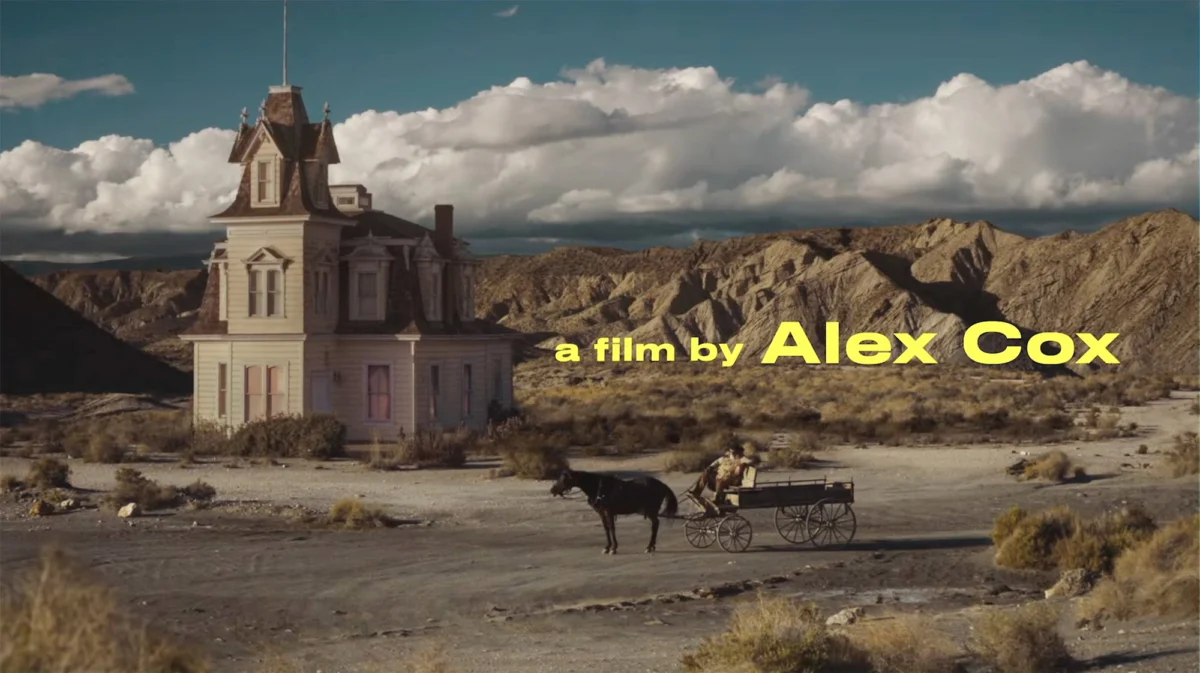
The cinematic landscape of 2026 has been marked by the return of one of independent cinema’s most idiosyncratic voices. Alex Cox, the English filmmaker who rose to prominence during the punk-rock era of the 1980s, has officially released his latest project, Dead Souls. Distributed by Kino Lorber, the film serves as both a directorial effort and a rare leading performance for the 71-year-old auteur. Set against the harsh, sun-drenched backdrop of 1890 Arizona, Dead Souls is a loose but pointed adaptation of Nikolai Gogol’s 1842 Russian novel of the same name. The film, which premiered at the Almeria Western Film Festival in 2025, has transitioned from the international festival circuit to select theatrical engagements across the United States, with a Video on Demand (VOD) release scheduled to follow.
The narrative follows a mysterious drifter named Strindler—a name that intentionally echoes "swindler"—portrayed by Cox himself. Arriving in a border town during the year of the pivotal 1890 US Census, Strindler begins an unusual and unsettling business venture: he offers to pay significant sums of money for the names of deceased Mexican laborers. As he wanders between saloons, ranches, and dusty outposts, his presence ignites a mixture of greed, suspicion, and chaos among the local populace, including corrupt officials, outlaws, and desperate ranchers. The film is described by its distributors as a "frontier fable of American greed," a meditative exploration of a territory where legacies are constructed upon foundations of blood and gold.
The Directorial Legacy of Alex Cox
To understand the significance of Dead Souls, one must look at the four-decade career of Alex Cox. Born in 1954, Cox became a seminal figure in the "New Punk" cinema movement. His 1984 debut, Repo Man, became a cult classic for its blend of sci-fi, social satire, and punk aesthetics. He followed this with Sid & Nancy (1986), a harrowing biopic of Sex Pistols bassist Sid Vicious, and Straight to Hell (1987), a surrealist Western that featured a cast of musicians including Joe Strummer and Elvis Costello.

Cox’s relationship with the Western genre is long-standing and complex. His 1987 film Walker was a radical, anachronistic critique of American interventionism in Nicaragua, a film that effectively blacklisted him from major Hollywood studios due to its overt political messaging. Despite this, Cox continued to produce fiercely independent work, such as Highway Patrolman (1991) and Tombstone Rashomon (2017). Dead Souls represents a culmination of these themes, blending his interest in historical Western settings with a deep-seated cynicism toward institutional corruption and the commodification of human life.
From Tsarist Russia to the American Frontier
The decision to adapt Nikolai Gogol’s Dead Souls into an American Western provides a unique thematic bridge between 19th-century Russian literature and the mythology of the American West. In Gogol’s original work, the protagonist, Chichikov, travels the Russian countryside buying "dead souls"—deceased serfs who are still listed on the census—to use as collateral for social advancement and loans.
In Cox’s reimagining, the "souls" are deceased Mexican laborers in the Arizona borderlands. This shift moves the focus from the feudal system of the Russian Empire to the racial and economic tensions of the late 19th-century United States. By setting the film in 1890, Cox taps into a transformative year in American history. This was the year the U.S. Census Bureau declared the "frontier" officially closed, signifying the end of the westward expansion era and the beginning of a more rigid, bureaucratic control over the land and its people. The film uses this historical context to explore how the American "nightmare" was built on the exploitation of migrant labor and the manipulation of official records.
Production Details and Creative Collaboration
Dead Souls is a production that leans heavily on Cox’s established network of collaborators. The film was produced by Merritt Crocker and Guillermo de Oliveira, the latter of whom has a deep connection to Western cinema history, having directed the documentary Sad Hill Unearthed.

One of the most notable creative contributions comes from Gianni Garko, who is credited as a co-writer. Garko is a legend of the Spaghetti Western genre, best known for his portrayal of the character Sartana in the late 1960s and early 1970s. Garko’s involvement ensures that Dead Souls remains tethered to the aesthetic traditions of European Westerns—characterized by moral ambiguity, stylized violence, and picaresque storytelling—while Cox’s influence steers the film toward dark satire and experimental narrative structures.
The cast features several actors who have appeared in previous Cox productions, reinforcing the "repertory theater" feel of his independent filmography. These include:
- Zander Schloss: A frequent collaborator and member of the Circle Jerks, who previously appeared in Repo Man and Straight to Hell.
- Dick Rude: Known for his roles in Sid & Nancy and Repo Man.
- Edward Tudor-Pole: The British musician and actor who starred in Straight to Hell and Walker.
- Merritt Crocker, Maria Robles, Karen E. Wright, and Eric Schumacher: Rounding out the ensemble of townspeople and outlaws that Strindler encounters on his journey.
Chronology of Release and Critical Reception
The journey of Dead Souls from conception to release has followed a traditional path for high-profile independent cinema.
- 2024–2025: Production took place in locations known for their historical Western atmosphere, likely utilizing the Almeria region of Spain, where many classic Spaghetti Westerns were filmed.
- October 2025: The film had its world premiere at the Almeria Western Film Festival, an event dedicated to the preservation and promotion of the Western genre. It received attention for its unique tone and Cox’s return to the screen.
- Early 2026: Kino Lorber, a distributor known for its commitment to arthouse, classic, and independent cinema, acquired the North American distribution rights.
- July 2026: The film entered select theatrical markets in the United States, accompanied by a promotional campaign highlighting Cox’s legacy as a "punk" filmmaker.
Critical reception has been characteristically polarized, a common trend for Cox’s work. Some critics have praised the film as a "bizarre love letter to the Spaghetti Western," noting that its uneven pacing and eccentric performances are part of its charm. Others have found the film’s meditative pace and loose narrative structure challenging, describing it as a "picaresque" journey that prioritizes atmosphere over traditional plot development. However, there is a consensus among film historians that Dead Souls serves as a fitting "swan song" for Cox, encapsulating his career-long obsession with the fringes of society and the corruption of the American dream.

Technical Aspects and Visual Style
The trailer for Dead Souls suggests a visual style that favors the vast, desolate landscapes of the desert over high-octane action sequences. While the film includes genre staples such as pistol duels and saloon confrontations, the cinematography emphasizes the isolation of the characters. The use of the 1890 setting allows for a specific aesthetic that bridges the gap between the wildness of the mid-19th century and the emerging industrialization of the 20th century.
The soundscape of the film is also expected to play a major role, given Cox’s history with musical collaborators. The score likely reflects the film’s dual nature: part traditional Western, part avant-garde satire. The "meditative" label applied to the film suggests a slower editorial rhythm, allowing the audience to dwell on the moral implications of Strindler’s transactions.
Broader Implications and Industry Impact
The release of Dead Souls by Kino Lorber highlights a persistent niche in the film industry for auteur-driven, low-budget genre films. In an era dominated by large-scale franchise productions, filmmakers like Alex Cox represent a defiant alternative. By utilizing international co-productions and festival circuits, independent directors can still find audiences for stories that are too idiosyncratic for mainstream studios.
Furthermore, Dead Souls underscores the enduring relevance of the Western genre as a tool for sociopolitical commentary. By transposing a Russian satire about serfdom onto the American West, Cox invites audiences to reflect on contemporary issues such as immigration, the value of labor, and the ways in which historical narratives are constructed through official records like the census.

As the film moves toward its VOD release, it is expected to find a dedicated audience among cult cinema enthusiasts and students of film history. Whether or not Dead Souls truly serves as Alex Cox’s final directorial effort, it stands as a testament to his unwavering commitment to independent storytelling and his refusal to adhere to the conventions of commercial cinema. For a filmmaker who began his career by chronicling the "Repo Men" of modern Los Angeles, ending it by buying the names of "Dead Souls" in the old West provides a poetic and cynical bookend to a singular career.