Focus Features has officially debuted the first trailer for The Uprising, an ambitious historical action-thriller directed by Academy Award nominee Paul Greengrass that chronicles the tumultuous events of the 1381 English Peasants’ Revolt. Starring Andrew Garfield as a fictionalized ploughman who rises to leadership alongside the historical figure Wat Tyler, played by Cosmo Jarvis, the film is positioned as a visceral exploration of class struggle, political instability, and the human cost of systemic oppression. Scheduled for a wide theatrical release on September 11, 2026, the production marks a significant collaboration between Focus Features and Blumhouse Productions, signaling a high-stakes entry into the autumn cinematic calendar.
Narrative Scope and the 14th-Century Setting
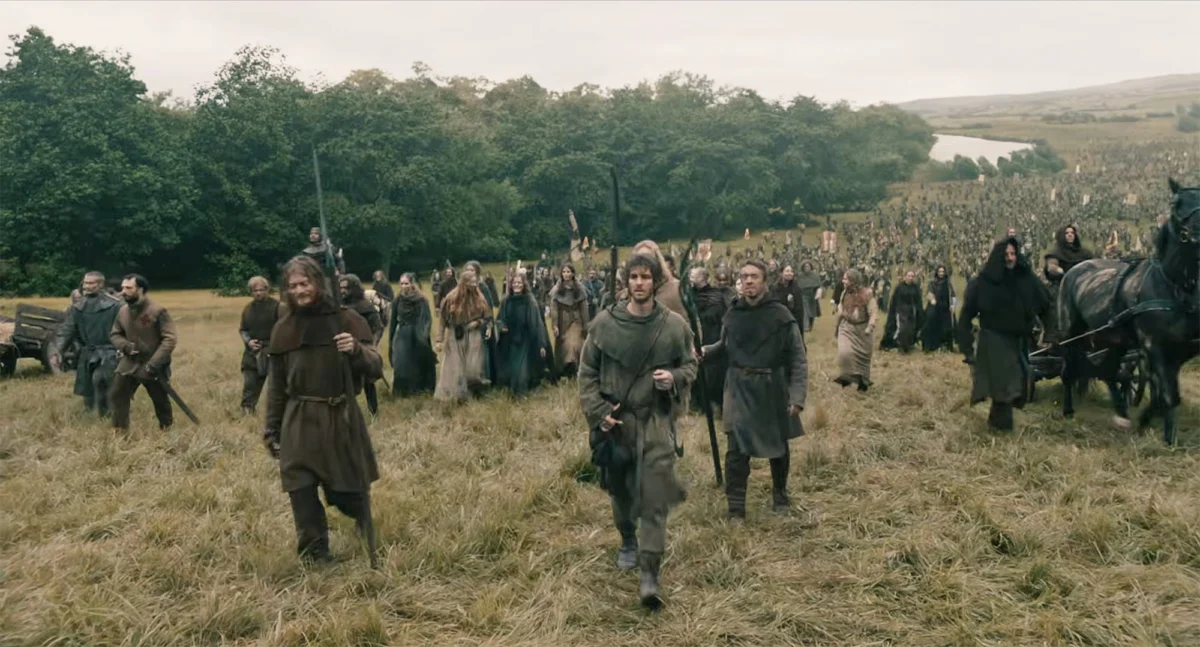
The Uprising centers on the catastrophic socio-economic landscape of 14th-century England, a period defined by the aftermath of the Black Death and the ongoing financial drain of the Hundred Years’ War. Andrew Garfield portrays a humble farmer whose personal grievances against the Crown’s local representatives ignite a broader fire of rebellion. The trailer highlights the "Rise or Die" ethos of the movement, showcasing the transition of rural laborers into a formidable, if disorganized, military force marching toward London.
The film’s antagonist is the young King Richard II, who was only 14 years old during the actual revolt. The narrative promises to explore the tension between the boy king’s advisors and the desperate populace. While Garfield’s character serves as the emotional anchor, the inclusion of Wat Tyler—a real-life figure who led the rebels into the heart of London—suggests a blend of historical accuracy and dramatized character arcs. The supporting cast features a robust ensemble of British and international talent, including Jamie Bell, Stephen Dillane, Tom Hollander, Thomasin McKenzie, and Katherine Waterston, many of whom portray key figures in the Royal Court and the rebel leadership.

Historical Context: The 1381 Peasants’ Revolt
To understand the stakes of The Uprising, one must look at the historical catalysts of the 1381 rebellion, often cited as one of the most significant popular uprisings in European history. The primary driver was the Statute of Labourers (1351), which attempted to freeze wages at pre-plague levels despite a massive labor shortage that should have naturally increased the bargaining power of the peasantry.
By the late 1370s, the English government was nearly bankrupt due to the protracted conflict with France. To fund the war, the government introduced a series of "Poll Taxes." The third of these taxes, levied in 1381, was particularly regressive, demanding a flat rate from every adult regardless of wealth. This sparked a powder keg of resentment that had been building for decades. The rebellion began in Essex and Kent, eventually converging on London, where the rebels burned the Savoy Palace and executed the Chancellor and the Treasurer.
Paul Greengrass, known for his meticulous research and documentary-style realism, reportedly spent years developing the script to ensure the film captures the "mud and blood" reality of the era. The production aims to move away from the romanticized chivalry often seen in medieval cinema, focusing instead on the gritty, tactical nature of peasant warfare and the psychological pressure of challenging a monarchy believed to be divinely ordained.
Creative Direction and Production Pedigree
The Uprising represents a thematic continuation of Paul Greengrass’s career-long fascination with moments of intense social and political friction. From the civil rights tragedy of Bloody Sunday to the high-stakes realism of United 93 and Captain Phillips, Greengrass has mastered the "shaky-cam" aesthetic and rapid-fire editing to create a sense of immediate, lived-in urgency. His move into the 14th century follows his recent foray into historical drama with the Western News of the World (2020) and the upcoming thriller The Lost Bus.

The film is produced by a heavyweight team including Jason Blum, Gregory Goodman, and Greengrass himself. The involvement of Blumhouse Productions—a studio traditionally associated with high-concept horror—indicates a lean, intense approach to the historical epic. The collaboration suggests that The Uprising will prioritize tension and visceral action over the bloated runtimes often associated with period pieces.
Industry analysts suggest that Andrew Garfield’s casting is a strategic move to bridge the gap between prestige drama and commercial action. Garfield, who has earned acclaim for roles in Silence and Hacksaw Ridge, is known for his physical commitment to roles, a trait that the trailer suggests will be fully utilized as his character evolves from a laborer to a revolutionary icon.
Production Timeline and Development
The journey of The Uprising from concept to screen has been marked by a rigorous production schedule designed to capture the atmospheric gloom of medieval England.
- Late 2024: Paul Greengrass began finalizing the screenplay, drawing from contemporary chronicles and modern historical analysis of the 1381 revolt.
- Early 2025: Casting announcements were made, with Garfield and Jarvis secured for the lead roles. Principal photography began in various locations across the United Kingdom, utilizing historical sites and reconstructed medieval villages to maintain authenticity.
- Late 2025 – Early 2026: Post-production focused on blending practical effects with subtle CGI to recreate the scale of 14th-century London and the massive crowds involved in the march on the city.
- July 16, 2026: The first official trailer and poster were released, generating immediate viral interest due to the stark, modern-sounding dialogue ("There will be no peace until we are free").
- September 11, 2026: Scheduled wide release in the United States and international markets.
Industry Reaction and Anticipated Impact
Early reactions from film critics and industry insiders following the trailer release have been overwhelmingly positive, with many noting the film’s potential to redefine the medieval genre. Unlike the fantasy-heavy "sword and sorcery" films or the stylized "great man" biopics, The Uprising appears to be a "bottom-up" history, focusing on the collective power of the nameless many.

"Greengrass is bringing the same kinetic energy he brought to the Bourne franchise to the 1300s," noted one industry analyst. "By framing the Peasants’ Revolt through a modern lens of economic inequality, the film is likely to resonate with contemporary audiences who feel similar frustrations with the status quo."
The film’s release date on September 11, 2026, places it at the start of the prestigious fall festival season, suggesting that Focus Features views the project as a serious awards contender. The combination of a high-profile director, an A-list lead, and a timely narrative of resistance makes it a formidable entry for the upcoming cinematic year.
Analysis of Themes and Modern Relevance
While The Uprising is a period piece, its thematic core is undeniably contemporary. The trailer emphasizes phrases such as "time to pay" and "for all you’ve taken from us," echoing modern discourse regarding wealth gaps and the accountability of leadership. By focusing on the 14-year-old King Richard II, the film also explores the fragility of power and the dangers of a leadership disconnected from the reality of its subjects.
Furthermore, the film highlights the role of the "unintentional legend." Garfield’s character does not set out to change history; he is forced into it by circumstance. This "everyman" hero archetype is a staple of Greengrass’s filmography, where ordinary individuals find themselves at the center of extraordinary, world-changing events.

Conclusion and Release Information
The Uprising is poised to be one of the most significant releases of 2026, offering a rare big-budget look at a pivotal but often overlooked chapter of British history. With its focus on the socio-economic triggers of the 1381 revolt and its commitment to a gritty, realistic portrayal of medieval life, the film promises to be both an educational and a thrilling cinematic experience.
Focus Features will handle the domestic distribution, with the film opening in theaters across the United States on September 11, 2026. As the marketing campaign ramps up, audiences can expect further insights into the tactical battles and political maneuvering that defined the English Peasants’ Revolt. For now, the trailer serves as a stark reminder of the film’s central message: that the seeds of revolution are often sown in the fields of the ignored.